
Subscribe to the 100% free rdnewsNOW daily newsletter!
Sponsored

Market Watch: November 21

Nov 24, 2025 | 4:39 PM

This week’s highlights

  • AI optimism fades as Fed uncertainty caps rally
  • Policy ambiguity and data gaps drive yield volatility
  • Canadian inflation eases to 2.2% in October, slightly higher than expected
  • U.S. job growth beats expectations in September; unemployment rate rises to 4.4%
  • EU lowers growth outlook for 2026 on higher-than-forecast U.S. tariffs

Week in review

AI optimism fades as Fed uncertainty caps rally

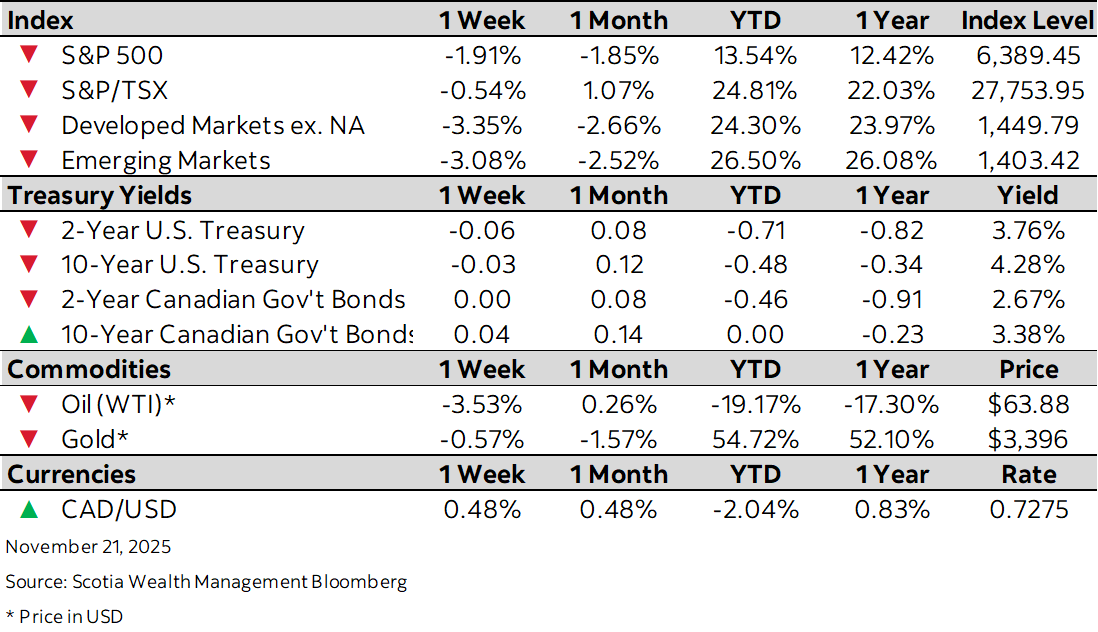
U.S. equities oscillated as investors weighed stretched valuations against key catalysts. Early weakness followed rating downgrades on mega-cap tech and cautious retail guidance, while Nvidia’s blowout results and Walmart’s upbeat outlook briefly reignited risk appetite, and concerns over Federal Reserve (Fed) policy and AI investment and debt loads drove a sharp reversal towards the end of the week before Friday’s return of risk appetite. Canadian markets mirrored global volatility amid soft retail sales and moderating inflation, reinforcing expectations for a Bank of Canada (BoC) pause. In Europe, mixed Purchasing Manager Index (PMI) data and easing U.K. inflation strengthened conviction for near-term policy easing ahead of next week’s budget. Asian performance was uneven: Japan surged on stimulus headlines before retracing, while Chinese and broader EM benchmarks remained under pressure as demand signals faltered.

Highlights:

  • U.S. equities returned -1.91%1, swinging sharply as mega-cap downgrades and cautious retail guidance weighed early, before Nvidia’s stellar results and Walmart’s upbeat outlook briefly revived sentiment, only for Fed uncertainty and valuation concerns to trigger a late-week reversal.
  • Canadian equities returned -0.54%2 tracking global volatility amid soft retail sales and easing inflation, reinforcing expectations for a BoC pause, while fiscal measures offered limited support against a backdrop of weak economic momentum and fragile labour conditions.
  • European stocks fell -3.35%3 as mixed PMI readings and moderating U.K. inflation strengthened conviction for near-term policy easing, though fiscal uncertainty ahead of next week’s budget and uneven growth signals tempered risk appetite across major indices.
  • Emerging markets were -3.08%4 lower for the week with Chinese and broader EM benchmarks facing persistent pressure from faltering demand signals and geopolitical uncertainty, leaving regional sentiment fragile despite a global risk-on appetite.

Policy ambiguity and data gaps drive yield volatility

U.S. government bond yields were volatile as investors prepared to digest labor data and FOMC minutes signaled a divided committee, initially reinforcing expectations for a December hold before soft payroll details and dovish Fed commentary revived modest easing bets. The absence of an October CPI report – canceled due to the prolonged government shutdown – added to uncertainty, leaving the Fed without a key inflation gauge ahead of its next meeting. Canadian bonds were steady early in the week, with muted reaction to moderating inflation and weak retail sales, as markets remained anchored to a BoC pause following last month’s cut. In Europe, gilts cheapened midweek on fiscal concerns ahead of the U.K. budget but later rallied on softer inflation, while bunds and OATs tracked global risk sentiment. Japanese debt sold off sharply on stimulus headlines before retracing as details suggested limited fiscal strain, while broader EM curves were pressured by geopolitical uncertainty and shifting growth expectations.

Highlights:

  • The 2- and 10-year U.S. Treasury yields fell 6 basis points (bps) and 3 bps, respectively. In Canada, the 2- and 10-year yields were flat bps and up 4 bps, respectively. Bond yields and prices move inversely to one another.
  • Yields initially held steady on FOMC minutes before soft payroll details and dovish Fed commentary spurred modest easing bets, while gilts and bunds tracked fiscal and inflation signals.
  • Credit spreads tightened early on risk-on sentiment following strong earnings but widened later as equity volatility and lingering macro uncertainty weighed on high yield, while investment-grade remained resilient amid stable funding conditions and muted issuance.

Weekly dashboard

Canadian inflation eases to 2.2% in October, slightly higher than expected

Cheaper prices at the gas pumps and grocery store helped bring down inflation in October, Statistics Canada (StatCan) reported. The annual rate of inflation cooled to 2.2% in October, slightly higher than economists’ expectations but down from 2.4% in September. Gas prices fell 4.8% on a monthly basis in October as retailers switched to cheaper winter blends of fuel and global crude oil prices dropped on concerns of oversupply.

Highlights:

  • Prices at the grocery store also fell 0.6% in October, the largest month-to-month decline since September 2020. On an annual basis, food prices rose 3.4%, cooling from 4.0% in September.
  • Keeping the overall inflation rate sticky in October was a rare increase in cellular service costs. StatsCan said this segment saw prices rise 7.7% annually, the first yearly increase since April 2023.
  • Consumers were also paying more for home, mortgage and car insurance in October, particularly in Alberta. Over the past five years, the cost of home and mortgage insurance has risen 38.9% nationally, while vehicle insurance premiums are up 18.9%.

U.S. job growth beats expectations in September; unemployment rate rises to 4.4%

U.S. job growth accelerated in September, but the unemployment rate increased to a four-year high of 4.4% and the economy in August shed jobs for the second time this year as employers navigate an uncertain environment. According to the U.S. Labor Department, the increase in the jobless rate from 4.3% in August was a reflection of more people entering the labour market in search of work. Other data from the Labor Department showed layoffs remained low in mid-November, suggesting the labour market remained in a holding pattern. The report was initially due on October 3 but was delayed by the 43-day shutdown of the government.

Highlights:

  • Nonfarm payrolls increased by 119,000 jobs after a downwardly revised 4,000 drop in August. Economists had forecast 50,000 jobs would be added after a previously reported 22,000 gain in August.
  • The healthcare sector continued to lead employment growth, adding 43,000 jobs in September. Employment at restaurants and bars increased 37,000, while social assistance payrolls advanced 14,000. The transportation and warehousing industry lost 25,000 jobs.
  • The labour market has lost significant momentum this year as evidenced by sharp downward revisions to nonfarm payroll counts. Economists and policymakers blame the slowdown on reduced supply and demand for workers.

EU lowers growth outlook for 2026 on higher-than-forecast U.S. tariffs
The European Union raised its expectations for economic growth in the eurozone this year amid resilient activity, though higher-than-forecast tariffs are expected to weigh on the bloc in 2026. In its twice-yearly report on the economic outlook, the European Commission (EC) said growth in the first three quarters of the year surpassed expectations, with momentum set to continue in the coming quarters driven by rising private consumption and investment.

Highlights:

  • The commission said it now expects total gross domestic product across the 21-nation eurozone, including Bulgaria, which is set to join the currency bloc on January 1, to rise 1.3% this year, up from prior expectations of 0.9% growth and against a 0.4% rise in 2024.
  • Forecasts were revised down marginally for 2026 to 1.2%, from 1.4% previously. The commission said the challenging global environment continued to weigh on the outlook, with risks tilted to the downside. It noted higher average tariffs on exports to the U.S. than assumed in its previous forecast.
  • Looking ahead, the EC also noted the risks to growth from equity market volatility, especially in the U.S. technology sector. Domestic political uncertainty and climate-related disasters were outlined as additional threats to growth.

The Global Week Ahead

A Playbook for a Nimble FOMC

This week’s risk dashboard:

  • Three ways the FOMC can handle December’s unique risks
  • Forget the minutes: here’s a vote-weighted round up of FOMC leanings
  • Eat, Shop, Drop — Tracking Holiday Sales
  • Canadian GDP: stall speed won’t surprise the BoC
  • US to continue catching up key releases

Read the full publication here

  • Eurozone CPI won’t sway the ECB’s coming hold
  • BoJ bets may hang on Tokyo CPI
  • UK Budget: Pay Up!
  • RBNZ — could this be the last cut?
  • BoK to hold on FX and housing stability concerns
  • Global macro

1 S&P 500 Index USD
2 S&P/TSX Composite Index USD
3 Bloomberg Developed Markets ex N. America Large & Mid Cap Price Return Index USD
4 Bloomberg EM Large & Mid Cap Price Return Index USD