
Subscribe to the 100% free rdnewsNOW daily newsletter!
sponsored

Market Watch – July 18, 2025

Jul 19, 2025 | 11:34 AM

This week’s highlights

  • Markets juggle mixed inflation, earnings strength, and trade policy uncertainty
  • Rates steady amid differing inflation signals and continued focus on Federal Reserve leadership
  • Canadian inflation ticks up to 1.9% in June, boosting expectations of no BoC rate cut in July
  • U.S. inflation picks up to 2.7% as tariffs start to seep into prices
  • China says its economy held up under Trump tariff attack

Week in review

Markets juggle mixed inflation, earnings strength, and trade policy uncertainty

U.S. markets were initially buoyed by softer-than-expected Consumer Price Index (CPI) and Producer Price Index (PPI) data, which eased inflation concerns and supported expectations for Fed rate cuts later this year–a view further supported by dovish commentary from several Federal Reserve (Fed) officials. Strong bank earnings and upbeat retail sales further lifted sentiment, though volatility returned midweek amid reports that President Trump was considering firing Fed Chair Powell, raising concerns about central bank independence. Canadian markets held up relatively well throughout the week, even as hotter-than-expected inflation and resilient labour market data reduced the likelihood of near-term rate cuts, tempering equity gains amid a more cautious policy outlook. European markets were pressured early by new U.S. tariffs and later by hotter U.K. inflation, though strong corporate earnings and easing rate expectations helped recover losses. In China and broader EM, better-than-expected trade and GDP data supported equities early, but concerns over the durability of export strength and fading stimulus effects tempered gains.

Highlights:

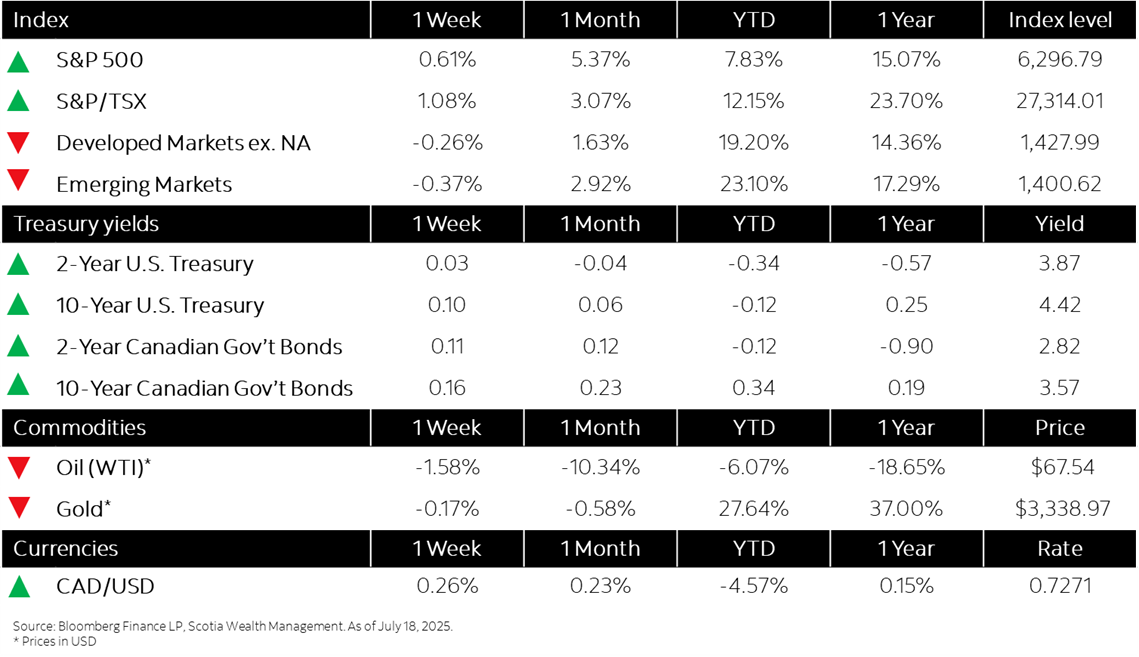
  • U.S. equities returned 0.61%1, lifted by softer CPI and PPI data and strong bank earnings, but midweek volatility emerged after reports that President Trump considered firing Fed Chair Powell.
  • Canadian markets returned 1.08%2, weighed down by hotter-than-expected inflation and resilient labour data which reduced the likelihood of further rate cuts. Trade tensions also added to the uncertain outlook.
  • European markets lost -0.26%3, initially declining on new U.S. tariffs and hotted U.K. inflation, but later rebounding on strong corporate earnings and expectations of a coordinated trade response and potential monetary easing.
  • Emerging markets fell -0.37%4 despite being supported by stronger-than-expected trade and GDP data. Concerns over fading stimulus effects, weak domestic demand, and the temporary nature of export strength driven by tariff truce front-loading weighed on investor sentiment.

Rates steady amid differing inflation signals and continued focus on Federal Reserve leadership

U.S. fixed income markets were driven by a series of inflation prints that showed modest price pressures, with softer-than-expected CPI and PPI data anchoring rate expectations and reinforcing the case for eventual Fed easing. However, volatility midweek — sparked by speculation around Fed Chair Powell’s job security — briefly steepened the curve before dovish remarks from Fed Governor Waller helped return some stability. In Canada, hotter inflation and resilient labour market data reduced the likelihood of near-term rate cuts, keeping yields elevated, though the long-end pressure eased following a well-received 30-year bond auction. European rates moved lower early in the week on soft macro data but reversed course after hotter U.K. CPI and Germany’s rejection of the EU’s budget proposal raised fiscal concerns.

Highlights:

  • The 2-year U.S. Treasury yield rose 3 basis points (bps) while the 10-year yield rose 10 bps. In Canada, the 2-year yield rose 11 bps while the 10-year was up 16 bps. Bond yields and prices move inversely to one another.
  • Several Fed board members, including Governor Waller, signalled a shift in tone this week, with Waller stating the Fed should cut rates by 25 bps to provide “a little more stimulus” amid signs of private sector softness.
  • Credit spreads have been trading within a relatively tight range since the beginning of the month. This week’s investment grade primary sales ran well below projections, while high yield demand remains strong.

Weekly dashboard

Canadian inflation ticks up to 1.9% in June, boosting expectations of no BoC rate cut

Canada’s annual inflation rate ticked up to 1.9% in June and underlying price pressures remained sticky, reinforcing expectations that the Bank of Canada (BoC) will hold off from cutting interest rates later this month. Statistics Canada (StatCan) reported that the annual rate rose from 1.7% in May, largely in line with forecasts.

Highlights:

  • The BoC’s preferred core measures of inflation, which strips out volatility in price changes, continued to hover around 3%, suggesting that underlying price pressures in the economy remain strong.
  • Prices for durable goods in June rose faster year-over-year, with passenger vehicle prices increasing by 4.1%, while grocery prices increased at a slower pace of 2.8% last month, compared with 3.3% in May.
  • Clothing and footwear prices accelerated to 2%, as trade uncertainty put upward pressure on prices in the industry, StatCan noted.

U.S. inflation picks up to 2.7% as tariffs start to seep into prices

Inflation in the U.S. picked up in June, a potential sign that companies are starting to pass tariff costs on to consumers. Consumer prices rose 2.7% in June from a year earlier, the U.S. Labor Department reported, faster than May’s increase of 2.4%. That was in line with the economists’ expectations.

Highlights:

  • Core inflation, which exclude volatile food and energy prices, was 2.9%, also in line with forecasts.
  • Prices of furniture, toys and clothes, items that tend to be sensitive to tariffs, posted larger increases in June. At the same time, car prices unexpectedly fell.
  • Consumer prices rose 0.3% in June compared with May, the largest monthly gain since January. But core prices rose 0.23%, at the middle of the range of monthly price increases over the previous year.

China says its economy held up under Trump tariff attack
China’s economy showed resilience in a turbulent first half of the year, remaining on track to hit its official growth target for the year despite U.S. President Trump’s shifting tariff assault. China said its gross domestic product (GDP) expanded 5.2% in the second quarter of 2025 compared with a year earlier, slowing a touch from the 5.4% pace set in the first three months of the year and coming in line with economists’ expectations.

Highlights:

  • For the first half of the year, the world’s second-largest economy increased 5.3% from a year earlier, China’s National Bureau of Statistics reported, above the level needed to hit Beijing’s official full-year target of around 5% growth.
  • On a quarter-over-quarter basis, China said its GDP grew 1.1% in the April-to-June period, slowing slightly from the first quarter’s 1.2% gain.
  • The robust result was driven in large part by its export sector as industrial production was up 6.8% in June compared with a year earlier.

1 S&P 500 Index USD
2 S&P/TSX Composite Index USD
3 Bloomberg Developed Markets ex N. America Large & Mid Cap Price Return Index USD
4 Bloomberg EM Large & Mid Cap Price Return Index USD