
Subscribe to the 100% free rdnewsNOW daily newsletter!
sponsored

Market Watch: April 18, 2025

Apr 21, 2025 | 9:34 AM

This week’s highlights

  • Equity markets continue to show resiliency despite uncertainty
  • Bond markets regain a more stable footing following several volatile weeks
  • Bank of Canada holds rate steady at 2.75% amid trade war uncertainty
  • U.S. retail sales surge in March due to motor vehicle purchases ahead of tariffs
  • China’s exports surge as orders front-loaded before tariffs

Week in review

Equity markets continue to show resiliency despite uncertainty

U.S. equity markets initially rose on optimism from the weekend announcement of President Trump’s temporary tariff exemptions on consumer electronics, but turned lower mid-week following disappointing earnings from Nvidia and ASML, and new restrictions on Nvidia’s chip exports to China which caused a broader selloff in tech stocks. Canadian markets were broadly positive following softer-than-expected inflation data which complicated the Bank of Canada’s (BoC) rate decision, ultimately leaving rates unchanged. In Europe, equities were buoyed by the European Central Bank’s (ECB) 25 basis point (bps) rate cut, though the euro fell modestly. Meanwhile, China’s markets saw mixed reactions; strong credit data and a rebound in exports supported early gains, but concerns over escalating trade tensions with the U.S. which has caused a precipitous drop in trans-pacific trade and weaker property sales tempered enthusiasm. Emerging markets were impacted by varying export performances, with strong growth in ASEAN and Latin America contrasting with underperformance in the EU, Japan, and Korea.

Highlights:

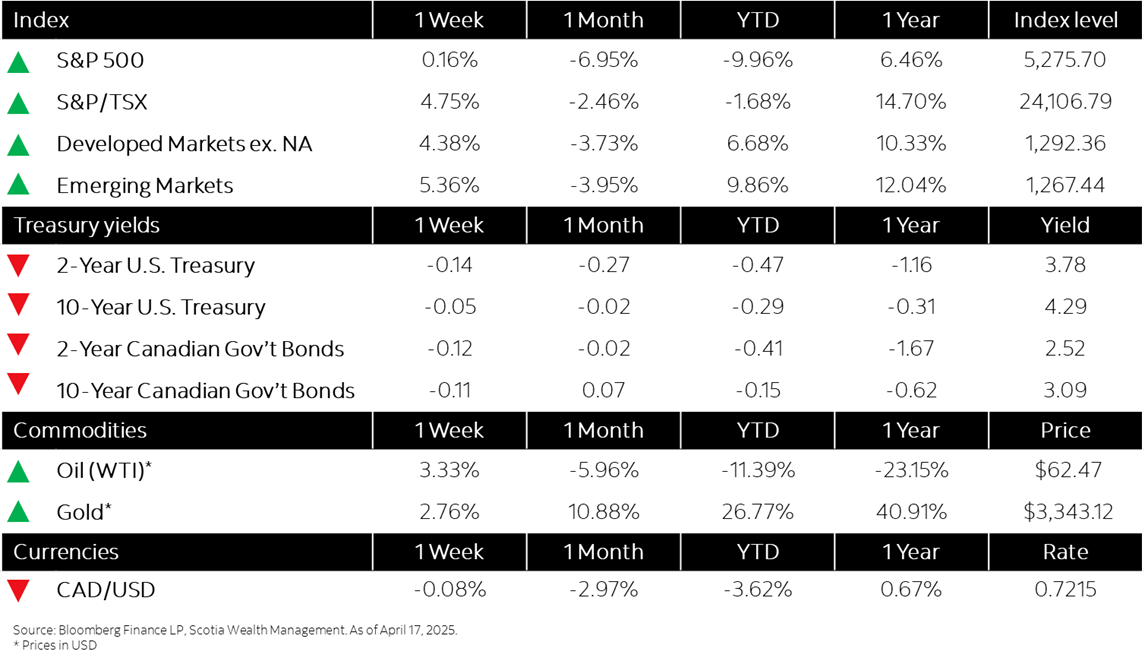
  • U.S. markets returned 0.16%1 for the week, initially rising due to optimism from tariff exemptions on consumer electronics, but turned lower mid-week following disappointing earnings from ASML, and new restrictions on Nvidia’s chip exports to China.
  • Canadian markets returned 4.75%2 for the week, influenced by softer-than-expected inflation data, which complicated the BoC’s rate decision amid broader economic uncertainties and a recent softening in the labour market.
  • European markets returned 4.38%3 for the week, buoyed by the European Central Bank’s 25 basis points rate cut, though the euro fell modestly as President Christine Lagarde highlighted increasing downside risks to economic growth and trade headwinds facing Europe.
  • Emerging markets closed 5.36%4 amid mixed reactions; strong credit data and a rebound in exports supported early gains, but concerns over escalating trade tensions with the U.S. and weaker property sales tempered investor enthusiasm.

Bond markets regain a more stable footing following several volatile weeks

Fixed income markets were broadly positive despite Federal Reserve (Fed) Chair Jerome Powell’s comments on inflation and economic growth, alongside retail sales data showing a significant monthly increase as consumers made large purchases ahead of tariffs. Canadian rates remained stable following softer-than-expected inflation data, which left the Bank of Canada’s rate decision unchanged. European fixed income markets reacted positively to the ECB’s 25 bps rate cut, with President Lagarde emphasizing downside risks to economic growth and trade headwinds. In China, strong credit data and a rebound in exports initially supported fixed income markets, but broader concerns over escalating trade tensions with the U.S. and weaker property sales continued to linger.

Highlights:

  • The 2- and 10-year U.S. Treasury yields were 14 basis point (bps) and 5 bps lower, respectively. In Canada, the 2- and 10-year yields were also 12 bps and 11 bps lower, respectively. Bond yields and prices move inversely to one another.
  • European bond markets are outperforming following the European Central Bank (ECB) 25bps rates cut which was largely as expected. ECB President Lagarde joined Fed Chair Powell in warning of the increased downside risks to the economy, indicating that unemployment and inflation are likely headed away from the central banks’ targets.
  • Credit spreads are tighter this week despite elevated supply this week dominated by U.S. banks new issuance as the primary market regained a semblance of life this week as dealers called for ~$25.0bn of new investment grade (IG) debt to be priced.

Weekly dashboard

Bank of Canada holds rate steady at 2.75% amid trade war uncertainty

The Bank of Canada held interest rates steady, pausing its easing campaign amid massive uncertainty caused by U.S. President Donald Trump’s erratic and destabilizing trade war. The central bank’s governing council voted to hold the policy rate at 2.75%. This follows seven consecutive rate cuts, which have lowered Canadian borrowing costs considerably since last summer.

Highlights:

  • “A lot has happened since our March decision five weeks ago. But the future is no clearer. We still do not know what tariffs will be imposed, whether they’ll be reduced or escalated, or how long all of this will last,” Governor Tiff Macklem said.
  • The bank is also navigating intense uncertainty about the future of U.S. trade policy and about how tariffs and other trade disruptions will affect the Canadian economy, affecting consumer spending, employment, business investment, and prices.
  • While the bank halted its easing campaign, Mr. Macklem said that he and his team are “prepared to act decisively if incoming information points clearly in one direction.” That suggests the bank could resume rate cuts in the coming months if the trade war escalates and the Canadian economy deteriorates further.

U.S. retail sales surge in March due to motor vehicle purchases ahead of tariffs

U.S. retail sales surged in March as households boosted purchases of motor vehicles ahead of tariffs, though concerns about the economic outlook are hurting discretionary spending. Retail sales increased 1.4% last month after an unrevised 0.2% rise in February, the U.S. Commerce Department’s Census Bureau reported. Economists had forecast retail sales, which are mostly goods and are not adjusted for inflation, accelerating 1.3%.

Highlights:

  • Tariffs were likely at the top of consumers’ minds, as spending on motor vehicles and parts dealers rose 5.3% from a month earlier, and spending at restaurants and bars increased 1.8% from February.
  • Consumers were also stocking up on imported goods. Bank credit and debit card data suggest spending continues to be driven by high-income households, with low-income consumers struggling. There was less discretionary spending, mainly on services, the economy’s main engine.
  • Retail sales excluding automobiles, gasoline, building materials and food services rose 0.4% in March after an upwardly revised 1.3% advance in February. These so-called core retail sales correspond most closely with the consumer spending component of gross domestic product.

China’s exports surge as orders front-loaded before tariffs
China’s exports surged in March as shipments were likely front-loaded before U.S. President Trump’s “Liberation Day” tariffs, but they are expected to falter in the coming months. According to the official data, outbound shipments rose 12.4% compared with the same period a year earlier. That was much stronger than the 2.3% increase in the first two months and the 4.4% growth expected by economists.

Highlights:

  • U.S. tariffs on Chinese goods mean that it could take years before exports return to current levels, as are already signs of shipments being rerouted via third countries as exports to Vietnam and Thailand accelerated.
  • China’s imports fell 4.3% on year in March, better than the 8.4% decline in the January-February period, but weaker than the 1.8% rise expected by economists.
  • That put China’s trade surplus at US$102.64 billion in March, bigger than the US$77 billion projected by economists. In dollar terms, exports in the first quarter rose 5.8% on year, while imports fell 7.0%.