Subscribe to the 100% free rdnewsNOW daily newsletter!
sponsored

Market Watch: Feb. 7, 2025

Feb 7, 2025 | 4:03 PM

This week’s highlights

  • Tariff uncertainty drives renewed volatility
  • Bond markets adjust to uncertain economic outlook
  • Canada posts first trade surplus in 10 months as exports continue to expand
  • University of Michigan’s Inflation Expectation survey points towards higher inflation
  • China PMI gauge signals softer services sector growth

Week in review

Tariff uncertainty drives renewed volatility

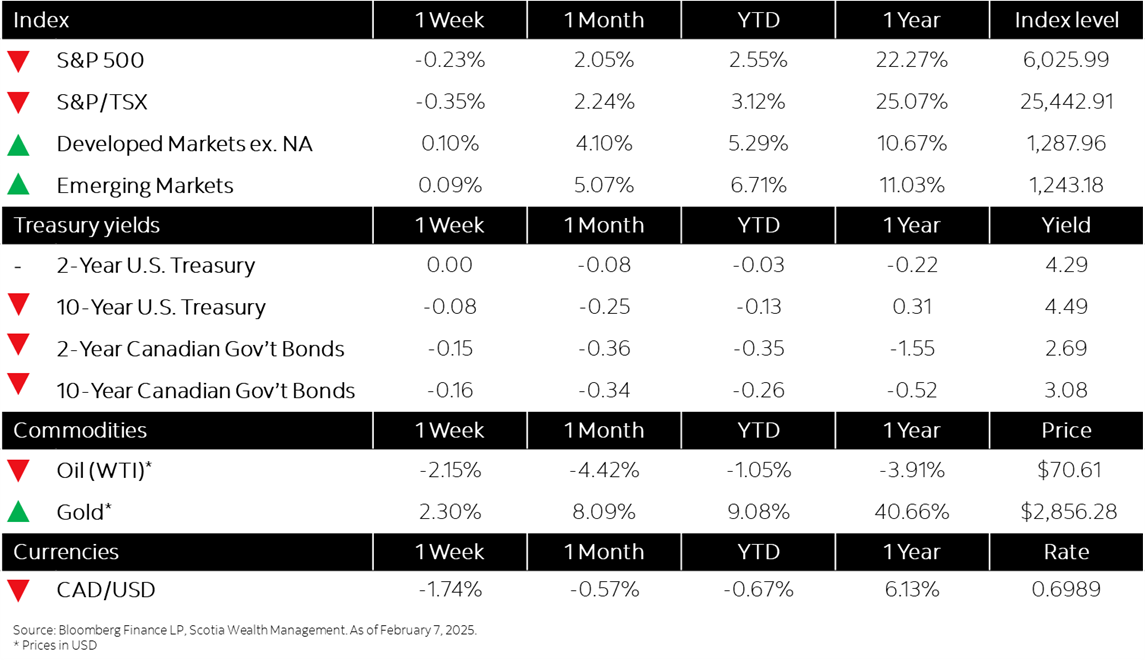
In the U.S., equity markets faced pressure from escalating trade tensions early in the week as President Trump imposed tariffs on key trading partners, leading to retaliatory measures and eventually a 30-day delay for Canada and Mexico. Following this, markets found some relief, but disappointing earnings from major tech companies weighed on sentiment. In Canada, markets were volatile due to trade uncertainties, with the Canadian dollar hitting a low before rebounding on tariff delays. European markets were impacted by auto sector declines and rising inflation, while the Bank of England’s (BoE) rate cut added to the mixed sentiment. In China and other emerging markets, modest retaliatory tariffs from China and ongoing trade tensions with the U.S. contributed to market instability.

Highlights:

  • U.S. markets returned -0.23%1 for the week influenced by escalating trade tensions, mixed corporate earnings, and economic data releases including a stronger-than-expected ADP employment report and a below-consensus nonfarm payrolls figure.
  • Canadian markets returned -0.35%2 for the week due to U.S. trade uncertainties, with the Canadian dollar rebounding on tariff delays. Strong employment growth and a lower unemployment rate provided support, despite concerns about future rate cuts.
  • European markets returned 0.10%3 for the week, influenced by auto sector declines, rising inflation, and the BoE’s rate cut. Trade tensions and disappointing economic data further contributed to market volatility.
  • Emerging markets closed 0.09%4 higher, impacted by modest retaliatory tariffs from China in response to U.S. trade measures, ongoing trade tensions, and geopolitical uncertainties, contributing to an overall risk-off sentiment.

Bond markets adjust to uncertain economic outlook

Fixed income markets experienced mixed movements as long-term rates fell while short-term rates were mostly flat, influenced by trade tensions and economic data releases that point towards an uneven economic growth outlook. Canadian bond yields dropped sharply early in the week due to trade uncertainties with the U.S., but later stabilized as tariff delays provided some relief. European bond markets saw lower yields driven by risk-off sentiment and disappointing economic data, with the European Central Bank expected to continue its accommodative stance. In emerging markets, sovereign bonds faced pressure from trade-related volatility, while safe-haven flows into U.S. Treasuries and other high-quality bonds increased, reflecting investor caution amid ongoing geopolitical and economic uncertainties.

Highlights:

  • The 2- and 10-year U.S. Treasury yields were flat and 8 basis points (bps) lower, respectively. In Canada, the 2- and 10-year yields were down 15 bps and 16 bps, respectively. Bond yields and prices move inversely to one another.
  • The market is discounting a 50% likelihood of a rate cut by the Bank of Canada in March, while projections for the Fed and ECB haven’t changed post Friday’s economic releases.
  • Credit spreads remain tight despite relatively high primary volume. Investment grade new issuance has been moving at healthy clips, currently running 4% higher than last year’s sales for the same period.

Weekly dashboard

Canada posts first trade surplus in 10 months as exports continue to expand

Canada saw its first trade surplus in 10 months in December as exports continued to expand faster than imports, led by higher energy product exports, higher crude oil prices and partly by weaker local currency. According to Statistics Canada (StatCan), the December trade surplus was at $708 million, from a revised deficit of $986 million the prior month, helped by a 4.9% growth in exports. Imports grew 2.3% in December, a bit slower than the 2.8% gain seen in November.

Highlights:

  • Canada’s trade surplus with the U.S. widened for the second month in a row, growing 5% in December to $11.3 billion, led primarily by higher exports of energy products and a higher price of crude oil. Imports from the U.S. fell 1.5% in December.
  • Canada’s merchandise trade surplus with the U.S., its biggest trading partner, amounted to $102.3 billion for 2024, down from a surplus of $108.3 billion in 2023, StatCan said.
  • According to StatCan, the combined value of Canada’s imports and exports of goods traded with the U.S. surpassed the $1 trillion mark for a third consecutive year. Last year Canada exported 75.9% of its total exports to the U.S. and bought 62.2% of its total imports from south of the border.

University of Michigan’s Inflation Expectation survey points towards higher inflation

The University of Michigan’s Inflation Expectation survey for January showed a significant rise in both short-term and long-term inflation expectations. Year-ahead inflation expectations increased to the highest since May 2024, reflecting growing concerns about future price increases. Long-term inflation expectations also edged up, matching the level seen in November 2024. These increases were observed across various income and educational groups, indicating widespread apprehension about inflationary pressures.

Highlights:

  • Year-ahead inflation expectations rose to 3.3%, the highest since May 2024. This increase reflects growing consumer concerns about rising prices in the near term, driven by factors such as supply chain disruptions and higher energy costs.
  • Long-term inflation expectations increased to 3.2%, matching November 2024 levels. This suggests that consumers are anticipating sustained inflationary pressures over the next five to ten years.
  • The survey highlighted that consumers are increasingly motivated to make purchases in advance to avoid anticipated price hikes, contributing to robust auto and retail sale.

China PMI gauge signals softer services sector growth

A private gauge of China’s service activity expanded at a slower clip in January, pointing in the same direction as official data as both demand and supply cooled at the start of the year. The Caixin services purchasing managers index (PMI) fell to 51.0 in January from 52.2 in December. Despite the slowdown, the measure remained above the 50 mark that separates activity contraction from expansion, and where it has been since January 2023.

Highlights:

  • Softer services activity countered quicker manufacturing output growth to push the Caixin composite index down in January, decelerating to the lowest in four months and employment recording the fastest fall in 26 months.
  • New business growth eased to a four-month low in January, but export orders returned to growth after falling at the end of 2024, Caixin said.
  • The sustainability of strong external demand is uncertain amid rising trade tensions between Beijing and Washington.

1 S&P 500 Index CAD
2 S&P/TSX Composite Index CAD
3 Bloomberg Developed Markets ex N. America Large & Mid Cap Price Return Index CAD
4 Bloomberg EM Large & Mid Cap Price Return Index CAD