Subscribe to the 100% free rdnewsNOW daily newsletter!
SPONSORED

Market Watch: Jan. 17, 2025

Jan 20, 2025 | 11:35 AM

This week’s highlights

  • Equity markets finish volatile week on a strong note
  • Bond markets dance to the tune of inflation and central bank policy
  • Canadian home sales finish strong in 2024
  • U.S. inflation ticks up to 2.9%, but underlying price gains are muted
  • China’s central bank reiterates easing pledges amid policy dilemmas

Week in review

Equity markets finish volatile week on a strong note

In the U.S., equity markets faced pressure from declines in major tech stocks, but later gained on speculation of a less aggressive tariff strategy and the December Consumer Price Index (CPI) report that showed firm headline inflation but moderated core inflation. Canadian markets mirrored U.S. trends, with markets moving lower initially but stabilizing later in the week following the Bank of Canada’s (BoC) speech on balance sheet normalization and a climb in oil prices following a new round of Sanctions on the Russian energy sector. European equities slipped due to fears of U.S. tariffs on China but rebounded with strong bank earnings and a ceasefire deal in the Middle East. The U.K. December CPI report showed easing inflation, reinforcing expectations of a rate cut by the Bank of England (BoE). In China, markets were influenced by a decline in new loan issuance and mixed economic data, including Q4 GDP and industrial production, but ended the week positively with stronger-than-expected GDP growth, despite ongoing concerns regarding U.S. tariffs.

Highlights:

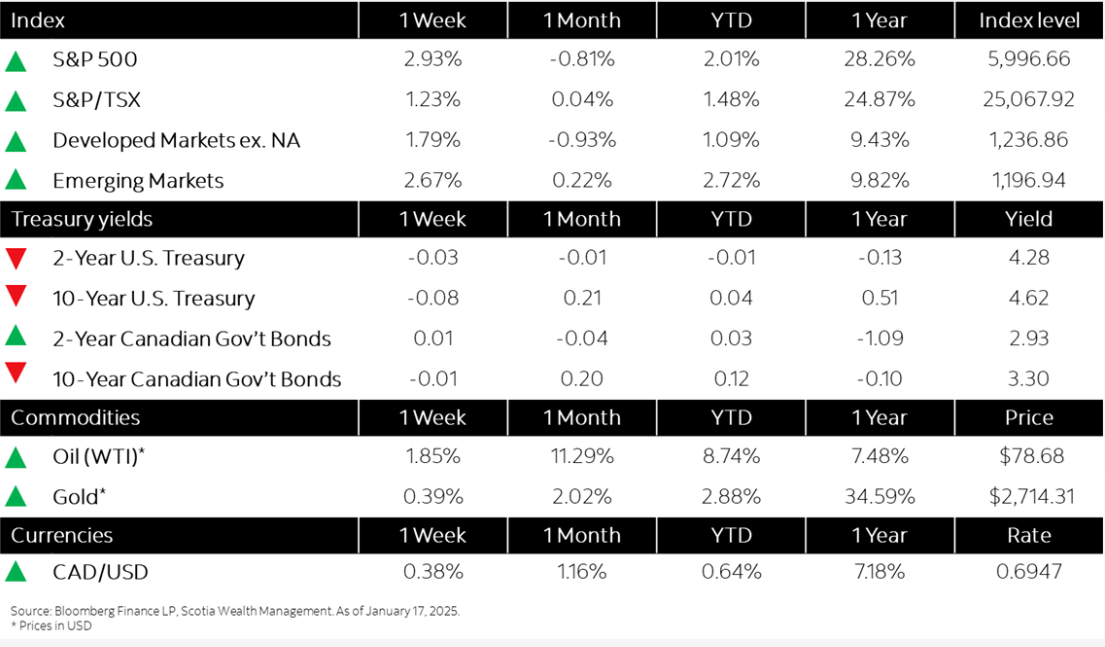
  • U.S. markets returned 2.93%1 for the week despite early declines in major tech stocks on speculation of a less aggressive tariff strategy, robust bank earnings, and an inflation reading that was in line or below expectations.
  • Canadian markets mirrored the U.S., rising 1.23%2 for the week following the BoC’s discussion on balance sheet normalization and a jump in oil prices after the U.S. enacted a new round of sanctions on the Russian energy sector.
  • European markets returned 1.79%3 for the week after initial fears of tariff fallout subsided, the announcement of a ceasefire in the Middle East, and U.K. inflation declining which increased the likelihood of the BoE cutting rates.
  • Emerging markets closed 2.67%4 higher amid mixed economic data from China including Q4 GDP and industrial production and ongoing concerns about U.S. tariffs alongside fluctuations in oil prices due to geopolitical tensions.

Bond markets dance to the tune of inflation and central bank policy

In the U.S., fixed income markets saw Treasury yields dip following the December CPI report, which showed firm headline inflation but moderated core inflation. This led to increased speculation of potential Federal Reserve policy easing. Canadian bond markets followed a similar trend, with rates initially rising but later stabilizing, influenced by the Bank of Canada’s discussion on balance sheet normalization. In Europe, bond markets were impacted by fears of U.S. tariffs on China, but yields fell later in the week as the Bank of England’s December CPI report showed easing inflation, reinforcing expectations of a rate cut. In China, bond markets were influenced by mixed economic data, including Q4 GDP and industrial production, but ended the week positively with stronger-than-expected GDP growth.

Highlights:

  • The 2- and 10-year U.S. Treasury yields were 3 and 8 bps lower, respectively. In Canada, the 2-year yield was up 1 bps while the 10-year yield was down 1 bps. Bond yields and prices move inversely to one another.
  • After edging higher early in the week, U.S. rates moved lower for three straight sessions following the release of inflation data Wednesday. Canadian and European bond markets were also bid.
  • Credit spreads have been trading within a range since mid November, close to historically tight levels. Attractive yields have been supportive of demand in both secondary and primary markets.

Weekly dashboard

Canadian home sales finish strong in 2024

The number of homes that changed hands across the country in December was up 19.2% compared with a year earlier, as the Canadian Real Estate Association says a strong fourth quarter bodes well for a rebound in sales in 2025. The association says the final three months of last year saw sales rise 10% from the third quarter, marking one of the busiest quarters in the past 20 years, aside from the pandemic.

Highlights:

  • Last month, 27,643 homes changed hands across Canada, compared with 23,190 in December 2023. This follows a 26% year-over-year rise in November and a 30% increase in October sales.
  • On a seasonally adjusted month-over-month basis, Canadian home sales in December fell 5.8% from November but remained 13% above where they were in May, just before the Bank of Canada’s first of five interest rate cuts last year.
  • The national average sale price for December rose 2.5% compared with a year earlier to $676,640.

U.S. inflation ticks up to 2.9%, but underlying price gains are muted

According to the U.S. Labor Department, the overall CPI came in relatively hot, rising 2.9% over the year. The index rose 0.4% from the previous month, driven by a 4.4% jump in gas prices. The so-called core CPI, which excludes volatile food and energy prices, rose 0.2%, its smallest gain since July and less than the 0.3% increase expected by economists.

Highlights:

  • December marked a third straight month of gains in the 12-month CPI. Core inflation has remained higher than many economists had hoped in part because official measures of housing prices have been slow to reflect the deceleration seen in private-sector rent gauges.
  • The decline in core inflation was mostly driven by softness in prices for goods other than food and energy. That metric advanced 0.1% in December from November.
  • Prices for services, which account for a greater share of spending, were firmer, rising 0.3%. That gain was partly driven by airfares, car insurance and housing, though the latter two categories have been cooling.

China’s central bank reiterates easing pledges amid policy dilemmas
China’s central bank again vowed to help the economy grow this year, firming expectations of more monetary easing, as it walks a fine line between conflicting policy targets complicated by a possible trade war with the U.S. Officials at the People’s Bank of China, said that they will ramp up support for the economy with measures like lower interest rates and reducing the amount of cash lenders must hold as reserves to free up liquidity. They also again promised to defend the yuan and warned against the risk of an overheated bond market.

Highlights:

  • Calibrating the right policy fix for the structural problems ailing China’s economy has been complicated by unfavourable market forces, with the yuan under pressure, government bond yields tumbling and equities off to a weak start this year.
  • China’s central bank said it is determined to stabilize the yuan, including setting a strong daily reference rate to help regulate fluctuations and enforce penalties for market-distorting behaviours.
  • Economists still expect a sizable slash to rates later this year, as the Chinese leadership in December adopted a “moderately loose” monetary policy stance for the first time in 14 years.

1 S&P 500 Index CAD
2 S&P/TSX Composite Index CAD
3 Bloomberg Developed Markets ex N. America Large & Mid Cap Price Return Index CAD
4 Bloomberg EM Large & Mid Cap Price Return Index CAD