Subscribe to the 100% free rdnewsNOW daily newsletter!
sponsored

Market Watch: Oct. 25, 2024

Oct 28, 2024 | 9:34 AM

Week in review

Equity markets cautious amidst earnings season and the upcoming U.S. elections

Equity markets cautiously assessed the U.S. Federal Reserve’s (Fed) next move while the earnings season is in full swing. In the U.S., it was a jam-packed week of earnings reports, more than one-third of S&P 500 companies have reported third-quarter results so far. About 75% of them have beaten profit expectations, compared with the five-year average of 77%, according to FactSet. Investors also reflected on the mixed economic data, including lower-than-expected jobless claims and a slowdown in manufacturing activity. Additionally, continued uncertainty and anticipation around the U.S. election made investors cautious, monitoring potential policy changes and their implications for sectors like technology and healthcare.

Highlights:

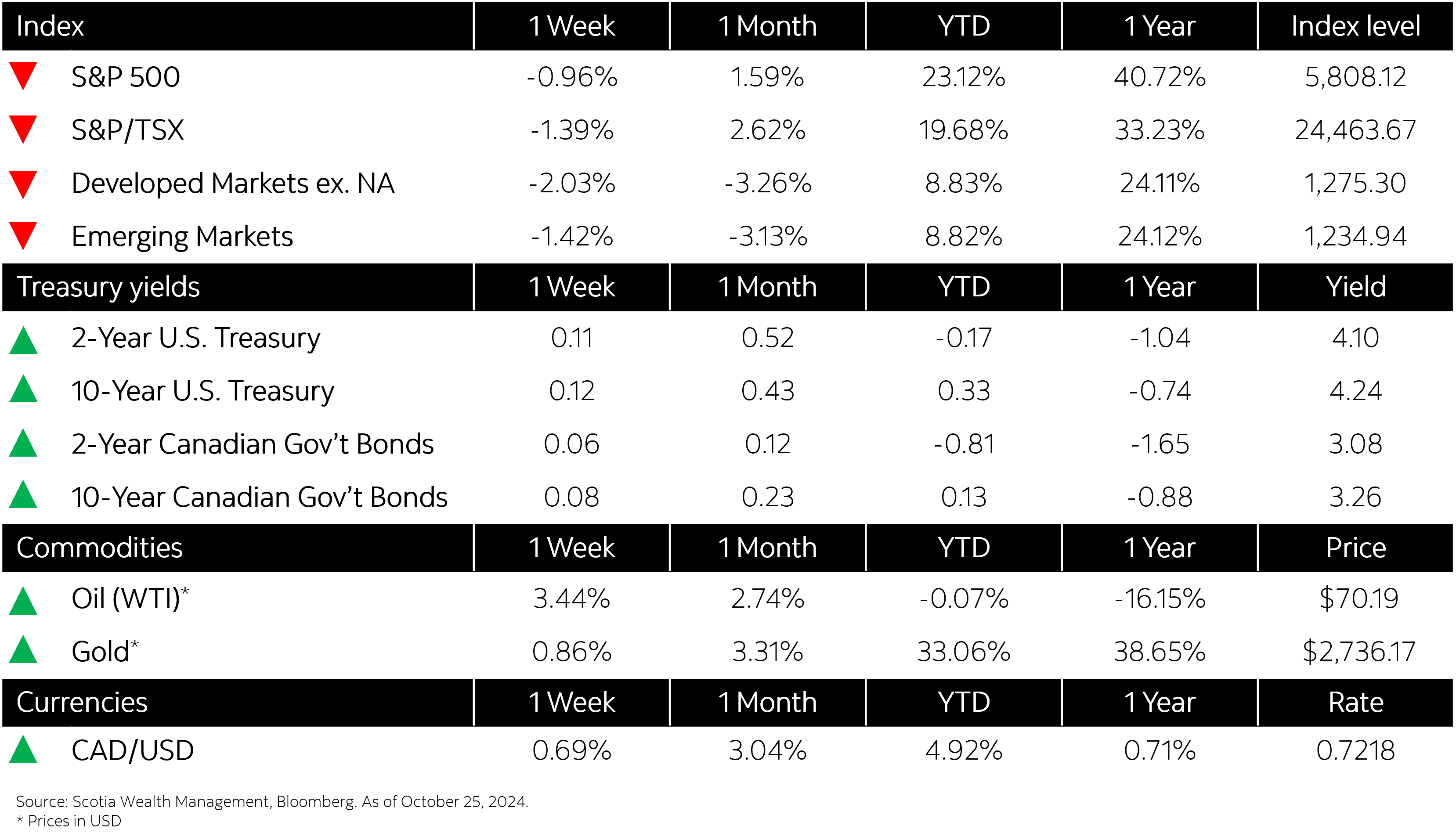
U.S. markets closed -0.96%1 lower for the week despite the heavy-weight group of interest rate-sensitive technology stocks boosting the market ahead of their upcoming earnings.

Canadian markets fell -1.39%2 for the week as investors assessed data showing marginal retail sales growth in August, which missed expectations and highlighted consumer spending strains across sectors.

European markets returned -2.03%3 for the week, as a handful of weak corporate earnings from auto-related companies such as Mercedes-Benz and Valeo and appliances-maker Electrolux dented investor sentiment.

  • Emerging markets closed -1.42%4 lower for the week despite China’s commercial banks cutting both the 1-year and 5-year loan prime rates as investors awaited further details of Beijing’s fiscal stimulus.

Bond yields climb up as markets parse economic data

U.S. Treasury yields rose this week hitting a three-month high on Wednesday. Investors closely followed Fed policymakers’ comments on September’s significant 50-basis-point rate cut and future monetary policy directions. Similarly, in Canada, sovereign yields increased as investors responded to the Bank of Canada’s recent decision to reduce the overnight rate 50 basis points to 3.75%. Next week could bring more volatility to bond markets with major macro releases due such as October’s U.S. employment data, personal consumption expenditures (PCE) and the first read of the 3Q U.S. gross domestic product (GDP), along with the the tight presidential election a week later.

Highlights:

  • The 2- and 10-year U.S. Treasury yields were 11 basis point (bp) and 12 bps higher, respectively. In Canada, the 2- and 10-year yields rose 6 bps and 8 bps, respectively.

Bonds trading wider than 1,000 bps have declined, likely due to credit spreads trading at historically tight levels, attractive yields and the Fed’s latest easing cycle which started in September.

Despite the selloff, the high-yield primary market prices new deals, while investment grade supply lags, and CCC-rated debt spreads have dropped to 583 from 890 basis points since early August, according to Bloomberg.

Weekly dashboard

Bank of Canada cuts its key interest rate by a half-point to 3.75%

The Bank of Canada (BoC) cut its policy interest rate by half-a-percentage point and revised its inflation forecast lower, accelerating the pace of monetary policy easing in an attempt to engineer a soft landing for the economy. As widely expected, the bank’s governing council lowered the benchmark interest rate to 3.75% from 4.25%. This was the fourth consecutive cut since June and follows three quarter-point moves.

Highlights:

BoC governor Tiff Macklem said the bank expects to continue lowering interest rates, although he said the pace of cuts will depend on incoming economic data.

The larger-than-usual rate cut follows a string of data showing that Canadian inflation is lower and economic growth is weaker than the bank expected.

The bank’s new forecast sees economic growth picking up through the last quarter of the year and into next year, as falling interest rates lower debt-servicing costs and encourage business investment and consumer spending.

U.S. home sales on track for worst year since 1995

Sales of existing homes in the U.S. are on track for the worst year since 1995, for the second year in a row. Persistently high home prices and elevated mortgage rates are keeping potential home buyers on the sidelines. Sales of previously owned homes in the first nine months of the year were lower than the same period last year, the National Association of Realtors (NAR) reported.

Highlights:

Existing-home sales in September fell 1% from the prior month to a seasonally adjusted annual rate of 3.84 million, NAR said, the lowest monthly rate since October 2010.

September sales fell 3.5% from a year earlier.

After a sluggish 2023, economists and real-estate executives widely expected activity to pick up in 2024.

China cuts benchmark lending rates as easing push to boost economy continues

China’s commercial lenders cut their benchmark lending rates , a highly anticipated move as policymakers intensify their efforts to boost the ailing economy. The one-year and five-year loan prime rates were both cut 25 basis points to 3.1% and 3.6%, respectively, according to the People’s Bank of China (PBOC). Economists widely expect the central government to take on new debt at a scale ranging from 1 trillion yuan to 3 trillion yuan, though some say as much as 10 trillion yuan is needed to move the needle.

Highlights:

The bundle of rate cuts forms part of a package of stimulus measures announced by Chinese authorities in September amid weakening economic growth.

Underscoring the challenge, data last week showed that the economy expanded 4.6% in the July-to-September quarter from a year ago, which though slightly better than expected, was the slowest pace in six quarters.

  • While economists widely expect more monetary easing in the coming months, it’s doubtful that the PBOC’s moves alone will boost loan demand, as confidence and borrowing appetite remains weak.
  • In the news: Boeing machinists reject contract, extending strike
  • Boeing’s largest union rejected a new labour deal, extending a six-week strike that has plunged the jet maker into increasing financial peril. Members of the machinist union voted 64% against a proposed contract that would have delivered a 35% wage increase over four years. The vote came on the same day Boeing warned investors that it would bleed cash into 2025 after burning through more than US$10 billion in the first nine months of 2024. Analysts estimate the walkout is costing Boeing around US$1 billion a month.

Behind the headline:

Credit-rating companies have warned they may downgrade Boeing to junk status.

The strike by 33,000 members of the International Association of Machinists and Aerospace Workers has already rippled beyond Boeing and prompted some key suppliers to cut staff or furlough workers.

Ending the stoppage is a priority for Boeing Chief Executive Kelly Ortberg, who recently set plans to cut 17,000 jobs and sell at least US$10 billion in shares to plug the company’s cash drain.

1 S&P 500 Index CAD
2 S&P/TSX Composite Index CAD
3 Bloomberg Developed Markets ex N. America Large & Mid Cap Price Return Index CAD
4 Bloomberg EM Large & Mid Cap Price Return Index CAD