Subscribe to the 100% free rdnewsNOW daily newsletter!
SPONSORED

Market Watch: July 12, 2024

Jul 15, 2024 | 1:02 PM

This week’s highlights

  • Markets post fresh highs as U.S. inflation slows
  • Bond yields move lower as disinflation momentum accelerates
  • Average asking rents in Canada reached $2,185 in June as growth slows to 7 per cent
  • U.S. inflation hits 3 per cent in June, lower than expected
  • China consumer inflation stays tepid, factory-gate prices continue to fall
  • In the news: U.S. imposes tariffs on non-Mexico origin metals

Week in review

Markets post fresh highs as U.S. inflation slows

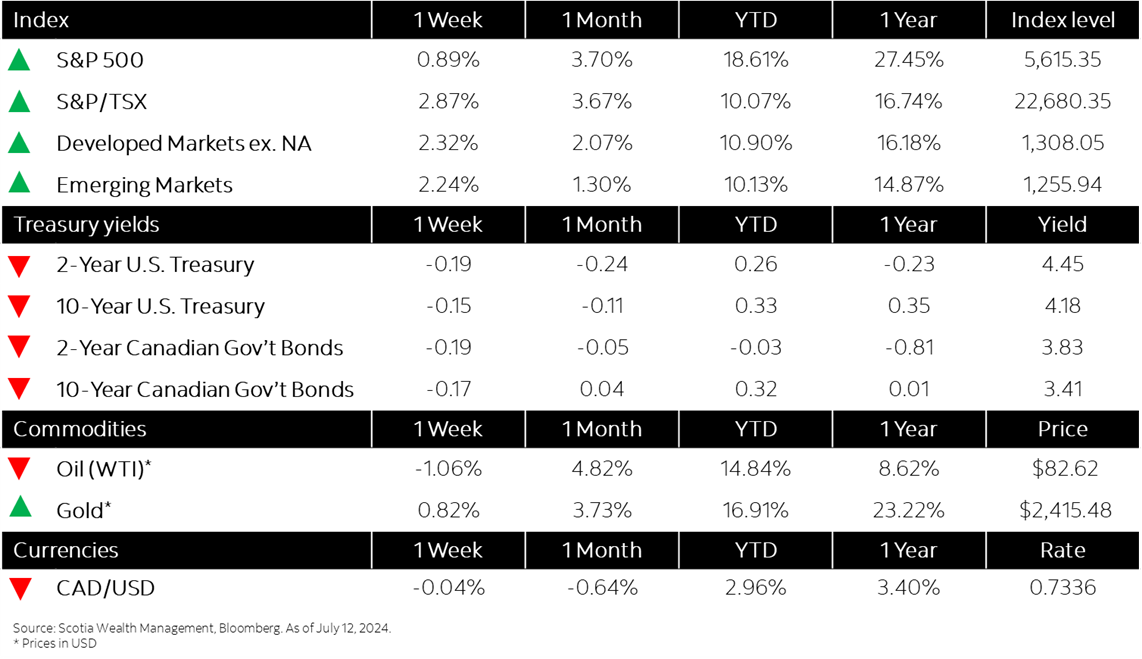
The recent market rally, which has largely been confined to a handful of mega-cap info tech names, has begun to broaden following the release of June’s consumer price index (CPI) that showed inflation slow to 3.0 per cent year-over-year (YoY). This, in turn, has fuelled speculation that the Federal Reserve (Fed) will likely cut rates at its September meeting. With investors closely watching for any signs of policy easing, this news led to a broad-based rally not only in the U.S. but internationally as well.

Highlights:

  • U.S. markets were 0.89 per cent1 higher for for the week in light of potential policy easing, which pushed both the S&P 500 as well as the tech-heavy Dow – which closed above 40,000 for the second time in history – to all-time highs.
  • Canadian markets returned 2.87 per cent2 for the week with strong gains across all sectors except info tech which lagged in large part due to Shopify which was down almost 4.0 per cent for the week.
  • With election uncertainty now in the rearview mirror, European markets returned 2.32 per cent3 for the week as stocks notched their best session since early June amid slowing U.S. inflation.
  • Emerging markets closed 2.24 per cent4 as Asian markets – and in particular banking stocks – experienced some of their biggest gains in years. Singapore’s main stock index, the Straits Times Index, closed at its highest level in six years.

Bond yields move lower as disinflation momentum accelerates

U.S. rates were broadly lower for the week following a lower-than-expected CPI inflation reading which triggered a rally in bonds. The odds of a September policy rate cut increased considerably following the CPI report. The 10-year benchmark yield is also trading below recent lows, currently at levels last seen in April. The rally was tempered somewhat by the producer price index (PPI) increasing across the board, defying expectations. Previous reads were revised higher also. PPI stripped of food, energy, and trade was the exception, with both MoM and YoY measures coming in lower. Credit spreads closed the week soft, high yield in particular. According to data compiled by Bloomberg, speculative-grade communications and technology sectors are predominantly set for downgrades, while energy and basic industry still stand out with mostly upgrade potential.

Highlights:

  • The two-year U.S. Treasury yield was 19 basis points (bps) lower while the 10-year yield fell 15 bps. In Canada, the two- and 10-year yields were 19 bps and 17 bps lower, respectively.
  • Many U.S. firms have been on the sidelines as foreign issuers have mostly tapped the primary market in recent weeks. This is partly due to the blackout just before the earnings season which kicked off on Thursday.
  • There are several Fed speakers scheduled for the coming week, including Fed Chair Powell. U.S. retail sales are due on Tuesday, while housing starts and the Fed’s Beige Book on Wednesday.

Weekly dashboard

Average asking rents in Canada reached $2,185 in June as growth slows to 7 per cent

A new report says the average asking rent for a home in Canada reached $2,185 in June, up 7 per cent compared with a year ago despite representing the slowest annual rate of growth in 13 months. The report by Urbanation and Rentals.ca, which analyzes monthly listings from the latter’s network, says average asking rents decreased 0.8 per cent from May, the largest month-over-month decline since early 2021 and atypical compared with usual monthly increases this time of year.

Highlights:

  • Based on the report, the average asking rent for a one-bedroom unit in Canada was $1,918 in June, up 7.7 per cent from a year ago, while the average asking price for a two-bedroom unit was $2,301, up 9.6 per cent.
  • Overall, asking rents for purpose-built rental apartments in June jumped 11 per cent compared with a year earlier to reach an average of $2,121, while condominium apartment rents, which averaged $2,320, were up 2.6 per cent.
  • The majority of provinces recorded year-over-year increases in asking rents for purpose-built and condo rentals, led by Saskatchewan, with a 22.1 per cent gain to reach $1,339. Ontario saw a 1.3 per cent decline from a year ago to $2,382, while rents in B.C. were flat.

U.S. inflation hits 3 per cent in June, lower than expected

U.S. inflation eased in June even more than economists had expected, extending a recent slowdown in price increases and boosting investors’ hopes that the U.S. Federal Reserve (Fed) could soon start cutting interest rates. The consumer-price index, a measure of goods and services costs across the economy, rose 3.0 per cent from a year earlier, the U.S. Labor Department reported, and fell 0.1 per cent since May. Another month of very mild inflation keeps the door wide open to a September interest-rate cut, especially if Fed officials conclude the labour market is slowing in a way that either diminishes a potential source of ongoing inflation or risks further unwelcome weakness.

Highlights:

  • Excluding volatile food and energy costs, so-called core prices climbed just 0.1 per cent from May to June, below the 0.2 per cent increase in the previous month. Measured from a year ago, core prices rose 3.3 per cent in June, down from 3.4 per cent in May.
  • The Fed has kept its key rate unchanged for nearly a year after aggressively raising it in 2022 and 2023, leading to costlier mortgages, auto loans, credit cards and other forms of consumer and business borrowing.
  • Inflation is now far below its peak of 9.1 per cent in mid-2022. Other measures suggest that the economy is healthy, though slowing: Unemployment is still relatively low, hiring remains steady and many consumers continue to travel, eat out and spend on entertainment.

China consumer inflation stays tepid, factory-gate prices continue to fall

China’s consumer inflation remained tepid last month while factory-gate prices continued to fall, pointing to persistently lacklustre demand despite Beijing’s efforts to increase consumption. The country’s consumer-price index rose for a fifth consecutive month in June, edging up 0.2 per cent from a year earlier, the National Bureau of Statistics reported. That missed the 0.4 per cent rise expected by economists and compared with May’s 0.3 per cent increase. Meanwhile, factory-gate prices stayed in deflation but narrowed their decline from May. The producer-price index fell 0.8 per cent in June from a year earlier, marking a 21st straight month of contraction.

Highlights:

  • The figures came as no surprise to many economists, who expect inflation to stay low throughout the year as a drawn-out property slump continues to dent consumer confidence and spending.
  • The latest data showed that core consumer inflation, which strips out more volatile categories such as food and energy, rose 0.6 per cent in June, matching the expansion seen in the prior month. Food prices dropped 2.1 per cent versus May’s 2.0 per cent decline, while prices of non-food items increased 0.8 per cent in June, the same pace as in the previous month.
  • While Beijing has launched initiatives to stimulate spending, including a nationwide program to encourage households to replace home appliances and cars with new ones, consumers have been reluctant to open their wallets.

In the news: U.S. imposes tariffs on non-Mexico origin metals

The Biden administration, in coordination with the Mexican Government, is imposing tariffs on steel and aluminum shipped from Mexico that originated from abroad. This move aims to prevent China from avoiding import taxes which were tripled in May by routing goods through Mexico, one of the United States’ closest trading partners. Lael Brainard, director of the White House National Economic Council, announced that the tariffs will be levied under section 232 of the Trade Expansion Act, which applies to imports that could threaten U.S. national security. The tariffs include a 25 per cent tax on steel not melted or poured in Mexico and a 10 per cent tax on aluminum. These measures address China’s overcapacity and tariff evasion and are intended to protect and grow the domestic steel industry – along with shipbuilding – which has been a key pillar of the U.S.’ re-industrialization strategy.

Behind the headline:

  • In 2023, around 3.8M tonnes of steel came into the U.S. through Mexico, with around 13% being melted or poured outside of North America.
  • In addition to the U.S.’ tariffs, Mexico has increased its own tariffs on steel and aluminium from certain countries while requiring more information from importers to be able to verify the source of steel and aluminium products.
  • Jay Shambaugh, Treasury’s under secretary for international affairs, said that China has been employing the same tactics with steel that it has with other products such as green energy technology and semiconductors, pointing out that China’s “government guidance funds” are likely propping up firms that would otherwise be non-viable.

Gauging Powell’s Confidence

This week’s risk dashboard:

  • How much more confidence will Powell signal?
  • ECB to say ‘see ya in September!’
  • PBOC to hold ahead of the Third Plenum
  • Canadian CPI & the BoC’s next decision
  • Canadian inflation expectations likely fell
  • US earnings season swings into higher gear
  • A big week for BoE watchers
  • BoJ hike risk could be informed by CPI
  • Are jobs still on fire down under?
  • Will Q2 CPI push the RBNZ to ease soon?
  • BI, SARB may be inching closer to easing
  • US, Canadian retail sales updates

Read the full publication here.

1 S&P 500 Index CAD
2 S&P/TSX Composite Index CAD
3 Bloomberg Developed Markets ex N. America Large & Mid Cap Price Return Index CAD
4 Bloomberg EM Large & Mid Cap Price Return Index CAD

Disclaimer

This publication has been prepared by The Bank of Nova Scotia for Scotia Wealth Management clients. It is for general information purposes only and should not be considered or relied upon as personal and/or specific financial, tax, pension, insurance, legal or investment advice. We are not tax or legal advisors, and we recommend that individuals consult with their qualified advisors, including tax and legal advisors, before taking any action based upon the information contained in this publication. The opinions and projections contained in this publication are our own as of the date hereof and are subject to change without notice. Scotia Wealth Management is under no obligation to update this commentary, and readers should assume the information contained herein will not be updated. While care and attention has been taken to ensure the accuracy and reliability of the material in this publication, neither The Bank of Nova Scotia nor any of its affiliates or any of their respective directors, officers or employees make any representations or warranties, express or implied, as to the accuracy or completeness of such material and disclaim any liability resulting from any direct or consequential loss arising from any use of this publication or the information contained herein. This commentary may contain forward-looking statements based on current expectations and projections about future general economic factors. Forward-looking statements are subject to inherent risks and uncertainties which may be unforeseeable and such expectations and projections may be incorrect in the future. Forward-looking statements are not guarantees of future performance and you should avoid placing undue reliance upon them. This publication and all the information, opinions and conclusions contained herein are protected by copyright. This publication may not be reproduced in whole or in part without the prior express consent of The Bank of Nova Scotia.

® Registered trademark of The Bank of Nova Scotia, used under licence. ™ Trademark of The Bank of Nova Scotia, used under licence. Scotia Wealth Management® in Canada consists of a range of financial services provided by The Bank of Nova Scotia (Scotiabank®); The Bank of Nova Scotia Trust Company (Scotiatrust®); Private Investment Counsel, a service of 1832 Asset Management L.P.; 1832 Asset Management U.S. Inc.; Scotia Wealth Insurance Services Inc.; and ScotiaMcLeod®, a division of Scotia Capital Inc. Private banking services are provided by Scotiabank. Estate and trust services are provided by The Bank of Nova Scotia Trust Company. Portfolio management is provided by 1832 Asset Management L.P. and 1832 Asset Management U.S. Inc. Insurance services are provided by Scotia Wealth Insurance Services Inc. Wealth advisory and brokerage services are provided by ScotiaMcLeod, a division of Scotia Capital Inc. International investment advisory services are provided by Scotia Capital Inc. Financial planning services are provided by Scotiabank and ScotiaMcLeod. Scotia Capital Inc. is a member of the Canadian Investor Protection Fund and regulated by the Canadian Investment Regulatory Organization. Scotia Wealth Insurance Services Inc. is the insurance subsidiary of Scotia Capital Inc., a member of the Scotiabank group of companies. When discussing life insurance products, ScotiaMcLeod advisors are acting as Life Insurance Agents (Financial Security Advisors in Quebec) representing Scotia Wealth Insurance Services Inc.

Scotia Wealth Management® in The Bahamas consists of a range of financial services provided by Scotiabank (Bahamas) Limited and The Bank of Nova Scotia Trust Company (Bahamas) Limited. International private banking and international investment advisory services are provided by Scotiabank (Bahamas) Limited, an entity licensed with The Central Bank of The Bahamas and The Securities Commission of The Bahamas. International wealth structuring solutions are provided by The Bank of Nova Scotia Trust Company (Bahamas) Limited, an entity licensed with The Central Bank of The Bahamas.

Scotia Wealth Management® in the Cayman Islands consists of a range of financial services provided by Scotiabank & Trust (Cayman) Ltd., an entity licensed by the Cayman Islands Monetary Authority. Scotiabank & Trust (Cayman) Ltd. provides international private banking services, international investment advisory services, and international wealth structuring solutions.