Subscribe to the 100% free rdnewsNOW daily newsletter!
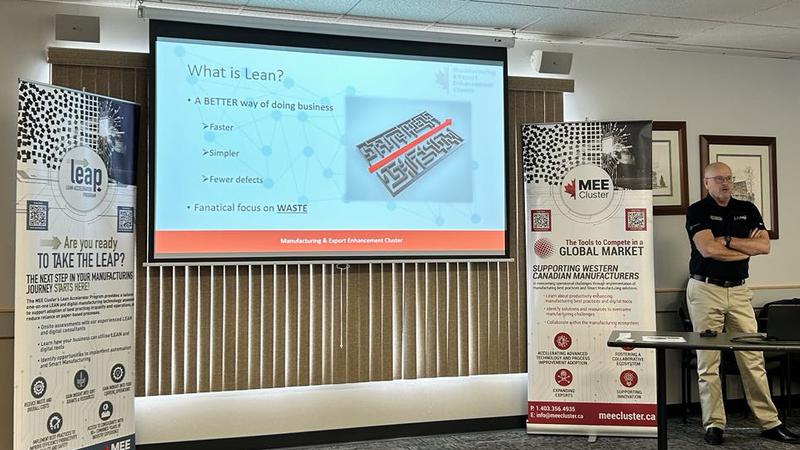
Bruce Ennis, Process Improvement Expert for the Manufacturing & Export Enhancement (MEE) Cluster, speaks about Lean manufacturing principles to business owners at Red Deer & District Chamber of Commerce Lunch n' Learn event. (rdnewsNOW/Alessia Proietti)
LEAN

Want to increase efficiency in your manufacturing? Red Deer businesses just learned how

Feb 13, 2024 | 4:03 PM

To increase productivity in a business, the key is to not just reduce waste within departments, but in between them. This methodology is known as Lean manufacturing and was explained to Red Deer business owners on Monday by a prominent industry leader.

At a Red Deer & District Chamber of Commerce Lunch n’ Learn event held at their local office, Process Improvement Expert for the Manufacturing & Export Enhancement (MEE) Cluster Bruce Ennis shared how Alberta companies can maintain their competitiveness with Lean principles.

Lean began at the Toyota automobile manufacturer in Japan following the Second World War. While western automobile companies focused on mass machinery production and Taylorism, completing repetitive tasks in a set time, Toyota began to look at increasing efficiency in their process to achieve faster and simpler results.

“Doing things the old way: which means siloed workforces, people in departments, ‘I only care about my department and I might even get a bonus if my department does well’ but being unaware about the harmony between departments. If I work with five other different departments, Lean is about everybody working together in harmony, nobody overburdening another one and only celebrating the success of the customer, not my department,” he said.

Today, roughly 70 per cent of Fortune 500 companies now apply Lean principles.

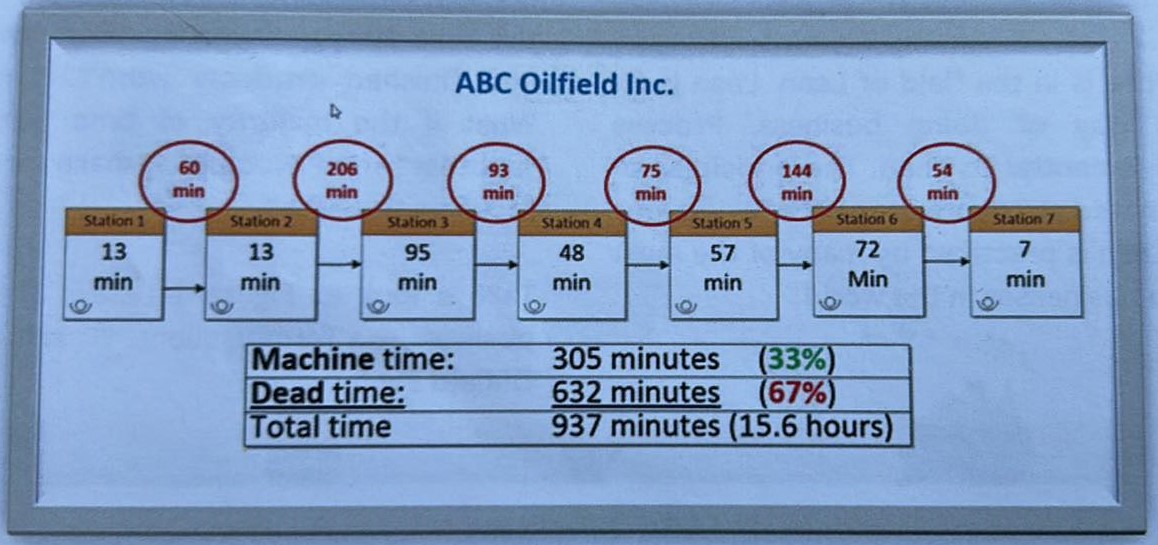
To elaborate, in a traditional western manufacturer, one would improve efficiency of machines within each department, with the total work time known as “cycle time”. Toyota decided to look at the time wasted in between each department for waiting, known as “dead time” or “queue time”. Some examples, Ennis says, include disorganization, poorly designed layouts, and uncoordinated departments that leave unassembled pieces of products sitting around until the next department is ready.

Figure 1: Process of a real business (with changed name) consisting of seven work stations and associated machine times. The times in the red circles are wait times in between stations. (Machine Efficiency Vs. Process Efficiency? What’s More Important? by Bruce Ennis)

Another example of waste includes undue amounts of bureaucracy. While Ennis says its origins came from a good place to avoid workplace injuries, it has grown to unnecessary amounts of paperwork that focus more on protecting companies from litigations. Examples can be seen in the healthcare system, he says, coming from doctors resistant to change and politics cutting employee budgets which, in turn, decreases morale.

Ennis says in many traditional western companies, about 20 per cent of a workday consists of actual work-related tasks towards achieving the end result, while the remaining 80 per cent is waste.

“One of the secrets of Lean is to break down activities in their fundamental levels and say, ‘if the customer knew we were doing this, would they approve it’,” he said.

He adds that while many are moving towards more automation and robotics, places like Japan have chosen to focus on people and ensuring departments are coordinated, which also costs less money and is based on better planning.

Ennis states companies need to focus on investing in the right people first, then process, and then technology.

Some key principles of Lean include:

  1. Identify value: answer the question of why a company is buying from you and remove egos associated with job titles.
  2. Eliminate waste: there are eight types including over/under production, waiting, unnecessary transportation, over/under processing, excess inventory, unnecessary motion, defects, and unused creativity of team members. Manufacturing areas should be clean and tidy.
  3. Level the work: ensure all departments have even amounts of work and take the same amount of time to avoid overburdening one department while another waits. This can be done by breaking down silos and increasing communication among departments.
  4. Employee respect: senior leadership should be on the factory floor rather than remaining in their offices in order to “walk a mile” in everyone’s shoes and understand where things are bottlenecking.

When questioned if Japan’s work culture of long hours and societal pressure to perform played an impact in their productivity levels, Ennis responded that a balance must be found, joking that Lean principles can be applied to life.

“I have figured out through Lean how to be very efficient in an eight-hour day. I probably get 12 hours [of] work done in an eight-hour day because I’ve leaned out all the waste and then I turn it off and go spend time with my family,” he said.

Ennis is a Lean Six Sigma Master Black Belt, a certification given to individuals who have achieved the highest level of proficiency and expertise in the Lean and Six Sigma methodologies.

—–

Download the rdnewsNOW mobile app on Google Play and the Apple App Store for all the latest updates on this and other stories.