Subscribe to the 100% free rdnewsNOW daily newsletter!
conditions as of oct. 4, 2022

Alberta Crop Report: Harvest well ahead of 5 and 10-year averages

Oct 7, 2022 | 4:50 PM

According to the latest crop report for Oct. 4, released Oct. 7, favourable harvest weather conditions continued over the past week, advancing progress by nine per cent for major crops from a week ago.

Ninety-six per cent of all crops provincially have been harvested, level with last year’s progress.

It’s also 26 per cent ahead of the five-year average, and 20 per cent ahead of the 10-year average.

“About two per cent of crops are in swath, and another two per cent are still standing. Regionally, harvest is most advanced in the South and North East Regions, where more than 97 per cent of crops are now in the bin,” the report, which is compiled by the Alberta Agricultural Fieldmen and AFSC staff, says.

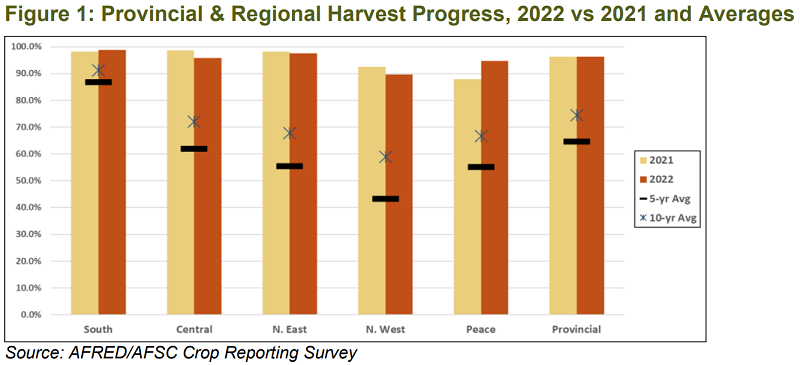
“About 96 per cent of crops in the Central Region and 95 per cent in the Peace Region have been combined. Harvest in the North West Region is 90 per cent complete. Compared to the five-year and 10-year averages, harvest is advanced for all regions. When compared to last year, 2022 harvest progress is ahead only in the South and Peace Regions, and on par in the North East Region.”

For the Central region, 100 per cent of durum wheat, winter wheat, fall rye, dry peas and lentils have been combined.

Spring wheat is at 99.0 per cent, barley is at 99.7 per cent, oats are at 96.4 per cent, canola 88.8 per cent, and potatoes are at 80.0 per cent.

(Alberta Crop Report for Oct. 4, 2022)

Dryland yields for the Central and North East Regions are estimated nine and eight per cent, respectively, above the 5-year averages, the report notes.

Region Two: Central (Rimbey, Airdrie, Coronation, Oyen)

  • Dry, warm weather continued over the past week, which has been favourable for harvest operations and producers have begun fall fieldwork.
  • Harvest is 96 complete, with estimated yields nine per cent above the 5-year averages. Harvest progress is ahead of the 5-year average of 71 per cent and 10-year average of 73 per cent. Still standing crops include two per cent of oats, four per cent of canola and 20 per cent of potato and flaxseed.
  • Crop quality for malt barley and the top two grades of hard red spring wheat, canola and dry peas is above their regional 5-year averages. Quality for the top two grades of durum wheat and oats as well as feed barley is below the 5-year averages. About 91 per cent of hard red spring wheat, 82 per cent of durum wheat and 73 per cent of oats are grading in the top two grades. About 48 per cent of barley is eligible for malt and 40 per cent is grading as No. 1 feed. About 88 per cent of canola is grading as No. 1 and nine per cent as No. 2. For dry peas, 36 per cent are grading as No. 1, with 57 per cent as No. 2.
  • Fall seeded crops are rated as 12 per cent poor, 46 per cent fair, 41 per cent good and 1 per cent excellent.
  • Pasture conditions are rated as 31 per cent poor, 49 per cent fair, 19 per cent good and 1 per cent excellent.
  • About 88 per cent of total dryland tame hay in the region was from first cut, with the average yield (5-year averages shown in brackets) at 1.7 (1.3) tons per acre. The remaining 12 per cent was from second cut, with yield at 1.5 (1.5) tons per acre. For irrigated hay, first cut hay accounted for 80 per cent of the total, with yield reported at 2.3 (2.2) tons per acre, while second cut hay accounted for 20 per cent, with yield at 1.1 (1.2) tons per acre.

Read the full report here.