Sign up for our free daily newsletter!
(rdnewsNOW/Sheldon Spackman)
Flooded Areas Drying Up

Recent warm temperatures welcomed by local farmers

Jul 15, 2022 | 4:55 PM

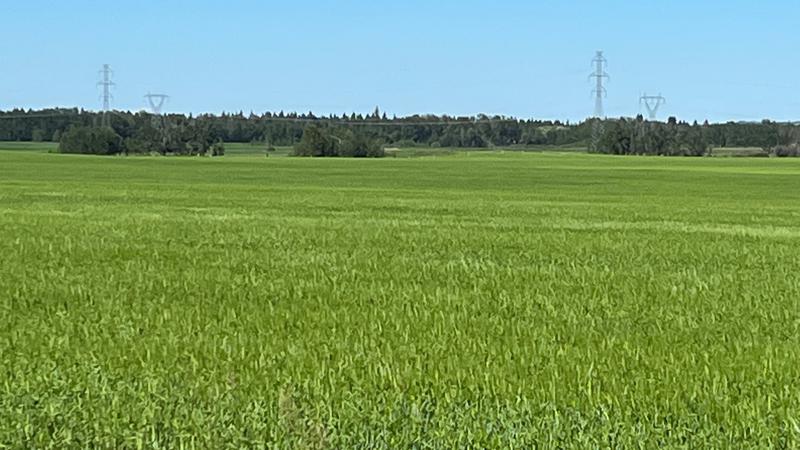
The Central Region of Alberta received a lot of moisture over the past two weeks, with some pockets of flooded areas, now starting to evaporate.

That, according to the latest Alberta Crop Report from Agriculture Financial Services Corporation (AFSC) and Alberta Agriculture, Forestry and Rural Economic Development.

According to the report, however, the warmer temperatures received are also most welcome.

Officials add though, that hail storms are starting to damage crops in some counties. In general, all crops and forages are said to be growing well, with the exception of canola in some fields. Gophers and flea beetle infestation is becoming a concern in some areas.

Spring cereals are currently in the head emergence stage of development, while fall seeded crops are in the milk development stage. About 82 per cent of canola and 69 per cent of dry peas are now in flower, while two per cent of canola and 29 per cent of dry peas are in the podding stage.

About 14 per cent of dryland haying is complete (compared to the 5-year averages of 42 per cent), while irrigated haying has not yet started. Dryland yield is estimated at 1.5 tons per acre, above the 5-year average of 1.4 tons per acre. Hay quality is rated at 12 per cent poor or fair and 88 per cent good or excellent for dryland.

Tame hay conditions are now reported as 3 per cent poor, 15 per cent fair, 59 per cent good and 23 per cent excellent.

Surface soil moisture is reported (sub-surface soil moisture ratings shown in brackets) at 1 (4) per cent poor, 12 (16) per cent fair, 41 (41) per cent good and 35 (31) per cent excellent, with 11 (8) per cent excessive.

Over the past two weeks, precipitation has been highly variable throughout the province. Many areas in the Peace Region and the south eastern parts of the province received less than 10 mm of rain, while in the central parts of the province precipitation was at least 40-50 mm, with many areas receiving more than 100 mm. For the rest of the province, precipitation has been between the above mentioned ranges.

Also, some light to moderate hail damage was reported for different regions. Compared to the last crop report (conditions as of June 27), crop growing conditions in the province remained practically unchanged, with 75 per cent of crops rated in good to excellent condition, above the provincial 5-year average of 65 per cent and the 10-year average of 69 per cent.

Regionally, crop growing conditions are currently the best in the North East Region, with 82 per cent of all crops rated as good or excellent, while the lowest rating is reported in the South Region, at 64 per cent good or excellent. About 78 per cent of crops in the Central and Peace Regions and 76 per cent in the North West Region are rated as good or excellent.

Overall, the stage of development for various crops are marginally behind normal, say officials. Wheat is generally in good condition, but barley and oats are struggling in some fields, due to excess moisture. For canola, stage of development varies widely across the province and even within fields, from the vegetative stage to well into flowering. This variability is said to be driven by several factors, including select seed performance issues (which can delay the crop development), a cool and dry spring and pest problems, notably flea beetles and cutworms.

Precipitation over the month of June has significantly improved soil moisture reserves across the province. Currently, officials note surface soil moisture is rated at 82 per cent good, excellent or excessive, compared to 49 per cent good or excellent at the beginning of the season (May 4, 2022). Provincial sub-surface soil moisture ratings are rated at 8 per cent poor, 27 per cent fair, 42 per cent good and 20 per cent excellent, with 3 per cent excessive. Compared to the long term normal, soil moisture reserves are now at least normal for most of the province, moderately high in the central parts of the province and the central to northern parts of the Peace Region, and low in some eastern parts of the South, Central and North East Regions.

Pastures are generally growing well. However, conditions in some areas remain poor to fair due to the heavy grazing last year and challenging conditions over the past couple of seasons. Provincial pasture conditions across the province are now reported as 11 per cent poor, 34 per cent fair, 46 per cent good and 9 per cent excellent.

Haying has been delayed due to earlier dry and cool conditions in spring, followed by heavy rains in June. Even so, above average yields are expected. First cut dryland hay is only 19 per cent complete across the province, compared to the 5-year average of 46 per cent. The estimated yield of dryland hay is 1.6 tons per acre (above the 5-year average of 1.4 tons per acre), with quality rated as 65 per cent good to excellent.

For irrigated hay, first cut is 27 per cent complete (significantly behind the 5-year average of 81 per cent), with yield at 2.2 tons per acre (below the 5-year average of 2.4 tons per acre). Quality is rated as 69 per cent good to excellent.