Subscribe to the 100% free rdnewsNOW daily newsletter!
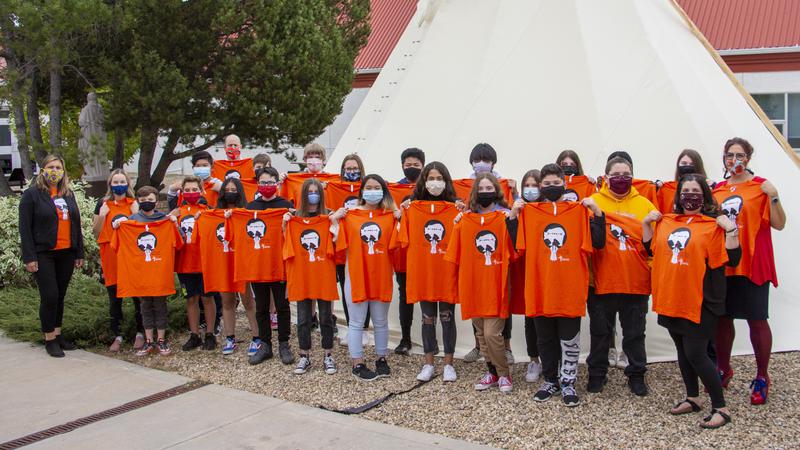
Deneen Hawryszko and her fellow grade eights at St. Thomas Aquinas Middle School will don orange shirts this week bearing a logo she designed. More below. (Red Deer Catholic Regional Schools)
acknowledging the past

School divisions recognize Orange Shirt Day

Sep 30, 2020 | 7:00 AM

Created in 2013, Orange Shirt Day was inspired by residential school survivor Phyllis Jack Webstad, whose orange shirt – a gift from her grandmother – was confiscated on her first day at the school when she was six. That was in Williams Lake, B.C.

Orange Shirt Day is recognized every year on Sept. 30.

“It’s not just about students coming to school and wearing an orange shirt, we do lots of pre-teaching to ensure they know why they are wearing an orange shirt, and what Phyllis’s story is,” says Selena Frizzley, First Nations, Métis, and Inuit Support Team coordinator at Red Deer Catholic Regional Schools. “That’s the most important thing. Other classes and schools will do drumming, art projects, presentations and prayer.”

Red Deer Catholic ran an Orange Shirt Day logo contest that was won by grade eight student Deneen Hawryszko at St. Thomas Aquinas Middle School.

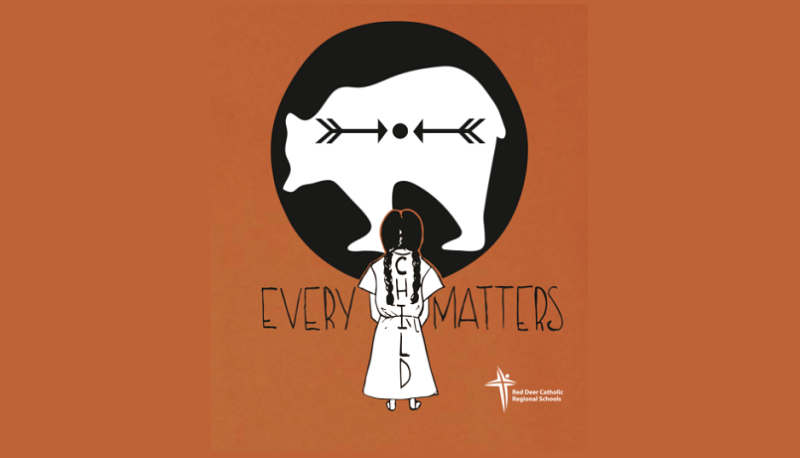
“Originally I wanted the child to be looking at their ancestors, as Aboriginal people go through generational trauma from the residential schools, colonization, and mass murder of their people and culture. Though since there was a chance of it being on a shirt, I reconsidered and did some more research,” says Hawryszko. “I found the bear was a sign of strength and the symbol inside of it represented protection. The circle the bear is inside also is a symbol of the moon, which represents many things like protection and grandmother moon, who is the leader of feminine life, which is a nod to the missing and murdered Indigenous women today.”

All orange shirts seen around the school division this week will feature the logo, which includes the slogan ‘Every child matters.’

(Red Deer Catholic Regional Schools/Deneen Hawryszko)

Frizzley says the division’s main strategy in teaching Indigenous perspectives and about residential schools is focusing on foundational knowledge.

“Our hope is that we can reduce the achievement gap between our FNMI students and all others. We do this through professional development, lesson planning, and we have a cultural teacher on stuff who can co-teach lessons in an authentic way.”

There’s also a knowledge keeper on staff, and elders often attend for blessings and to talk with students. Frizzley says having that resource has been very enriching.

Asked if students ever have a hard time grappling with Catholic involvement in residential schools, she says it comes down to simply acknowledging the facts.

“We go through what occurred and with the facts we know. I belong to the Remembering the Children Society also, and in working with them, we look at the residential school that was right here in Red Deer,” she says. “When it comes to the numbers of children who attended that school, for students to hear that, sometimes they’re very surprised.”

Red Deer Catholic has approximately 800 First Nations, Métis, and Inuit students.

Hayley Christen, Coordinator for FNMI Learning Services at Red Deer Public Schools, says it’s important for Canadians to understand that thousands of children were taken from their families while attending residential schools with the goal of taking away their ceremonies, teachings, and culture.

“Things that their families had passed down, and to give to them what the government and church officials at the time thought was better values, better teachings,” she explains. “I think sometimes people don’t realize the damage that has been done from residential schools and they think people got a good education or it wasn’t that bad or everywhere there were abuses happening at that time.”

She notes that talking about the history of residential schools and the impact they’ve had, starts with kids in Kindergarten and Grade 1.

“The work that we do with the teachers here, we really focus on using literacy to teach about residential schools and there’s a lot of Indigenous authors that have excellent books that they’ve written about their experiences,” adds Christen. “And when I work with Kindergarten or Grade 1 students, we really teach to them about how important it is that their parents and their families or their first teachers or their parents or grandparents and the teachings that they get from their families are what they need to honour.”

Christen says when their students come to school, they’re taught to always honour their family teachings first.

“I think that’s really important as we move forward and accept that we all come with different teachings and different practices and there’s not a better one or a worse one, they’re just different.”