
LOCAL NEWS THAT MATTERS, SENT TO YOU DIRECTLY. SUBSCRIBE FOR FREE!
Sponsored

Market Watch — Oct. 6, 2026

Nov 9, 2026 | 2:21 PM

Market highlights

  • Post-midterm rally fades as policy uncertainty drives AI repricing
  • Fiscal hopes meet firmer rate expectations

Economic highlights

  • Canada’s job market stalls as unemployment rises, trade surplus widens
  • U.S. job growth remains solid as manufacturing activity strengthens
  • Eurozone inflation rises as retail sales weaken
Week in review

Post-midterm rally fades as policy uncertainty drives AI repricing

U.S. equities traded sideways Monday and Tuesday as weakness in AI-related stocks offset a stronger ISM manufacturing report. Markets rallied Wednesday following the decisive Democratic sweep of both chambers of Congress, before reversing sharply Thursday as investors reassessed AI infrastructure spending and what the regulatory landscape might look like going forward. Stocks attempted to rebound Friday, but stronger-than-expected payrolls increased expectations for another Fed rate hike and limited the recovery. Canadian equities were relatively muted Monday and Tuesday before jumping Wednesday as the U.S. midterms raised hopes for a less restrictive approach to Canadian tariffs. Markets followed U.S. technology shares lower Thursday, before stabilizing Friday as investors reassessed the selloff, although weaker employment and rising unemployment reinforced signs of a cooling economy and weighed on the domestic outlook.

European equities traded cautiously Monday and Tuesday before rallying Wednesday as the U.S. midterms improved the tariff outlook and lower energy prices eased inflation concerns. Markets reversed Thursday as the U.S. technology selloff spread globally, while a hawkish Bank of England (BoE) hike reinforced rate concerns. Equities stabilized somewhat on Friday, although hawkish European Central Bank (ECB) commentary kept the prospect of further tightening in focus.

Chinese and emerging-market equities were mixed early in the week before rallying Wednesday as the U.S. election outcome improved the trade outlook and global risk sentiment. Those gains faded Thursday as U.S. technology weakness spread globally, with Asian markets remaining under pressure Friday as concerns around AI spending and valuations weighed particularly heavily on technology and semiconductor shares.

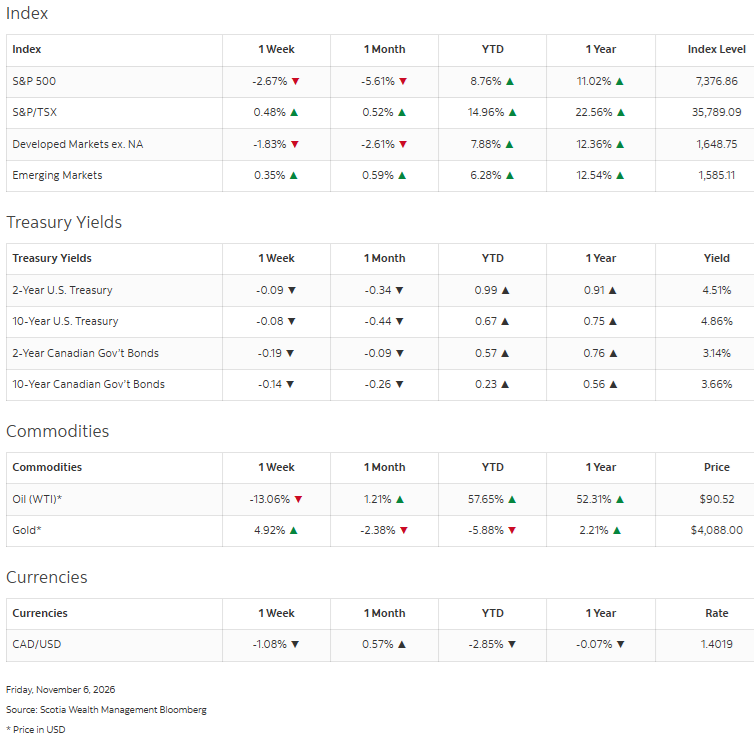
  • U.S. equities returned -2.67%¹, as an early-week AI-driven pullback gave way to a post-midterm rally, before renewed concerns around AI infrastructure spending and regulation weighed on technology shares. Strong payrolls on Friday also reinforced expectations for further Fed tightening.
  • Canadian equities returned 0.48%2, rallying midweek as the U.S. election outcome raised hopes for a less restrictive tariff environment before following global technology shares lower. Friday’s weaker employment report reinforced signs of a cooling domestic economy.
  • European equities returned -1.83%3, as improved tariff prospects and lower energy prices supported a midweek rally before the global technology selloff reversed gains. A hawkish BoE rate hike and ECB commentary also kept further monetary tightening in focus.
  • Chinese and emerging-market equities returned 0.35%4, as improved trade expectations following the U.S. midterms initially lifted sentiment, before the global technology selloff weighed on Asian markets, particularly AI- and semiconductor-related shares, later in the week.

Fiscal hopes meet firmer rate expectations

U.S. Treasuries began the week supported by falling oil prices before yields moved higher Tuesday as safe-haven demand faded and strong manufacturing data reinforced a higher-for-longer rate outlook. Bonds rallied Wednesday after the US midterms and continued Thursday, as safe haven flows intensified from equities selloff. Canadian bonds largely followed Treasurys until Friday, when weaker employment drove yields lower as markets reduced expectations for another BoC hike. European bonds were volatile, with the BoE’s hawkish rate hike pressuring Gilts and expectations for another ECB hike weighing on longer maturities. Asian rates diverged, with Japanese government bonds rallying sharply Friday as the risk-off backdrop prompted investors to pare Bank of Japan (BoJ) tightening expectations.

  • The 2- and 10-year U.S. Treasury yields were 9 bps and 8 bps lower, respectively. In Canada, the 2- and 10-year sovereign yields were 19 bps and 14 bps lower, respectively. Bond yields and prices move inversely to one another.
  • Falling oil prices provided an early tailwind for global bonds, as expectations for easing geopolitical tensions reduced inflation concerns before renewed Middle East uncertainty returned some volatility to energy markets.
  • The U.S. midterm result introduced a new source of uncertainty for rates markets, with investors weighing the potential for greater fiscal restraint and changes to tariff policy under a divided government.

Canada’s job market stalls as unemployment rises, trade surplus widens

Canada’s labour market lost momentum in October, while a widening merchandise trade surplus and new federal spending measures offered a mixed picture of the economy heading into the final months of 2026. Employment was little changed in October, declining by 4,700 positions following losses in both August and September, Statistics Canada reported Friday. The unemployment rate rose 0.2 percentage points to 6.7%, while the employment rate slipped to 60.5%. The softer labour figures followed Wednesday’s report showing Canada’s merchandise trade surplus widened to $5.4 billion in September from $5.0 billion in August.

Highlights:

  • Job weakness was concentrated in wholesale and retail trade, which shed 29,000 jobs. Construction employment increased 16,000, while educational services added 15,000 positions. Alberta recorded the largest provincial decline, losing 24,000 jobs, while British Columbia added 12,000. Average hourly wages rose 2.2% from a year earlier to $37.89.
  • Exports edged 0.2% higher to $78.6 billion, supported by stronger shipments of energy products and precious metals, while imports fell 0.3% to $73.2 billion. However, trade volumes were weaker, with real exports falling 4.0% and real imports declining 2.5%.
  • Thursday’s Budget 2026 outlined plans to mobilize $400 billion in capital investment over six years, alongside measures aimed at improving productivity, boosting business investment and diversifying Canada’s trade relationships. The government also said it intends to limit direct program spending growth and put the deficit-to-GDP ratio on a declining path.

U.S. job growth remains solid as manufacturing activity strengthens

The U.S. labour market continued to expand in October, while a separate measure of manufacturing activity pointed to improving momentum in the factory sector, providing further evidence that the economy remains resilient despite elevated interest rates and lingering inflation pressures. U.S. nonfarm payrolls increased 165,000 in October, according to the U.S. Bureau of Labor Statistics. The unemployment rate was little changed at 4.1%, remaining within the relatively narrow 4.1% to 4.3% range recorded since March. Employment gains were concentrated in professional and business services, health care, and transportation and warehousing.

Highlights:

  • Labour force participation held at 61.9%, while the employment-to-population ratio was unchanged at 59.3%. However, there were some indications of softer conditions beneath the headline figures, with the number of people working part-time for economic reasons rising 339,000 to 4.8 million.
  • The ISM Manufacturing PMI Report showed its headline index climbed to 55.5 in October from 54.5 in September, marking a 10th consecutive month of expansion. Readings above 50 generally indicate manufacturing activity is growing.
  • Production rose sharply to 59.0, its strongest reading since November 2021, while new orders remained firmly in expansion territory at 55.5. Manufacturing employment also continued to grow, although at a slightly slower pace. At the same time, cost pressures remained elevated, with the ISM Prices Index registering 75.2.

Eurozone inflation rises as retail sales weaken

Eurozone inflation accelerated in October while retail sales weakened in September, presenting a mixed picture of the region’s economy as policymakers contend with renewed price pressures and signs of softer consumer demand. Annual inflation in the euro area rose to 4.0% in October from 3.8% in September, according to Eurostat. Energy remained the primary driver, with prices jumping 20.8% from a year earlier, accelerating from 18.9% in September.

Highlights:

  • Services inflation also edged higher to 3.3%, while food, alcohol and tobacco prices rose 1.6%. Inflation excluding energy, food, alcohol and tobacco held at 2.5%.
  • Eurozone retail trade volumes fell 0.7% in September from August, reversing the previous month’s 0.4% increase. Compared with a year earlier, retail sales increased a modest 0.4%.
  • Retail weakness was particularly evident in discretionary spending. Sales of non-food products declined 1.2% during September, while food, drinks and tobacco sales fell 0.3%. Automotive fuel sales increased 1.0%. Germany recorded one of the largest monthly declines among European Union members, with retail trade volumes falling 2.0%.

1 S&P 500 Index CAD

2 S&P/TSX Composite Index CAD

3 Bloomberg Developed Markets ex N. America Large & Mid Cap Price Return Index CAD

4 Bloomberg EM Large & Mid Cap Price Return Index CAD