Weather warnings may be in place around central Alberta!
(Image Credit: Scotia Wealth Management)
Sponsored

Market Watch — July 24, 2026

Jul 24, 2026 | 4:24 PM

This week’s highlights

  • Investors overlook tariff threats as oil and rates take centre stage
  • Energy prices and rate hike expectations drive yields higher before late-week relief
  • Canadian inflation softens, setting the stage for more dovish policy
  • Lower-than-expected jobless claims signal ongoing U.S. labour market resilience
  • ECB holds rates steady, signals cautious approach amid energy uncertainty

Week in review

Investors overlook tariff threats as oil and rates take centre stage

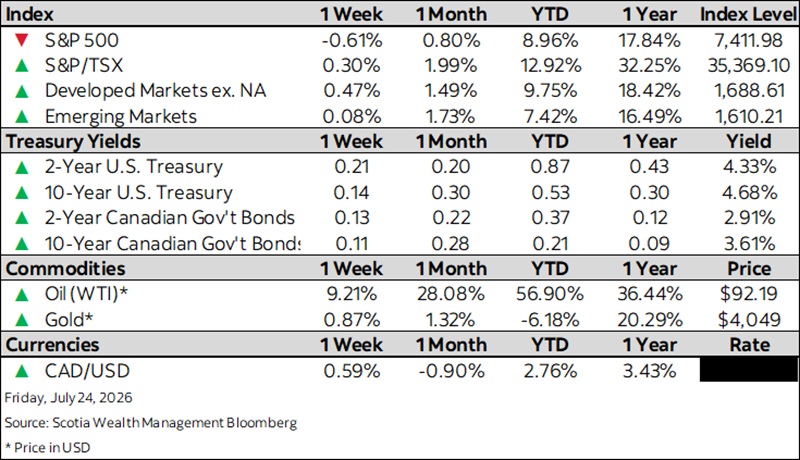
U.S. equities started the week higher, led by technology and semiconductor stocks, as investors largely discounted escalating Middle East tensions and fresh tariff announcements. Sentiment deteriorated midweek as intensifying U.S.-Iran hostilities drove oil prices sharply higher, renewing concerns about inflation and interest rates. Lower-than-expected jobless claims data reinforced those worries by underscoring labour market resilience and reducing pressure on the Federal Reserve to ease policy, weighing on rate-sensitive technology shares.

In Canada, equities were supported early in the week by softer-than-expected June CPI data, which eased concerns about domestic inflation pressures and prompted a modest pullback in expectations for further Bank of Canada (BoC) tightening. Higher oil prices later in the week also provided support to the energy-heavy TSX, helping offset concerns surrounding U.S. tariff announcements and the broader risk-off tone.

European equities generally outperformed their North American counterparts as investors welcomed the European Central Bank’s (ECB) decision to leave rates unchanged and digested U.K. inflation and employment data that supported a cautious policy outlook. Stronger-than-expected July PMI readings, including Germany’s return to expansion, added to the positive backdrop, although rising energy prices continued to raise questions about the path of inflation and future rate hikes.

Chinese and broader Asian equities traded in a relatively narrow range, rallying early in the week before fading into Friday. Despite continued pressure in memory-related technology stocks, regional markets proved relatively resilient amid rising energy prices and escalating geopolitical tensions, though those same risks continued to cap investor risk appetite.

Highlights:

  • U.S. equities returned -0.61%1 as technology-led gains gave way to weakness as surging oil prices and strong jobless claims reignited inflation and interest-rate concerns.
  • Canadian equities returned 0.30%2 as softer June CPI reduced BoC tightening expectations, while higher oil prices supported the energy-heavy TSX despite tariff-related uncertainty.
  • European stocks returned 0.47%3 after an ECB rate hold, supportive UK economic data, and stronger PMIs boosted sentiment, though rising energy prices tempered optimism late-week.
  • Chinese and emerging markets declined 0.08%, stabilizing amid a continued memory-stock sell off, but higher energy prices and geopolitical tensions capped gains.

Energy prices and rate hike expectations drive yields higher before late-week relief

U.S. Treasury yields were relatively contained early in the week before moving higher as escalating U.S.-Iran hostilities drove oil prices sharply upward and renewed concerns around inflation. Lower-than-expected jobless claims data reinforced the resilience of the labour market, reducing expectations for near-term policy easing and adding further upward pressure to yields. By end of week, however, yields retraced some of these moves as oil prices eased amid reports that Pakistan, with China’s support, was seeking to revive ceasefire discussions, helping moderate geopolitical risk sentiment. In Canada, softer-than-expected June CPI initially supported government bonds by tempering BoC tightening expectations, though this was later offset by energy-driven inflation concerns. European bond markets faced similar pressure as the ECB held rates steady while markets priced in a more hawkish policy path amid rising energy costs and improving PMI data.

Highlights:

  • The 2- and 10-year U.S. Treasury yields were 21 basis point (bps) and 14 bps higher, respectively. In Canada, the 2- and 10-year yields rose 13 bps and 11 bps, respectively. Bond yields and prices move inversely to one another.
  • Yields initially climbed on rising oil prices and resilient economic data before easing somewhat late in the week as lower crude prices and renewed ceasefire hopes supported government bonds.
  • Credit markets remained firm as economic data supported risk appetite, though higher oil prices and shifting rate expectations limited further spread tightening.

Weekly dashboard


Canadian inflation softens, setting the stage for more dovish policy

Canadian headline CPI decelerated more than anticipated in June, rising 2.8% year-over-year versus the consensus of 2.9%, and easing from May’s 3.2%. On a month-over-month basis, prices declined 0.4%, exceeding expectations for a 0.2% decline and partially reversing May’s 1.0% increase. While lower gasoline prices were the primary driver of the headline slowdown, the softness was broad-based and extended to core inflation, with two of the BoC’s three preferred measures falling below expectations. Markets reacted modestly, trimming expectations for further tightening, with roughly 16bps of hikes now priced in by year-end versus 18-19bps before the release. The report reinforces the disinflation trend, with underlying inflation pressures continuing to moderate.

Highlights:

  • Transportation was the primary drag on headline CPI, slowing to 6.7% YoY from 9.0%, as motor fuel inflation decelerated from 33.2% to 20.5% YoY; the segment fell 1.6% MoM after May’s 2.0% gain.
  • Shelter inflation eased to 1.6% YoY from 1.7%, with owned accommodation slowing to 0.2% from 0.4% YoY while rented accommodation held flat at 3.4%; shelter represents 28.3% of the basket.
  • Core measures softened materially, with median and trim CPI at 1.9% and 1.8% YoY (from 2.1% and 2.0%, respectively), marking the first sub-2% readings since 2020–2021; the three-month annualized average cooled to 1.6% from 2.2%.

Lower-than-expected jobless claims signal ongoing U.S. labour market resilience

The latest U.S. jobless claims report reinforced the view that the labour market remains on solid footing, with initial claims for unemployment benefits falling to 187,000, well below market expectations. The decline suggests layoffs remain exceptionally low despite ongoing uncertainty surrounding trade policy, inflation, and geopolitical developments. For policymakers, the report is likely to support the Federal Reserve’s cautious approach, as continued labour market resilience reduces pressure to ease monetary policy in the near term. While broader employment indicators have shown some moderation, including a softer labour force participation rate, the claims data continue to suggest that workers are generally holding onto their jobs and that underlying labor market conditions remain healthy.

Highlights:

  • Initial jobless claims fell by 22,000 to 187,000, the lowest reading since September 1969 and well below economists’ expectations, underscoring the limited pace of layoffs across the economy.
  • Continuing claims declined to 1.796 million, a six-week low, suggesting many workers who do lose their jobs are still finding employment relatively quickly.
  • The strength in claims data is likely to support the Fed’s patient stance on rates, though other labour market indicators, including participation, point to a more balanced backdrop beneath the headline figures.

ECB holds rates steady, signals cautious approach amid energy uncertainty
The ECB left its deposit facility rate unchanged at 2.25%, as widely expected, pausing after June’s 25 bps increase while policymakers assess how higher energy prices may feed through to inflation. The decision gives the Governing Council more time to evaluate a volatile backdrop shaped by renewed Middle East tensions, higher oil prices and rising European natural gas costs. Current conditions point to a likely 25 bps hike at the September 10 meeting, which could bring the deposit rate to 2.50%. If energy prices normalize, the ECB may stop there; however, if Brent remains near $90–100/bbl and Dutch natural gas around €60–65/MWh for several months, additional tightening could be warranted.

Highlights:

  • Energy prices remain the key driver of ECB expectations. The ECB noted that the outlook for energy prices remains highly volatile and currently stands close to the June baseline, but still well above levels seen before the Middle East conflict.
  • Markets have repriced toward a more hawkish path. With oil and gas prices rising again, markets are pricing roughly 47 bps of additional tightening by year-end, effectively adding back an extra quarter-point hike.
  • The September decision will be data-dependent. Before the next meeting, policymakers will receive Q2 GDP, negotiated wage and labour-cost data, July and August CPI, PMIs and other survey indicators, which should help clarify whether higher energy prices are creating broader inflationary pressure or weighing on demand.

Source: Eurostat, Bloomberg Finance LP 1  S&P 500 Index USD2 S&P/TSX Composite Index USD3 Bloomberg Developed Markets ex N. America Large & Mid Cap Price Return Index USD4 Bloomberg EM Large & Mid Cap Price Return Index USD