Weather warnings may be in place around central Alberta!
(Image Credit: ID 20864917 © Karenr | Dreamstime.com)
Q1 2026

Quarterly report reveals ‘job vacancy rates’ around Alberta

Jul 23, 2026 | 4:54 PM

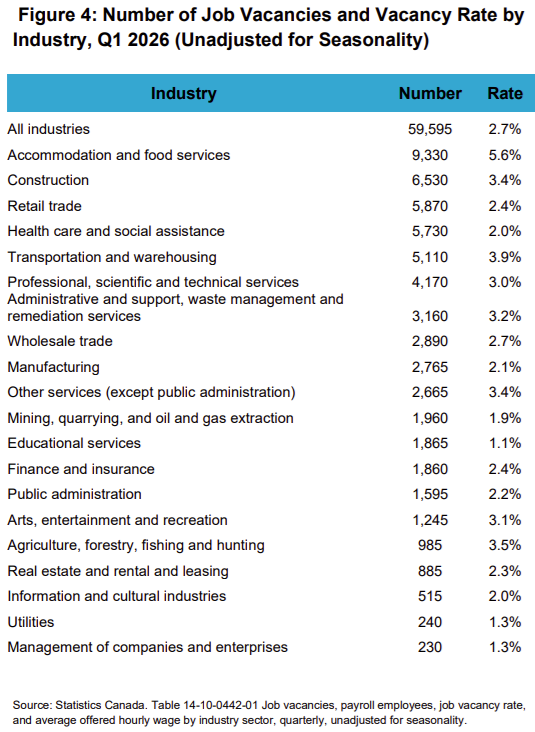
The latest Alberta Job Vacancy Report, for January to March 2026 (Q1 2026), has been published.

‘Job vacancy rate’ (JVR) refers to the rate of job vacancies or vacant positions on the last business day of the month based on labour demand (occupied positions and vacant positions).

Alberta’s JVR in Q1 2026 was 2.9 per cent, a tick higher than the 2.8 per cent rate from the quarter prior.

In all, Alberta employers were seeking to fill 64,140 vacant positions, which is 4.7 per cent higher than the previous quarter.

The national average was 2.8 per cent.

Across Alberta

  • Calgary economic region: 2.8%
  • Edmonton economic region: 2.8%
  • Red Deer: 2.7% (lowest in province)
  • Banff-Jasper-Rocky Mountain House: 4.0%
  • Athabasca-Grande Prairie-Peace River: 4.0%
  • Lethbridge-Medicine Hat: 3.3%

The Government of Alberta notes most industries reported higher job vacancies in Q1 2026 compared with Q1 2025.


The full report can be found here.

Meanwhile, the province has also shared sub-regional numbers for April employment and unemployment.

Key highlights include (*all unemployment rates in this report are presented as a three-month moving average):

  • Unemployment rates decreased year-over-year in nine of 17 regions compared to April 2025.
  • Wood Buffalo recorded the highest unemployment rate in the province at 8.9 per cent, as well as Alberta’s largest year-over-year increase in unemployment rate (+2.1 percentage points).
  • Camrose and High   River had the lowest unemployment rates in the province at 6.1 per cent.
  • In April 2026, employment grew in eight of 17 regions in Alberta compared to April 2025.
  • Calgary had the largest year-over-year employment growth (+7.2 per cent), followed by High River (+3.9 per cent).
  • Lloydminster (Alberta side) had the largest year-over-year employment decline, decreasing by 10.3 per cent.