Follow our top 10 countdown of the most memorable stories of the last decade, as reported by rdnewsNOW!
Sponsored

Market Watch — July 3, 2026

Jul 4, 2026 | 10:44 AM

This week’s highlights

  • Equity markets broadly positive amid short trading week for North America
  • Bond markets lag as economic activity and moderating inflation encourage risk appetite
  • Canada’s GDP rebounds while manufacturing remains in expansion mode
  • Softer U.S. job gains ease pressure on U.S. Federal Reserve
  • Eurozone inflation eases as labour market remains resilient

Week in review

Equity markets broadly positive amid short trading week for North America

U.S. equities advanced early in the holiday-shortened week as easing oil prices, resilient manufacturing activity and improving risk sentiment supported markets. Attention later shifted to labour market data and Federal Reserve (Fed) commentary, where softer-than-expected job gains weighed on growth expectations and led to some intraday pressure. However, markets ultimately finished the week higher as investors scaled back expectations for a near-term Fed rate hike and looked through a significant pullback in semiconductor stocks.

Canadian equities were largely range-bound through much of the week, also shortened by holiday, as investors balanced ongoing trade uncertainty, fluctuating commodity prices and questions surrounding the domestic growth outlook. Following the Canada Day closure, markets moved higher as stronger-than-expected GDP data and improving manufacturing activity reinforced confidence in the resilience of the Canadian economy, while lower bond yields supported rate-sensitive sectors. Investor sentiment was further aided by renewed momentum behind nation-building infrastructure projects, including plans for a new West Coast oil pipeline, which provided additional support to energy and resource shares.

European equities advanced over the week as moderating eurozone inflation, resilient manufacturing activity and supportive commentary from policymakers at the European Central Bank’s (ECB’s) annual forum reinforced confidence in the region’s economic outlook. Gains strengthened later in the period as incoming data pointed to continued economic resilience, while easing concerns around energy markets and a constructive risk backdrop supported cyclical sectors.

In China and emerging markets, equities were mixed through much of the week as investors balanced trade and geopolitical developments against signs of improving economic momentum. Sentiment strengthened later in the period as Purchasing Manager Index (PMI) data pointed to resilient activity and technology shares recovered, while firmer domestic conditions in China supported regional markets. Gains were tempered by lingering trade and semiconductor-related uncertainties.

Highlights:

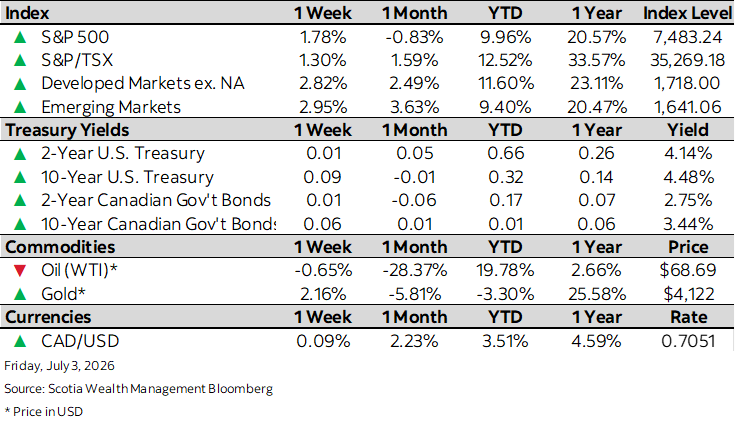
  • U.S. equities returned 1.78%1, as investors were encouraged by easing energy prices and evidence of continued economic expansion, though enthusiasm moderated later in the week following softer labour-market data and renewed scrutiny of Federal Reserve policy signals.
  • Canadian equities returned 1.30%2 after being range-bound for much of the week and then moving higher following the Canada Day holiday, supported by stronger GDP and manufacturing data, lower yields and optimism around new infrastructure projects.
  • European stocks returned 2.82%3 as cooling inflation and resilient economic activity reinforced confidence in the region’s outlook, while supportive ECB commentary and easing energy concerns further lifted sentiment.
  • Chinese and emerging markets declined 2.95%, strengthening later into the week as PMI data indicated resilient activity and technology shares rebounded, although trade and semiconductor-related uncertainties remained a headwind.

Bond markets lag as economic activity and moderating inflation encourage risk appetite

Treasury markets remained under pressure throughout the week as improving risk sentiment, easing concerns around energy markets and economic data that generally pointed to a resilient economy. While softer-than-expected U.S. labour market data provided some support to bonds later in the week, investors continued to balance signs of moderating growth against a policy backdrop focused on inflation and price stability following commentary from Fed Chair Kevin Warsh. Canadian bond yields moved higher alongside global rate markets as stronger-than-expected GDP and manufacturing data also reinforced confidence in the domestic economy. In Europe, sovereign yields also trended higher despite softer inflation readings, as resilient economic activity and expectations for a still-restrictive ECB policy stance limited demand for duration.

Highlights:

  • The 2- and 10-year U.S. Treasury yields were up 1 basis point (bps) and 9 bps, respectively. In Canada, the 2- and 10-year yields were up 1 bps and 6 bps, respectively. Bond yields and prices move inversely to one another.
  • Sovereign yields generally moved higher over the week as resilient economic data and reduced recession concerns outweighed the supportive impact of softer U.S. employment data and moderating Eurozone inflation.
  • Credit markets remained supported by firm risk appetite, stable corporate fundamentals and improving macro sentiment, allowing spreads to remain relatively contained despite higher government bond yields.

Weekly dashboard


Canada’s GDP rebounds while manufacturing remains in expansion mode

Canada’s economic data offered a cautiously constructive signal heading into the second half of the year. April GDP exceeded expectations and followed a weak first quarter, indicating a rebound in economic activity for the month and pulling the country out of technical recession. Growth was broad-based across several sectors despite ongoing trade uncertainty related to tariffs and Canadian-United States-Mexico Agreement (CUSMA) negotiations. At the same time, the June PMI pointed to improving operating conditions in the factory sector, with activity remaining in expansion territory. However, the survey also highlighted that manufacturers continue to navigate tariff-related uncertainty, supply-chain disruptions and elevated cost pressures.

Highlights:

  • April GDP rose 0.5% month over month, exceeding preliminary estimates of 0.4% and marking the strongest monthly increase since July 2025. Growth was broad-based, with 14 of 20 industries expanding during the month.
  • The S&P Global Canada Manufacturing PMI edged up to 53.0 in June from 52.9 in May, remaining above the 50-expansion threshold for a third consecutive month. Output, new orders, employment and purchasing activity all increased.
  • Despite stronger activity, manufacturers reported ongoing challenges. Input-cost inflation accelerated to its highest level since July 2022, while supplier delivery times lengthened to the greatest extent since September 2022, reflecting continued supply-chain disruption and tariff-related pressures.

Softer U.S. job gains ease pressure on U.S. Federal Reserve

U.S. labour market data for June showed a loss of momentum, with non-farm payrolls increasing just 57k, below expectations, and prior months revised lower. While the unemployment rate declined unexpectedly to 4.2%, the move was driven by a sharp drop in labour force participation rather than stronger hiring, making the headline improvement less constructive. Even though a lower unemployment rate could fuel a policy tightening, the illusory data, particularly related to the ease of the unemployment rate, reduces the pressure and urgency for additional Fed tightening.

Highlights:

  • April GDP rose 0.5% month over month, exceeding preliminary estimates of 0.4% and marking the strongest monthly increase since July 2025. Growth was broad-based, with 14 of 20 industries expanding during the month.
  • The S&P Global Canada Manufacturing PMI edged up to 53.0 in June from 52.9 in May, remaining above the 50-expansion threshold for a third consecutive month. Output, new orders, employment and purchasing activity all increased.
  • Despite stronger activity, manufacturers reported ongoing challenges. Input-cost inflation accelerated to its highest level since July 2022, while supplier delivery times lengthened to the greatest extent since September 2022, reflecting continued supply-chain disruption and tariff-related pressures.

Eurozone inflation eases as labour market remains resilient
Eurozone economic data was broadly supportive during the week, reinforcing confidence that inflation pressures are gradually easing while the labour market remains resilient. The June flash inflation report showed a continued moderation in price growth across key categories, helping to alleviate concerns about persistent inflationary pressures. At the same time, stable employment conditions suggested underlying economic activity remains on reasonably solid footing despite pockets of slower growth.

Highlights:

  • April GDP rose 0.5% month over month, exceeding preliminary estimates of 0.4% and marking the strongest monthly increase since July 2025. Growth was broad-based, with 14 of 20 industries expanding during the month.
  • The S&P Global Canada Manufacturing PMI edged up to 53.0 in June from 52.9 in May, remaining above the 50-expansion threshold for a third consecutive month. Output, new orders, employment and purchasing activity all increased.
  • Despite stronger activity, manufacturers reported ongoing challenges. Input-cost inflation accelerated to its highest level since July 2022, while supplier delivery times lengthened to the greatest extent since September 2022, reflecting continued supply-chain disruption and tariff-related pressures.
  • 1  S&P 500 Index USD
  • 2 S&P/TSX Composite Index USD
  • 3 Bloomberg Developed Markets ex N. America Large & Mid Cap Price Return Index USD
  • 4 Bloomberg EM Large & Mid Cap Price Return Index USD

Disclaimer

This publication has been prepared by The Bank of Nova Scotia for Scotia Wealth Management clients. It is for general information purposes only and should not be considered or relied upon as personal and/or specific financial, tax, pension, insurance, legal or investment advice. We are not tax or legal advisors, and we recommend that individuals consult with their qualified advisors, including tax and legal advisors, before taking any action based upon the information contained in this publication. The opinions and projections contained in this publication are our own as of the date hereof and are subject to change without notice. Scotia Wealth Management is under no obligation to update this publication, and readers should assume the information contained herein will not be updated. While care and attention has been taken to ensure the accuracy and reliability of the material in this publication, neither The Bank of Nova Scotia nor any of its affiliates or any of their respective directors, officers or employees make any representations or warranties, express or implied, as to the accuracy or completeness of such material and disclaim any liability resulting from any direct or consequential loss arising from any use of this publication or the information contained herein. This publication may contain forward-looking statements based on current expectations and projections about future general economic factors. Forward-looking statements are subject to inherent risks and uncertainties which may be unforeseeable and such expectations and projections may be incorrect in the future. Forward-looking statements are not guarantees of future performance and you should avoid placing undue reliance upon them. This publication and all the information, opinions and conclusions contained herein are protected by copyright. This publication may not be reproduced in whole or in part without the prior express consent of The Bank of Nova Scotia. To the extent this document contains information or data obtained from third party sources, it is believed to be accurate and reliable as of the date of publication, but Scotia Wealth Management does not guarantee its accuracy or reliability.

® Registered trademark of The Bank of Nova Scotia, used under licence (where applicable). ™ Trademark of The Bank of Nova Scotia, used under licence (where applicable). Scotia Wealth Management® consists of a range of financial services provided by The Bank of Nova Scotia (Scotiabank®); The Bank of Nova Scotia Trust Company (Scotiatrust®); Scotia Jarislowsky Fraser, a service of 1832 Asset Management L.P.; 1832 Asset Management U.S. Inc.; Scotia Wealth Insurance Services Inc.; and ScotiaMcLeod®, a division of Scotia Capital Inc. Private banking services are provided by The Bank of Nova Scotia. Estate and trust services are provided by The Bank of Nova Scotia Trust Company. Portfolio management is provided by 1832 Asset Management L.P. and 1832 Asset Management U.S. Inc. Insurance services are provided by Scotia Wealth Insurance Services Inc. Wealth advisory and brokerage services are provided by ScotiaMcLeod, a division of Scotia Capital Inc. International investment advisory services are provided by Scotia Capital Inc. Financial planning services are provided by The Bank of Nova Scotia and ScotiaMcLeod. Scotia Capital Inc. is a member of the Canadian Investor Protection Fund and is regulated by the Canadian Investment Regulatory Organization. Scotia Wealth Insurance Services Inc. is the insurance subsidiary of Scotia Capital Inc., a member of the Scotiabank group of companies. When discussing life insurance products, ScotiaMcLeod advisors are acting as Life Insurance Agents (Financial Security Advisors in Quebec) representing Scotia Wealth Insurance Services Inc.

Scotia Wealth Management® in The Bahamas consists of a range of financial services provided by Scotiabank (Bahamas) Limited and The Bank of Nova Scotia Trust Company (Bahamas) Limited, which are entities licensed to operate within The Bahamas. International private banking and international investment advisory services are provided by Scotiabank (Bahamas) Limited. International wealth structuring solutions are provided by The Bank of Nova Scotia Trust Company (Bahamas) Limited. ® Registered trademark of The Bank of Nova Scotia, used under licence.

Scotia Wealth Management® in the Cayman Islands consists of a range of financial services provided by Scotiabank & Trust (Cayman) Ltd. International private banking services, international investment advisory services, and international wealth structuring solutions are provided by Scotiabank & Trust (Cayman) Ltd., an entity licensed by the Cayman Islands Monetary Authority. ® Registered trademark of The Bank of Nova Scotia, used under license.

Scotia Wealth Management® in Jamaica consists of a range of Private Banking services provided by the Scotiabank Group of companies (Scotiabank®). ®Registered trademark of The Bank of Nova Scotia, used under licence.