Sign up for our free daily newsletter!
(Image Credit: Scotia Wealth Management)
sponsored

Market Watch — June 12, 2026

Jun 15, 2026 | 9:13 AM

A summary of the week’s important events and how they could impact the market.

This week’s highlights

  • Choppy week as inflation, geopolitics and AI trends collide
  • Rates reprice on energy-driven inflation and policy outlooks before stabilizing
  • Bank of Canada holds rate steady as it weighs weak growth against inflation risks
  • Rising U.S. consumer prices increase odds of a Fed rate hike
  • European Central Bank delivers first rate hike in nearly three years

Week in review

Choppy week as inflation, geopolitics and AI trends collide

As has been usual of late, U.S. equities began the week with a constructive tone as AI-driven strength and easing yields supported technology shares, even as rising oil prices from Middle East tensions kept inflation risks in focus. A brief relief rally on diplomacy hopes gave way midweek as renewed U.S.-Iran escalation and firm Consumer Price Index (CPI) and Producer Price Index (PPI) prints pressured sentiment, before equities stabilized and ultimately rebounded on signs of a pending U.S.-Iran deal, which pushed oil lower and eased inflation concerns; mega-cap IPO activity, including the high-profile SpaceX listing, also remained a focal point for market attention. Canadian equities followed a similar path, supported early by energy strength, before choppier oil prices and rising yields drove midweek volatility amid heightened inflation concerns. Sentiment improved through Friday as crude declined on peace prospects, helping stabilize the macro backdrop.

European equities were mixed early amid geopolitical uncertainty, briefly rallied on improving sentiment, then softened as conflict escalated and the European Central Bank (ECB) delivered a rate hike against a fragile growth backdrop. Markets rebounded into Friday as lower oil prices eased inflation pressures. Chinese and broader emerging market equities weakened early on risk aversion, rebounded with improving sentiment and tech strength, then faced renewed pressure midweek before advancing into week-end as easing oil prices and stronger global risk appetite supported flows.

Highlights:

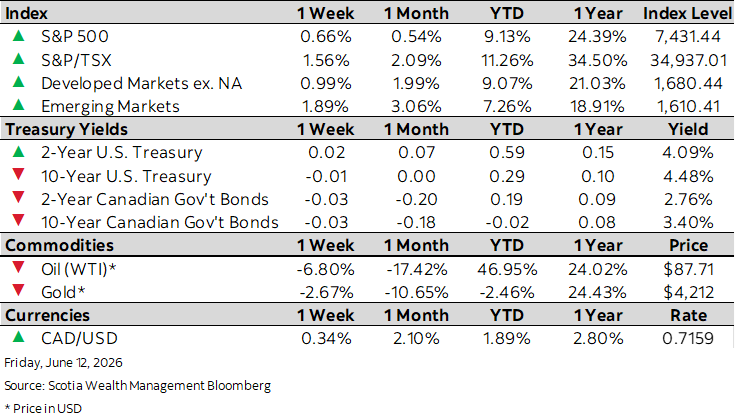
  • U.S. equities returned 0.66%1, driven by early strength in AI-linked large caps and falling yields, before midweek geopolitical escalation and firm inflation data weighed on sentiment, with a late-week rebound supported by easing oil prices and strong focus on a major IPO.
  • Canadian equities returned 1.56%2 supported by firm energy exposure, but volatility in crude prices and rising yields created midweek pressure, with improving sentiment into Friday as oil declined and broader inflation concerns eased.
  • European stocks returned 0.99%3, shaped by geopolitical risks and tightening policy, with the ECB’s rate hike and growth concerns weighing midweek before a recovery into week-end on falling energy prices.
  • Emerging markets advanced 1.89%4, reflecting swings in global risk appetite, weakening early on geopolitical tensions, recovering with improved sentiment and tech strength, then finishing stronger as oil prices fell and capital rotated back into risk assets.

Rates reprice on energy-driven inflation and policy outlooks before stabilizing

U.S. Treasuries began the week with modest gains as yields edged lower amid risk aversion tied to Middle East tensions, before a midweek reversal as renewed escalation and firm CPI and PPI data reinforced persistent inflation pressures and limited the scope for near-term monetary policy easing. Canadian rates largely mirrored U.S. moves, with yields initially declining before drifting higher into the Bank of Canada (BoC) decision, which delivered a hold and reinforced a patient policy stance. In Europe, sovereign bonds were volatile around the ECB’s rate hike, with yields rising midweek on tightening expectations before declining after ECB guidance signalled a likely July hold, reinforcing a broader rally driven by easing Middle East tensions and improving inflation expectations.

Highlights:

  • The 2- and 10-year U.S. Treasury yields were up 2 basis points (bps) and down 1 bps, respectively. In Canada, the 2- and 10-year yields were both down 3 bps. Bond yields and prices move inversely to one another.
  • Sovereign bond markets were shaped by early flight-to-quality demand and falling yields, before reversing midweek as geopolitical escalation and firmer inflation data pushed yields higher, with a late-week rally supported by easing oil prices.
  • Corporate credit conditions tightened modestly as inflation and rate volatility weighed on spreads midweek, though selective issuance, including large AI-linked funding activity, highlighted resilient demand despite a more cautious backdrop.

Weekly dashboard


Bank of Canada holds rate steady as it weighs weak growth against inflation risks

The Bank of Canada (BoC) left its policy rate unchanged at 2.25%, with Governor Tiff Macklem saying holding rates steady was the best way to balance the competing risks of a weak economy and higher inflation stemming from elevated energy prices. “For now, holding the policy rate unchanged balances those risks,” Macklem said, as the central bank maintained its wait-and-see stance for a fifth straight meeting. The central bank expects inflation to hover around 3% in the coming months, near the upper end of its 1% to 3% target range, largely due to elevated oil prices. Macklem indicated that while policymakers project a second-quarter growth rebound, spare economic capacity will continue to linger.

Highlights:

  • The decision reflects the BoC’s increasingly cautious approach as Canada’s economy remains soft. First-quarter gross domestic product (GDP) fell at a 0.1% annualized pace, marking the second consecutive quarterly contraction, although the bank expects growth to return in Q2.
  • Elevated energy prices are complicating the inflation outlook. The bank expects headline inflation to run near the top of its target range in the near term, though Macklem noted there is little evidence so far that higher oil prices are feeding more broadly into the prices of other goods and services.
  • Macklem said rate cuts could be considered if new U.S. trade measures hurt growth, while rate hikes remain possible if prolonged geopolitical tensions keep energy prices high and lift longer-term inflation expectations.

Rising U.S. consumer prices increase odds of a Fed rate hike

May U.S. Consumer Price Index (CPI) showed inflation moving higher again, but the details were less concerning for markets than the headline suggested. Consumer prices rose 4.2% year-over-year (YoY) and 0.5% month-over-month, largely reflecting another sharp increase in energy costs, while core inflation came in softer at 0.2% on the month. The composition of the release points to continued divergence between energy-driven volatility in the headline measure and more moderate underlying core pressures. Inflation pressures do not yet appear broad enough to force a major rethink on the U.S. Federal Reserve path, but markets responded accordingly, with Treasury yields edging lower after the release and expectations for additional tightening by year-end remaining relatively limited.

Highlights:

  • Headline CPI rose to 4.2% YoY in May, the highest level since April 2023, but the monthly increase matched expectations.
  • Energy was the main driver of the pickup in headline inflation, with gasoline prices accelerating sharply and accounting for nearly all of the increase from April to May.
  • Outside energy, food inflation edged lower but remained above target-like levels, core goods stayed flat, and services inflation ticked up modestly, helped by shelter and firmer services ex-housing and energy.

European Central Bank delivers first rate hike in nearly three years
The European Central Bank (ECB) raised interest rates this week, marking its first increase in nearly three years as policymakers moved to counter a renewed surge in inflation across the eurozone. The widely anticipated quarter‑point hike lifts the bank’s key deposit rate to 2.25%, reversing a period of policy easing that had been in place through much of 2025. The decision follows a steady pickup in price pressures in recent months, with eurozone inflation rising to around 3.2% in May, well above the ECB’s 2% target. Energy costs have been the primary driver, climbing sharply amid ongoing geopolitical tensions in the Middle East and disruptions to global oil supply.

Highlights:

  • In a statement, the ECB said the move was necessary to ensure inflation returns to target over the medium term, emphasizing that the current environment carries both upside risks to prices and downside risks to growth.
  • The rate increase comes at a delicate moment for the eurozone economy, which has shown signs of slowing even as price pressures persist. Recent data indicate contracting output alongside resilient labour markets, underscoring the challenge facing policymakers.
  • ECB President Christine Lagarde signalled that future decisions will remain data dependent, with no firm commitment on the path of rates. For now, however, the central bank has made clear that containing inflation remains its top priority.