Sign up for our free daily newsletter!
sponsored

Market Watch — May 22, 2026

May 22, 2026 | 5:26 PM

This week’s highlights

  • Markets inch higher amid backdrop of geopolitical uncertainty
  • Global rates hold steady amid eventful week
  • Canadian inflation increases in April driven primarily by energy price; underlying inflation measures moderate
  • Geopolitics continues to weigh on U.S. business optimism
  • Geopolitics also weighs on business optimism internationally

Week in review

Markets inch higher amid backdrop of geopolitical uncertainty

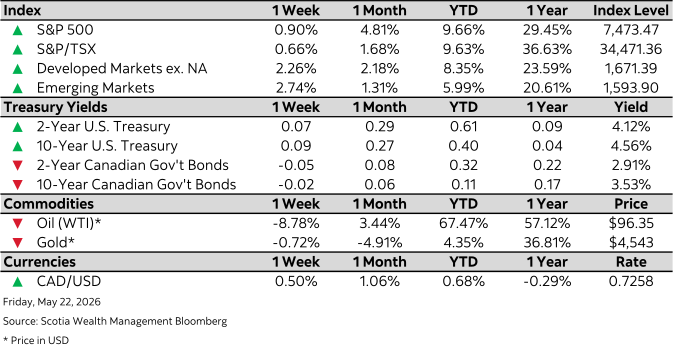
Global markets moved higher this week as geopolitics provided plenty of headlines but little news on forward momentum toward a concrete resolution to the conflict in the Middle East. While declining energy prices offered equity markets some reprieve, markets continue to digest the realities of elevated energy price.

In the U.S., markets were positive but remain headline sensitive. S&P’s Global Purchasing Managers Index (PMI) showed overall growth for the U.S. economy, however readings are pointing to a roughly 1% increase in 2Q GDP. At the company level, both Walmart and Home Depot reiterated their financial forecasts for the rest of the year, however, added caution around cost pressures on consumers due to higher costs at the pump.

We saw a similar story in Canada as the TSX was able to turn positive for the week, shaking off a mixed inflation report and retrenched sentiment around rate hikes to end the year. While inflation came in at 2.8% annualized, core inflation measures more favored by the Bank of Canada (BoC) continued their decline.

International markets followed their western hemisphere counterparts despite less than ideal economic and sentiment data. PMI Indices in Europe were less than enthusiastic while inflation began to show the effects of increased energy costs. Chinese markets were the one outlier posting a modest decline for the week.

Highlights:

  • U.S. equities returned 0.90%1, despite a decline in NVIDIA and Google. Strength in healthcare, banking, Apple, and select chip manufactures were able to help continue the indices upward momentum.
  • Canadian equities returned 0.66%2, led primarily by the banking sector as Canadian inflation offered the market more insight into the direction of interest rates.
  • Developed markets ex/ North America returned 2.26%3, buoyed by a similar rise in bank stocks and a large increase in ASML.
  • Emerging markets increased 2.74%4, despite China and Hong Kong seeing a more broad based selloff with industrial output for April missing market expectations by 1.7%

Global rates hold steady amid eventful week

Sovereign bond markets experienced a bit of a ride this week, beginning the week with a rise in rates as the U.S. 30 year bond hitting its highest levels since 2007. Throughout the week however, sentiment changed throughout the week as bond yields steadily declined, eventually settling broadly in line with where they ended last week. FOMC minutes released on Thursday pointed to a shift in tone toward a tightening bias while European rates were primarily influenced this week by lower than expected PMI readings.

Highlights:

  • The 2- and 10-year U.S. Treasury yields were up 7 basis points (bps) and 9 bps, respectively. In Canada, the 2- and 10-year yields were down 5 bps and 2 bps. Bond yields and prices move inversely to one another.
  • Fixed income markets continue to be at the mercy of geopolitical headlines offering little clarity to global central bankers weighing the effects and duration of high energy prices and potential economic softening.
  • Investment grade and high yield credit mirrored their sovereign counterparts throughout the week, reflecting moves in sentiment to the direction of central bank rates.

Weekly dashboard


Canadian inflation increases in April driven primarily by energy price; underlying inflation measures moderate

In Canada, recent data continues to suggest inflation pressures concentrate in energy, while broader price dynamics appear more contained, with consumer prices rising 2.8% year-over year. Core inflation measures have moderated on both a monthly and annual basis, and key components such as rent are showing slower growth than in prior periods. This suggests that, despite elevated headline figures, underlying inflation momentum is easing. The key focus for policymakers will likely remain on whether energy-related price increases begin to broaden into more persistent, economy-wide pressures.

While market expectations for rate increases over the course of 2026 have increased slightly, the April CPI data does not call for urgent action from the BoC. As a reminder, the BoC chose to hold its policy rate unchanged at its April meeting, looking past pressure on energy prices. However, it should be noted the BoC has stated it remains nimble and will be keeping a close eye on the extent to which higher energy prices influence broader prices in the coming months. The next BoC meeting is scheduled for June 10, 2026.

Highlights:

  • Energy prices rose 19.2% YoY, while gasoline prices jumped 28.6%. Outside of energy prices, inflationary pressures seem to remain contained for now.
  • Rent, which was a major driver of inflation post-covid, increased by 3.5%, its lowest since January 2022.
  • On a month-over-month basis (MoM), headline CPI decelerated to 0.4% from 0.9% previously, three-tenths below the median consensus estimate and reinforcing signs of soft inflation.

Geopolitics continues to weigh on U.S. business optimism

Business optimism in the U.S. has held steady in May, with the S&P Global U.S. Purchasing Managers Index (PMI) holding steady at 51.7. While still signaling growth, this is the third consecutive month in which optimism is subdued due to uncertainty around energy prices as a result of the conflict in the Middle East. Early indicators point to a roughly 1% annualized rate in GDP growth for the U.S. in 2Q, a noticeable downturn in growth in comparison to previous quarters.

Highlights:

  • The downturn in sentiment has been driven primarily by the services sector. While still signaling expansion, services PMI levels are now at their lowest since 2023.
  • Manufacturing continues to be a bright spot, rising at its fastest rate in over four years; however, concerns surround the sustainability of this optimism as order book growth appears to be primarily driven by domestic stockpiling.
  • Survey results show input prices rising to their highest level in years. Upcoming data points will be critical as the U.S. Federal Reserve looks to balance its dual mandate of price stability and maximum employment amid the backdrop of rising prices and a softening economy.

Geopolitics also weighs on business optimism internationally
Globally, readings from the S&P Purchasing Managers Index (PMI) are also pointing to dampening business optimism as geopolitical challenges begin to weigh on supply chains.

In the Eurozone, composite PMI dipped to 47.5, failing to live up to the median consensus estimate of 48.8. Both of the underlying manufacturing and services gauges missed estimates, with the latter being the driving force behind the sub-50 reading (readings below 50 signify a contraction). The U.K. tells a slightly different story, mirroring the U.S., as manufacturing continues to be a bright spot, but overshadowed by a steep downturn in optimism from the services sector.

Across Asia, Japanese business optimism remained stable, while India continues to be the outlier with a continuation of strong, positive business sentiment.

Highlights:

  • In Europe, as per S&P Global, the survey data impliesy the economy is tracking a 0.2% contraction for 2Q, and that with inflation potentially could running close to 4% in the coming months.
  • Like the Eurozone, S&P Global projects the U.K. economy will contract by 0.2% in 2Q.
  • Both the European Central Bank (ECB) and the Bank of England (BoE) find themselves in a similar spot to their central banking counterparts: balancing price increase pressures as a result of the conflict in the Middle East with early indicators of an economy that is slowing. Scotiabank Economics is projecting two rate increases for both the ECB and BoE through the end of 2026.

1  S&P 500 Index USD

2 S&P/TSX Composite Index USD

3 Bloomberg Developed Markets ex N. America Large & Mid Cap Price Return Index USD

4 Bloomberg EM Large & Mid Cap Price Return Index USD

This publication has been prepared by The Bank of Nova Scotia for Scotia Wealth Management clients. It is for general information purposes only and should not be considered or relied upon as personal and/or specific financial, tax, pension, insurance, legal or investment advice. We are not tax or legal advisors, and we recommend that individuals consult with their qualified advisors, including tax and legal advisors, before taking any action based upon the information contained in this publication. The opinions and projections contained in this publication are our own as of the date hereof and are subject to change without notice. Scotia Wealth Management is under no obligation to update this publication, and readers should assume the information contained herein will not be updated. While care and attention has been taken to ensure the accuracy and reliability of the material in this publication, neither The Bank of Nova Scotia nor any of its affiliates or any of their respective directors, officers or employees make any representations or warranties, express or implied, as to the accuracy or completeness of such material and disclaim any liability resulting from any direct or consequential loss arising from any use of this publication or the information contained herein. This publication may contain forward-looking statements based on current expectations and projections about future general economic factors. Forward-looking statements are subject to inherent risks and uncertainties which may be unforeseeable and such expectations and projections may be incorrect in the future. Forward-looking statements are not guarantees of future performance and you should avoid placing undue reliance upon them. This publication and all the information, opinions and conclusions contained herein are protected by copyright. This publication may not be reproduced in whole or in part without the prior express consent of The Bank of Nova Scotia. To the extent this document contains information or data obtained from third party sources, it is believed to be accurate and reliable as of the date of publication, but Scotia Wealth Management does not guarantee its accuracy or reliability.

® Registered trademark of The Bank of Nova Scotia, used under licence (where applicable). ™ Trademark of The Bank of Nova Scotia, used under licence (where applicable). Scotia Wealth Management® consists of a range of financial services provided by The Bank of Nova Scotia (Scotiabank®); The Bank of Nova Scotia Trust Company (Scotiatrust®); Scotia Jarislowsky Fraser, a service of 1832 Asset Management L.P.; 1832 Asset Management U.S. Inc.; Scotia Wealth Insurance Services Inc.; and ScotiaMcLeod®, a division of Scotia Capital Inc. Private banking services are provided by The Bank of Nova Scotia. Estate and trust services are provided by The Bank of Nova Scotia Trust Company. Portfolio management is provided by 1832 Asset Management L.P. and 1832 Asset Management U.S. Inc. Insurance services are provided by Scotia Wealth Insurance Services Inc. Wealth advisory and brokerage services are provided by ScotiaMcLeod, a division of Scotia Capital Inc. International investment advisory services are provided by Scotia Capital Inc. Financial planning services are provided by The Bank of Nova Scotia and ScotiaMcLeod. Scotia Capital Inc. is a member of the Canadian Investor Protection Fund and is regulated by the Canadian Investment Regulatory Organization. Scotia Wealth Insurance Services Inc. is the insurance subsidiary of Scotia Capital Inc., a member of the Scotiabank group of companies. When discussing life insurance products, ScotiaMcLeod advisors are acting as Life Insurance Agents (Financial Security Advisors in Quebec) representing Scotia Wealth Insurance Services Inc.

Scotia Wealth Management® in The Bahamas consists of a range of financial services provided by Scotiabank (Bahamas) Limited and The Bank of Nova Scotia Trust Company (Bahamas) Limited, which are entities licensed to operate within The Bahamas. International private banking and international investment advisory services are provided by Scotiabank (Bahamas) Limited. International wealth structuring solutions are provided by The Bank of Nova Scotia Trust Company (Bahamas) Limited. ® Registered trademark of The Bank of Nova Scotia, used under licence.

Scotia Wealth Management® in the Cayman Islands consists of a range of financial services provided by Scotiabank & Trust (Cayman) Ltd. International private banking services, international investment advisory services, and international wealth structuring solutions are provided by Scotiabank & Trust (Cayman) Ltd., an entity licensed by the Cayman Islands Monetary Authority. ® Registered trademark of The Bank of Nova Scotia, used under license.

Scotia Wealth Management® in Jamaica consists of a range of Private Banking services provided by the Scotiabank Group of companies (Scotiabank®). ®Registered trademark of The Bank of Nova Scotia, used under licence.