Subscribe to the 100% free rdnewsNOW daily newsletter!
Sponsored

Market Watch — May 1, 2026

May 1, 2026 | 4:11 PM

This week’s highlights

  • Investors regain risk appetite on surging tech earnings
  • Fixed income volatility driven by cautious policy guidance amid energy shock
  • BoC holds rate at 2.25%, but warns of energy and trade risks
  • U.S. Fed puts hold on rates while other data signals inflation pressures and economic growth
  • Eurozone inflation accelerates, driven by surging energy prices

Week in review

Investors regain risk appetite on surging tech earnings

Equity markets began the week cautiously as investors weighed escalating Middle East tensions, surging oil prices and a dense slate of central bank decisions, with sentiment strengthening mid‑week amid strong yet uneven megacap technology earnings and renewed inflation concerns that have yet to fully be reflected in trailing data. U.S. equities were unsettled ahead of the Federal Open Market Committee (FOMC) meeting and interest rate decision, as rising energy prices and mixed signals from AI‑linked names tested risk appetite, before strong results from Alphabet, Amazon and Apple helped markets recover and finish the week modestly higher. Canadian equities largely mirrored global moves, pressured early by energy‑driven inflation risks and cautious Bank of Canada (BoC) messaging, but later found support from higher commodity prices and firmer domestic growth data. Trade uncertainty continues to ebb and flow as Canada-United States-Mexico Agreement (CUSMA) renegotiations approach, with early signals beginning to shape investor expectations. European markets swung on divergent bank and industrial earnings alongside stubborn inflation prints, before rebounding after the European Central Bank (ECB) held rates despite expectations for higher inflation. Chinese equities were range‑bound early in the week, rallied mid‑week as risk appetite improved, then went back to trading sideways late-week as oil‑driven inflation concerns re‑emerged amid tight supply conditions and expectations for rising fuel exports as Beijing eases export limits.

Highlights:

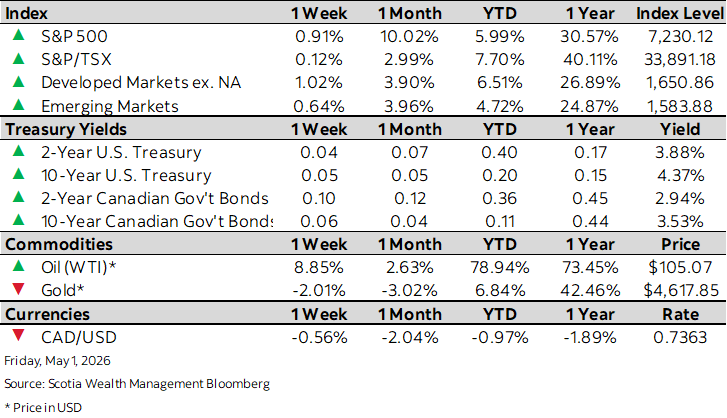
  • U.S. equities returned 0.91%1, shaped by pre‑FOMC uncertainty, higher energy costs and uneven signals from AI‑linked companies, before strong megacap earnings later in the week helped restore confidence and support a modest recovery.
  • Canadian equities returned 0.12%2 following global risk trends, initially constrained by energy‑driven inflation concerns and cautious BoC communication, then supported by firmer commodity prices, improving domestic growth signals and growing attention on upcoming CUSMA negotiations.
  • European stocks returned 1.02%3 as mixed bank and industrial earnings intersected with renewed inflation pressures, stabilizing later in the week after the ECB held policy steady despite markets adjusting to a higher‑inflation outlook.
  • Emerging markets rose 0.64%4, with mid‑week gains driven by improved risk appetite later giving way to renewed caution as oil‑related inflation risks resurfaced and fuel supply dynamics remained in focus.

Fixed income volatility driven by cautious policy guidance amid energy shock

Fixed income markets navigated a volatile week dominated by energy‑driven inflation risks, heavy central bank messaging and shifting policy expectations. U.S. Treasuries faced early upward pressure on yields as oil prices surged and investors braced for the FOMC announcement, before stabilizing after they held rates steady and underscored heightened uncertainty and emphasized flexibility rather than clear forward guidance. Canadian bonds generally followed U.S. rate moves, with the Bank of Canada’s hold accompanied by guidance that highlighted upside inflation risks from energy alongside potential downside growth risks linked to trade policy, helping anchor market expectations despite firmer data. In Europe, sovereign yields initially rose as inflation prints reinforced restrictive policy assumptions, then retraced after the ECB and Bank of England (BoE) maintained policy rates and leaned into data‑ and risk‑dependence. In Asia, Japanese rates moved higher following a Bank of Japan (BoJ) hold that highlighted oil‑related inflation risks alongside weaker growth projections.

Highlights:

  • The 2- and 10-year U.S. Treasury yields were up 4 basis points (bps) and 5 bps, respectively. In Canada, the 2- and 10-year yields were up 10 bps and 6 bps, respectively. Bond yields and prices move inversely to one another.
  • Global sovereign markets were dominated by energy‑driven inflation fears, cautious central bank holds and uneven growth signals, producing choppy trading as curves repriced policy path optionality rather than imminent easing.
  • Credit markets proved resilient, with investment‑grade spreads supported by strong earnings and stable funding conditions, while high yield weathered energy‑price volatility and policy uncertainty without signs of material stress.

Weekly dashboard


BoC holds rate at 2.25%, but warns of energy and trade risks

The Bank of Canada (BoC) held its benchmark interest rate steady this week but warned that interest rates may need to change depending on the duration of the oil price shock and the outcome of trade talks with the United States and Mexico. As widely expected, the bank’s governing council kept its policy rate at 2.25% for the fourth consecutive time, even as the conflict in the Middle East has pushed energy prices sharply higher and squeezed Canadian consumers at the gas pump.

Highlights:

  • Governor Tiff Macklem said his team decided to “look through” the energy price shock in the near term. But he said the trajectory of monetary policy will depend to a significant degree on how long oil prices remain elevated.
  • The bank is also considering a scenario where oil prices remain elevated and starts bleeding into other consumer prices, becoming generalized inflation. “If this starts to happen, monetary policy will have more work to do – there may be a need for consecutive increases in the policy rate,” Macklem warned.
  • The BoC also highlighted the review of the United States-Mexico-Canada trade agreement as another source of uncertainty for the Canadian economy and for monetary policy “If the United States imposes significant new trade restrictions on Canada, we may need to cut the policy rate further to support economic growth,” Macklem said.

U.S. Fed puts hold on rates while other data signals inflation pressures and economic growth

The U.S. Federal Reserve (Fed) opted to keep its benchmark interest rate unchanged for a third consecutive meeting, maintaining the target range at 3.50%-3.75% amid heightened uncertainty tied to global conflicts and stubborn inflation. Policymakers cited elevated price pressures, driven in part by rising global energy costs, as a key reason for extending their “higher-for-longer” stance. The decision came during what is expected to be Jerome Powell’s final meeting as chair, though he has indicated he will remain on the Fed’s Board of Governors for an undetermined period.

Highlights:

  • Fresh economic data released alongside the Fed’s decision painted a mixed picture. U.S. gross domestic product (GDP) grew at a 2.0% annualized rate in the first quarter of 2026, rebounding from 0.5% growth in the previous quarter.
  • Inflation data underscored the Fed’s cautious tone. The Personal Consumption Expenditures (PCE) price index jumped 0.7% in March, the largest monthly gain since mid‑2022, driven heavily by surging gasoline prices linked to the Iran conflict.
  • On an annual basis, PCE inflation climbed to 3.5%, up sharply from 2.8% in February. Core PCE, which excludes food and energy and is closely watched by the Fed, rose 0.3% month‑over‑month and held at 3.2% year‑over‑year.

Eurozone inflation accelerates, driven by surging energy prices
Eurozone consumer prices rose sharply in April, with preliminary data from Eurostat showing annual inflation climbing to 3.0%, up from 2.6% in March. This marks a renewed inflationary push across the 21‑member currency bloc and places price growth further above the European Central Bank’s 2% target. The latest reading also slightly exceeded market expectations of 2.9%, underscoring the persistence of inflationary pressures.

Highlights:

  • The primary driver of the April surge was energy inflation, which jumped 10.9% year‑on‑year, more than doubling the 5.1% increase recorded in March. The escalation is closely tied to the ongoing Iran war, which has disrupted global oil flows.
  • Other major CPI components also contributed to the rise. Food, alcohol, and tobacco prices increased 2.5%, slightly above March’s 2.4%*, while non‑energy industrial goods inflation rose to 0.8% from 0.5%. Services inflation remained elevated , although easing marginally to 3.0% from 3.2%.
  • Core inflation, which excludes volatile food and energy categories, cooled modestly to 2.2%, down from 2.3% in March, a development that may offer limited reassurance to policymakers concerned about second‑round effects.