Get the free daily rdnewsNOW newsletter by subscribing here!
sponsored

Market Watch – Nov. 28, 2025

Nov 28, 2025 | 3:54 PM

This week’s highlights

  • Tech strength and FOMC rate cut bets drive steady equity gains despite releases of stale economic data
  • Bond markets juggle fiscal discipline and inflation uncertainty
  • Canada reports third-quarter GDP growth of 2.6%, avoiding recession
  • U.S. producer prices rise in September on higher energy costs
  • Eurozone business activity continues growth despite manufacturing hit

Week in review

Tech strength and FOMC rate cut bets drive steady equity gains despite releases of stale economic data

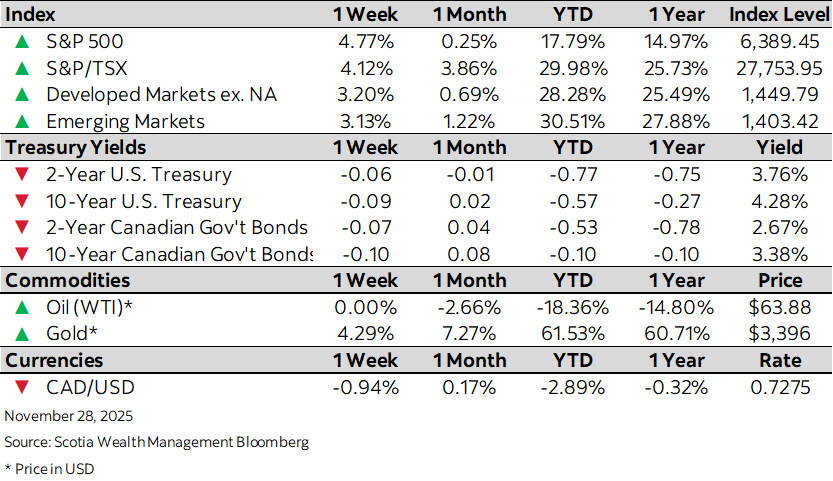
U.S. equities started the week higher on dovish Fed (FOMC) commentary and optimism around AI-related earnings, with Alphabet’s chip partnership news fueling tech gains. Sentiment held through mid-week as rate-cut odds climbed above 80%, though stale retail sales and Producer Price Index (PPI) data offered little fresh insight into the health of the economy. Canadian markets saw steady gains through the week until Friday’s upside Q3 GDP surprise drove local yields higher and tempered Bank of Canada (BoC) rate easing expectations. In Europe, stocks advanced as UK Chancellor Reeves’ budget signaled fiscal discipline despite stealth tax hikes, while UK government bond yields (gilts) were volatile on shifting growth outlooks. Asian benchmarks were mixed: Japan rallied on fiscal stimulus hopes, while China saw gains amid corporate pledges following Hong Kong’s fire tragedy. Oil softened on progress toward a Russia-Ukraine peace deal, while gold firmed on rate cut hopes.

Highlights:

  • U.S. equities returned 4.77%1, buoyed by dovish Fed rhetoric and AI optimism, but stale economic data offered little clarity; rate-cut expectations dominated sentiment, overshadowing concerns about valuations and muted holiday spending signals.
  • Canadian equities returned 4.12%2 steadily tracking global gains throughout the week. Fridays stronger-than-expected GDP print shifted focus to domestic fundamentals, lifting yields and dampening near-term easing hopes.
  • European stocks rose 3.20%3 as investors digested a U.K. budget that emphasized fiscal discipline and structural reforms. While tax measures raised growth concerns, improved credibility and stable inflation supported risk appetite.
  • Emerging markets were 3.13%4 higher as Chinese benchmarks edged higher amid corporate relief pledges following Hong Kong’s fire. Optimism was tempered by lingering tariff and geopolitical uncertainty.

Bond markets juggle fiscal discipline and inflation uncertainty

U.S. Treasury markets were anchored this week by dovish Fed commentary, with rate-cut odds climbing steadily as policymakers signaled support for easing at the last meeting of the year (Dec. 10) despite stale retail and PPI data offering little clarity. Midweek, speculation around Kevin Hassett succeeding Powell reinforced expectations for a more accommodative monetary policy, keeping the short end of the yield curve anchored. In Canada, yields rose late in the week after Q3 GDP surprised to the upside, tempering near-term BoC cut expectations despite signs of slowing momentum into Q4. European curves were mixed: gilts initially sold off on UK Chancellor Reeves’ budget before stabilizing as fiscal discipline reassured investors, while German government bonds held firm amid subdued inflation prints. Japanese yields edged higher on fiscal stimulus chatter, contrasting with muted moves elsewhere in Asia as geopolitical risks lingered.

Highlights:

  • The 2- and 10-year U.S. Treasury yields fell 6 basis points (bps) and 9 bps, respectively. In Canada, the 2- and 10-year yields were down 7 bps and up 10 bps, respectively. Bond yields and prices move inversely to one another.
  • Government bond markets were driven by dovish central bank signals, with U.S. yields anchored by rising rate-cut odds, Canadian debt selling off after a strong GDP surprise, and European curves swinging on fiscal headlines and mixed inflation prints.
  • Investment-grade spreads tightened on improved policy visibility and stable macro data, while high-yield performance was supported by risk-on sentiment early in the week, though lingering growth concerns and heavy CapEx plans kept issuance and appetite selective.

Weekly dashboard

Canada reports third-quarter GDP growth of 2.6%, avoiding recession

Canada’s economy grew at a much faster pace than expected in the third quarter as crude oil exports and government spending boosted overall economic activity even as business investments and household consumption disappointed. According to Statistics Canada (StatCan), the third quarter annualized gross domestic product grew 2.6%, escaping what could have been a technical recession after a contraction in the previous quarter of a downwardly revised 1.8%.

Highlights:

  • StatCan said the third quarter number could be subjected to a larger than normal revision in February as some parts of GDP by expenditure relies on foreign merchandise trade data that was not available due to the U.S. government shutdown.
  • On a month-on-month basis, the economy matched analysts’ predictions following a deceleration of an upwardly revised 0.1% in the prior month, StatCan said, primarily driven by a 1.6% expansion in manufacturing output.
  • But the underlying impacts of tariffs on the economy continue to reflect on business and consumer sentiment. Business capital investment was unchanged in the third quarter and household final consumption expenditure dropped 0.1% in the third quarter.

U.S. producer prices rise in September on higher energy costs

U.S. producer prices rebounded in September as the cost of energy goods surged and producers passed on some tariffs. According to the U.S. Labor Department’s Bureau of Labor Statistics, the Producer Price Index (PPI) for final demand increased 0.3% after an unrevised 0.1% drop in August. The report was delayed by the 43-day shutdown of the government. Economists had forecast the PPI would rebound 0.3%.

Highlights:

  • In the 12 months through September, the PPI increased 2.7% after advancing by the same margin in August.
  • Producer goods prices jumped 0.9%, the largest gain since February 2024, after climbing 0.2% in August. Energy goods, which accelerated 3.5%, accounted for two-thirds of the increase in goods prices.
  • Wholesale services prices were unchanged after falling 0.3% in August, when trade margins were compressed. The decline in trade margins had suggested that wholesalers were absorbing some of the tariffs on imported goods.

Eurozone business activity continues growth despite manufacturing hit
Business activity continued to grow in the eurozone in November, albeit at a slightly slower pace, hurt by lingering weakness in the manufacturing sector. According to S&P Global, the eurozone’s composite purchasing managers index, based on survey responses from around 5,000 manufacturers and service providers, fell to 52.4 from 52.5 in October. Economists had forecast it to hold at 52.5.

Highlights:

  • Services activity in the eurozone inched higher in November, but manufacturing returned to contractionary territory, hitting a five-month low, the survey said.
  • The data showed mixed signals across various countries. French business activity overall contracted, but reached its closest point to expansion for the first time in 15 months, while Germany’s hit a two-month low.
  • In the U.K., activity dropped particularly in the services sector ahead of the government’s budget announcement later in the month, which is expected to include tax increases and spending cuts.

1 S&P 500 Index USD
2 S&P/TSX Composite Index USD
3 Bloomberg Developed Markets ex N. America Large & Mid Cap Price Return Index USD
4 Bloomberg EM Large & Mid Cap Price Return Index USD

This publication has been prepared by The Bank of Nova Scotia for Scotia Wealth Management clients. It is for general information purposes only and should not be considered or relied upon as personal and/or specific financial, tax, pension, insurance, legal or investment advice. We are not tax or legal advisors, and we recommend that individuals consult with their qualified advisors, including tax and legal advisors, before taking any action based upon the information contained in this publication. The opinions and projections contained in this publication are our own as of the date hereof and are subject to change without notice. Scotia Wealth Management is under no obligation to update this publication, and readers should assume the information contained herein will not be updated. While care and attention has been taken to ensure the accuracy and reliability of the material in this publication, neither The Bank of Nova Scotia nor any of its affiliates or any of their respective directors, officers or employees make any representations or warranties, express or implied, as to the accuracy or completeness of such material and disclaim any liability resulting from any direct or consequential loss arising from any use of this publication or the information contained herein. This publication may contain forward-looking statements based on current expectations and projections about future general economic factors. Forward-looking statements are subject to inherent risks and uncertainties which may be unforeseeable and such expectations and projections may be incorrect in the future. Forward-looking statements are not guarantees of future performance and you should avoid placing undue reliance upon them. This publication and all the information, opinions and conclusions contained herein are protected by copyright. This publication may not be reproduced in whole or in part without the prior express consent of The Bank of Nova Scotia.

® Registered trademark of The Bank of Nova Scotia, used under licence. ™ Trademark of The Bank of Nova Scotia, used under licence. Scotia Wealth Management® in Canada consists of a range of financial services provided by The Bank of Nova Scotia (Scotiabank®); The Bank of Nova Scotia Trust Company (Scotiatrust®); Private Investment Counsel, a service of 1832 Asset Management L.P.; 1832 Asset Management U.S. Inc.; Scotia Wealth Insurance Services Inc.; and ScotiaMcLeod®, a division of Scotia Capital Inc. Private banking services are provided by Scotiabank. Estate and trust services are provided by The Bank of Nova Scotia Trust Company. Portfolio management is provided by 1832 Asset Management L.P. and 1832 Asset Management U.S. Inc. Insurance services are provided by Scotia Wealth Insurance Services Inc. Wealth advisory and brokerage services are provided by ScotiaMcLeod, a division of Scotia Capital Inc. International investment advisory services are provided by Scotia Capital Inc. Financial planning services are provided by Scotiabank and ScotiaMcLeod. Scotia Capital Inc. is a member of the Canadian Investor Protection Fund and regulated by the Canadian Investment Regulatory Organization. Scotia Wealth Insurance Services Inc. is the insurance subsidiary of Scotia Capital Inc., a member of the Scotiabank group of companies. When discussing life insurance products, ScotiaMcLeod advisors are acting as Life Insurance Agents (Financial Security Advisors in Quebec) representing Scotia Wealth Insurance Services Inc.

Scotia Wealth Management® in The Bahamas consists of a range of financial services provided by Scotiabank (Bahamas) Limited and The Bank of Nova Scotia Trust Company (Bahamas) Limited, which are entities licensed to operate within The Bahamas. International private banking and international investment advisory services are provided by Scotiabank (Bahamas) Limited. International wealth structuring solutions are provided by The Bank of Nova Scotia Trust Company (Bahamas) Limited. ® Registered trademark of The Bank of Nova Scotia, used under licence.

Scotia Wealth Management® in the Cayman Islands consists of a range of financial services provided by Scotiabank & Trust (Cayman) Ltd. International private banking services, international investment advisory services, and international wealth structuring solutions are provided by Scotiabank & Trust (Cayman) Ltd., an entity licensed by the Cayman Islands Monetary Authority. ® Registered trademark of The Bank of Nova Scotia, used under license.

Scotia Wealth Management® in Jamaica consists of a range of Private Banking services provided by the Scotiabank Group of companies (Scotiabank®). ®Registered trademark of The Bank of Nova Scotia, used under licence.