
Subscribe to the 100% free rdnewsNOW daily newsletter!
sponsored

Market Watch – Nov. 14, 2025

Nov 17, 2025 | 1:22 PM

This week’s highlights

  • Shutdown and AI euphoria give way to fiscal reality
  • Volatility reasserts itself as rate path uncertainty builds
  • Bank of Canada considered delaying October rate cut, deliberations show
  • U.S. consumer sentiment falls toward record-low levels
  • Eurozone industry ekes out growth, hindered by Ireland

Week in review

Shutdown and AI euphoria give way to fiscal reality

U.S. equities trended higher early in the week on optimism around AI earnings and the resolution of the government shutdown, but reversed sharply Thursday as concerns over elevated valuations and data center-related CapEx weighed on tech. Canadian markets followed a similar path, with midweek gains fading amid cautious sentiment and limited domestic drivers. In Europe, early strength driven by catch-up buying and easing rate expectations gave way to weakness after disappointing U.K. jobs and GDP data raised fiscal concerns, culminating in a late-week gilt selloff following a budget reversal. Chinese and EM equities faced pressure from deteriorating macro indicators including slowing retail sales, weaker industrial output, and deepening property sector stress, despite ongoing fiscal support and resilient export performance earlier in the year.

Highlights:

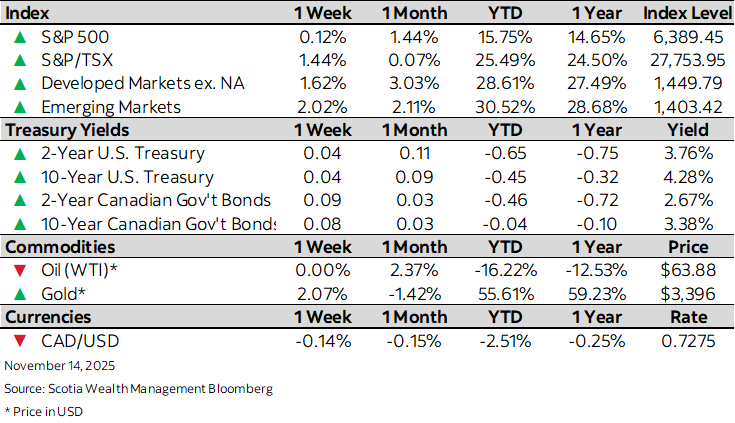
  • U.S. equities returned 0.12%1, rallying early on AI earnings and shutdown optimism, but retreated as stretched valuations and heavy tech CapEx plans triggered a late-week pullback.
  • Canadian equities returned 1.44%2 after tracking U.S. strength initially, but risk appetite faded midweek, leading to modest declines amid a lack of domestic catalysts.
  • European stocks rose 1.62%3 on rate cut hopes and U.S. shutdown relief, but weak U.K. jobs and GDP data raised fiscal concerns, prompting a sharp selloff in gilts.
  • Emerging markets were 2.02%4 higher despite signs of economic strain, as slowing consumption, weak industrial output, and property sector stress were offset by fiscal support and resilient exports.

Volatility reasserts itself as rate path uncertainty builds

U.S. Treasury yields drifted lower early in the week on improved risk sentiment following the shutdown resolution, but rate volatility rose sharply as investors positioned ahead of delayed economic data. Canadian bonds followed suit, rallying midweek before retracing gains amid shifting rate expectations. In Europe, gilts rallied on soft U.K. labour data and dovish rate speculation, but reversed after a surprise budget U-turn raised fiscal concerns. Core eurozone yields were mixed, balancing steady data with long-duration supply. In China and EM, weak credit growth and persistent property sector stress kept downward pressure on yields, with modest fiscal support and stable exports offering limited offset.

Highlights:

  • The 2- and 10-year U.S. Treasury yields rose 4 basis points (bps) and 4 bps, respectively. In Canada, the 2- and 10-year yields were up 9 bps and 8 bps, respectively. Bond yields and prices move inversely to one another.
  • Global government bonds saw mixed performance, with North American yields falling on risk-off sentiment and delayed data releases, while European rates fluctuated amid shifting fiscal expectations and soft macro data.
  • Investment grade and high yield bonds weakened as spreads widened despite supportive short-term rates; primary issuance was active early in the week ahead of bond market closures in the U.S. and Canada.

Bank of Canada considered delaying October rate cut, deliberations show

The Bank of Canada’s governing council was on the same page about the need to lower its benchmark interest rate last month, but the exact timing of the cut was up for debate. The central bank released the summary of deliberations from its decision to lower the policy rate by a quarter point to 2.25%. Those documents show council members felt the cut was warranted as a weak economy hampered by U.S. tariffs was expected to keep inflation around the Bank of Canada’s 2% target for the foreseeable future.

Highlights:

  • Some members of council argued waiting until a later would have given monetary policy-makers a better sense of how the economy was reacting to U.S. trade shifts as well as Ottawa’s federal budget tabled just last week.
  • Arguments to cut sooner rather than later won out amid a soft labour market and weak growth expectations for the second half of the year.
  • With that cut, the central bank’s governing council felt the Bank of Canada had likely done all it can to smooth the tariff transition and further rate reductions would likely be unnecessary if the economy continues to evolve in line with its expectations.

U.S. consumer sentiment falls toward record-low levels

U.S. consumers’ moods dropped further in November, according to a monthly survey from the University of Michigan, continuing a slide that has worsened amid persistent price increases and the extended government shutdown, which recently ended. The Michigan survey’s headline index fell to 50.3 in November, from 53.6 last month, based on preliminary November responses. Analysts were expecting a milder decline in the index, to 53.0.

Highlights:

  • The reading is now just slightly above the levels that sentiment sank to amid the historic inflation that hit in 2022 during the pandemic, making it among the lowest results recorded in the survey’s decades of history.
  • The survey found a particularly sharp decline in confidence among lower-income households, but pointed out that higher-income households are also less optimistic than they were at the start of the year.
  • On a somewhat positive note, the survey found that while consumers’ near-term inflation expectations inched higher, expectations over the longer run ticked down.

Eurozone industry ekes out growth, hindered by Ireland
The eurozone’s industry returned to slow growth in September, reflecting moderate resilience at a time of trade uncertainty and despite a significant drag in the month from Irish data. Production in the 20-nation currency area had been strong at the start of this year as goods exporters sought to boost output to get ahead of tariffs proposed by the Trump administration. However, manufacturing has relatively stagnated since the second quarter. Production was up 1.2% in September compared with the same month of 2024.

Highlights:

  • According to the European Union’s statistics agency Eurostat, industrial production grew 0.2% on month, following a 1.1% decline in August. Economists expected a 0.9% increase.
  • Much of the drag in eurozone production came from a 9.4% decline in Ireland. However, output in the eurozone’s four largest nations, Germany, France, Italy and Spain, all grew.
  • Production in durable goods, which are more exposed to export tariffs, decreased in September, but increased for energy and capital goods, Eurostat said.

1 S&P 500 Index USD
2 S&P/TSX Composite Index USD
3 Bloomberg Developed Markets ex N. America Large & Mid Cap Price Return Index USD
4 Bloomberg EM Large & Mid Cap Price Return Index USD