
Get the free daily rdnewsNOW newsletter by subscribing here!
sponsored

Market Watch – Oct. 31, 2025

Oct 31, 2025 | 4:16 PM

This week’s highlights

  • Central bank decisions and corporate guidance impact markets
  • Rates rise as central banks signal caution
  • Bank of Canada cuts rate to 2.25% and signals easing cycle may be over
  • U.S. Federal Reserve cuts key rate under cloudy economic outlook
  • The European Central Bank held interest rates steady for the third meeting in a row

Week in review

Central bank decisions and corporate guidance impact markets

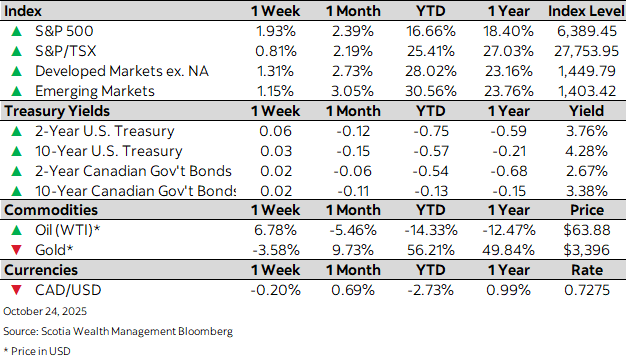
U.S. equities began the week higher on optimism around a U.S.–China trade deal and strong early earnings, but momentum faded after the Federal Reserve (Fed) cut rates by 25 basis points (bps) and ended quantitative tightening while signaling caution on further easing, which pressured markets alongside mixed tech results. In Canada, stocks were steady early on but softened after the Bank of Canada (BoC) delivered its second consecutive 25 bps cut and flagged limited scope for additional easing, reinforced by weak GDP data later in the week. European markets were muted as the European Central Bank (ECB) held rates and offered little forward guidance, with softer inflation and mixed GDP prints failing to lift sentiment. In Asia, Chinese equities lagged despite pledges to boost domestic consumption, while Japanese stocks gained after the Bank of Japan (BoJ) left policy unchanged but hinted at future tightening.

Highlights:

  • U.S. equities returned 0.46%1, climbing early on trade optimism and strong earnings but slipping after the Fed cut rates, ended QT, and signaled caution, while mixed tech results added pressure.
  • Canadian equities returned -0.48 %2 after the BoC’s second 25 bps cut and guidance limiting further easing, compounded by weak August GDP and muted growth projections in the most recent Monetary Policy Report.
  • European stocks fell -0.15%3 as the ECB held rates and reiterated a data-dependant stance; modest GDP surprises and sticky services inflation offered little support amid geopolitical uncertainty.
  • Emerging markets were -0.81%4 lower despite pledges from Chinese lawmakers to boost consumption as trade frictions persisted.

Rates rise as central banks signal caution

U.S. rates were stable early in the week ahead of the Fed meeting, then climbed after officials cut the policy rate and ended quantitative tightening but signaled caution on further easing, reducing expectations for a December cut. Canadian yields initially held firm before rising post-BoC decision as policymakers delivered a second 25 bps cut yet indicated the policy rate is near neutral, with odds of additional easing falling sharply; later, weaker GDP data nudged front-end yields slightly lower. In Europe, rates moved higher after the ECB held policy steady and upbeat GDP surprises reinforced its data-dependent stance, while sticky services inflation limited scope for further easing.

Highlights:

  • The 2- and 10-year U.S. Treasury yields were rose 12 basis points (bps) and 10 bps, respectively. In Canada, the 2- and 10-year yields rose 3 bps and 4 bps, respectively. Bond yields and prices move inversely to one another.
  • Both Canadian and U.S. rates turned higher this week on hawkish comments from both the FOMC and the BoC. Benchmark government yields have been trending lower for months and have yet to confirm if this is just an occasional pullback.
  • Investment-grade spreads tightened early amid heavy issuance and strong demand, while high yield rallied initially but softened later as rates climbed and risk appetite cooled following hawkish central bank messaging and mixed equity performance.

Weekly dashboard

Bank of Canada cuts rate to 2.25% and signals easing cycle may be over

The Bank of Canada cut its benchmark interest rate this week but signalled that it might be at the end of its easing cycle even as U.S. tariffs inflict significant damage on the Canadian economy. The bank’s governing council voted to lower the policy rate by a quarter-percentage-point to 2.25%. This was the bank’s second consecutive cut, and the fourth cut this year. The decision was driven by a weakening economic outlook and a belief that inflation is largely contained. But Governor Tiff Macklem suggested that it may be the bank’s last rate cut for some time.

Highlights:

  • If the economy evolves in line with the bank’s new forecast, Macklem said, “governing council sees the current policy rate at about the right level to keep inflation close to 2% while helping the economy through this period of structural adjustment.”
  • The bank’s new base-case forecast, published in its quarterly Monetary Policy Report, sees gross domestic product (GDP) growing by around 0.75% in the second half of the year, following a 1.6% drop in the second quarter.
  • Looking further out, the bank expects GDP to grow by a tepid 1.1% in 2026 and 1.6% in 2027, with trade uncertainty layered on top of a sharp slowdown in population growth as a result of Ottawa’s new immigration targets. This was the first base-case forecast the bank has published since January.

U.S. Federal Reserve cuts key rate under cloudy economic outlook

The U.S. Federal Reserve (Fed) cut its key interest rate for a second time this year as it seeks to shore up economic growth and hiring even as inflation stays elevated. The latest quarter-point cut reduces the Fed’s benchmark short-term interest rate to a range between 3.75% and 4%, the lowest setting in three years and down from a peak of around 5.4% that the central bank maintained for much of last year.

Highlights:

  • Compounding its challenges, the central bank is navigating without the economic signposts it typically relies on from the government, including monthly reports on jobs, inflation and consumer spending, which have been suspended due to the government shutdown.
  • The Fed has signaled it may reduce its key rate again in December but the data drought raises the uncertainty around its next moves.
  • Right now, its two goals are in conflict, so it is reducing borrowing costs to support the job market, while still keeping rates high enough to avoid stimulating the economy so much that it worsens inflation.

The European Central Bank held interest rates steady for the third meeting in a row
The European Central Bank (ECB) held interest rates steady, as investors question whether the institution’s most aggressive easing campaign since the financial crisis is really done. The ECB held its key interest rate at 2%, where it has been since June. The central bank cut rates by two percentage points in a year before hitting pause over the summer. The decision came a day after the U.S. Federal Reserve cut rates for the second time this year. The diverging policy paths threaten to complicate the ECB’s job by driving up the value of the euro, adding further pressure onto the bloc’s exports and inflation.

Highlights:

  • “The economy has continued to grow despite the challenging global environment,” the central bank said in its policy announcement. “However, the outlook is still uncertain, owing particularly to ongoing global trade disputes and geopolitical tensions.”
  • U.S. tariffs have hurt the bloc’s export-dependent economies, and the euro’s 12% gain against the dollar this year is making European exports even less competitive.
  • But recent business surveys suggest the economy is gaining steam, while Germany’s spending on infrastructure and its military is expected to boost activity starting next year. Recent data show the eurozone economy grew at an annualized rate of 0.9% in the third quarter.