
Get the free daily rdnewsNOW newsletter by subscribing here!
sponsored

Market Watch – Aug. 9, 2025

Aug 11, 2025 | 2:08 PM

This week’s highlights

  • Despite a mixed bag of events, economic data and tariffs news, markets end the week higher
  • Weak jobs report pushes Canadian government bond rates lower, increases chances of Bank of Canada cut
  • Canada’s trade deficit widened to $5.9 billion in June, second highest on record
  • U.S. services sector PMI activity slows in July
  • China’s services sector activity accelerates

Week in review

Despite a mixed bag of events, economic data and tariffs news, markets end the week higher

Global markets began the week positively despite some disappointing data reads. As the week progressed, markets gave back some of the early gains as a mixed bag of news on economic data, tariffs, and policy decisions played a role. U.S. tariffs kicked in on dozens of countries, signaling the next phase in the U.S.’ shift in trade policy. On the plus side, expectations increased for the U.S. Federal Reserve (Fed) to cut interest rates (currently at ~90% for the September 17 meeting), while investors assessed a new round of major corporate earnings. Markets ended the week in positive territory. In the U.S., markets ended slightly higher as the international goods and services trade deficit narrowed, driven by a sharp decline in imports. On the negative side, the Employment Index fell, contracting for the fourth time in five months, signaling a softer labour market south of the border. In Canada, equities finished in positive territory despite the economy losing 41,000 jobs in July. Statistics Canada reported Canada’s merchandise trade deficit widened in June as imports grew faster than exports, mainly due to a one-time high-value oil equipment import. On the trade front, Canada-U.S. trade talks are said continue over the coming weeks, after the two sides failed to reach a deal last Friday. European markets were up as the Bank of England (BoE) lowered its policy rate and lifted the inflation outlook higher, while Germany reported that its industrial output slid sharply in June. Markets also had to deal with additional tariff risk as President Trump announced he is imposing tariffs on pharmaceuticals and semiconductors in the coming weeks. In Asia, markets were mostly positive as China reported that exports grew year-over-year in July, above expectations. However, imports were also up, consequently, the trade surplus shrank. India’s growth outlook was weighed by President Trump’s punitive 50% tariff on the South Asian economy, but there’s still hope negotiations will ease the impact.

Highlights:

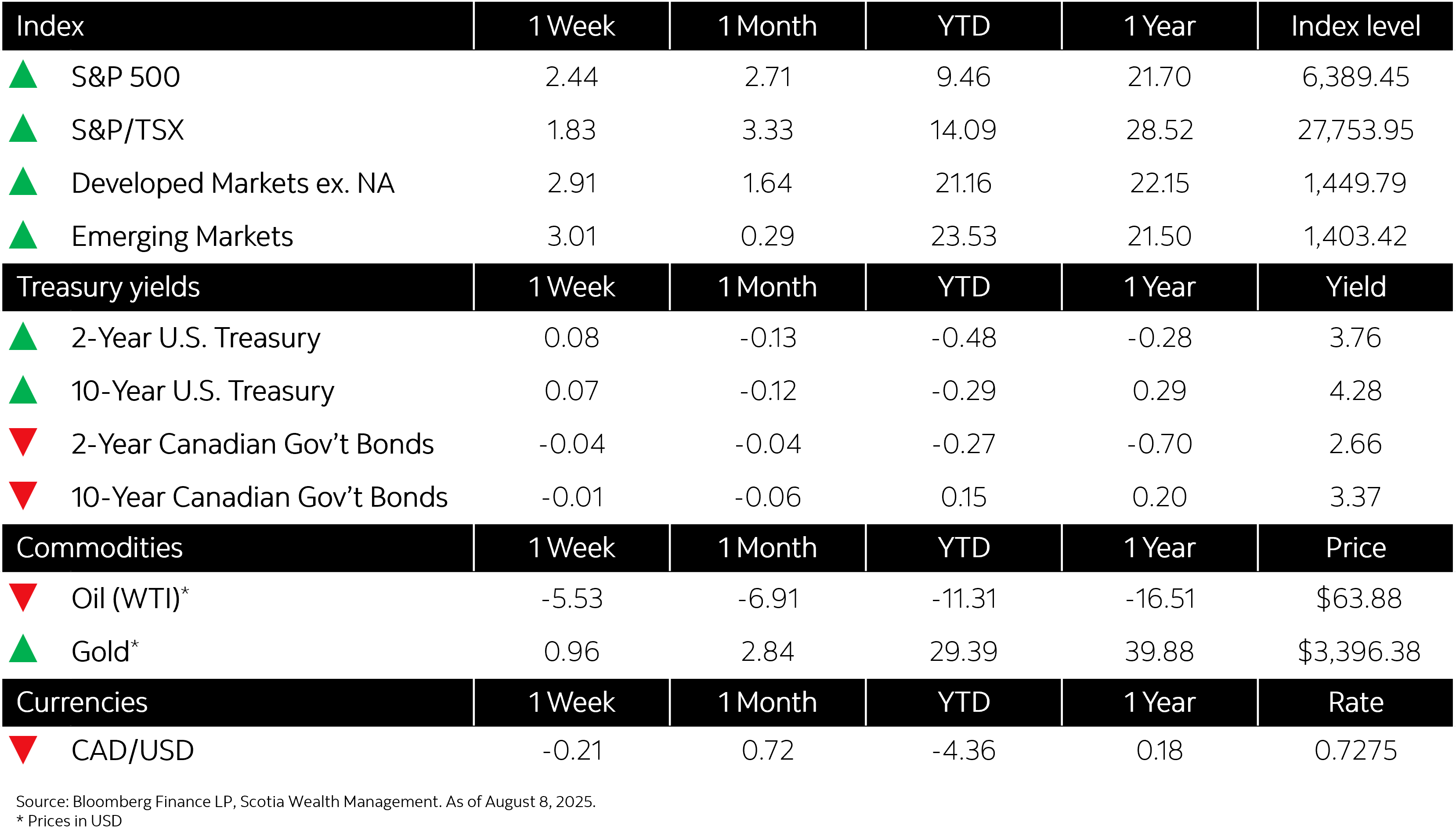
  • U.S. equities returned 2.44%1, despite the service sector contracting and another round of weak employment data. Shares of Apple rose after Trump threatened a roughly 100% tariff on semiconductors, but said companies such as Apple that are investing in U.S. manufacturing will get a waiver.
  • Canadian markets returned 1.83%2 boosted by Shopify’s earnings which showcased double-digit revenue growth and profit for the second quarter and projected strong growth for the coming quarter. Gold equities also contributed to the index’s positive returns with gold acceleration in gold prices. Data to end the week showed a contraction in the Canadian labour market in July as well as the lack of progress in trade talks, was not enough to temper market performance.
  • European markets returned 2.91%3, even though German exports to the U.S. fell for the third-straight month and German and U.K. consumer confidence turned gloomier.
  • Emerging markets were up 3.01%4, with the help from a sharp rally in TSMC shares, which jumped after the company was reportedly exempted from Trump’s proposed 100% tariffs on semiconductor imports. Japan’s Nikkei and Hong Kong’s Hang Seng also followed suit.

Weak jobs report pushes Canadian government bond rates lower, increases chances of Bank of Canada cut

Yields on Canadian government bonds declined this week, led by short term rates following the disappointing jobs report. Canada 41,000 jobs lost in July was driven primarily by declines in youth employment, bringing the youth employment rate to its lowest levels since 1998 outside the pandemic period. The weak jobs report led bond markets to increase expectations of a rate cut from the Bank of Canada (BoC) at its next meeting. In the U.S., rates rose this week, following last Friday’s sharp decline after that countries’ employment report, with a muted reaction to weaker than expected initial jobless claims. In Europe, as expected, the BoE lowered its main policy rate by 25bps but with a hawkish tone in the Bank’s communication that sent gilt yields higher.

Highlights:

  • The 2-year U.S. Treasury yield increased 8 basis points (bps) while the 10-year yield was up 7 bps. In Canada, the 2-year yield fell 4 bps while the 10-year was down 1 bps. Bond yields and prices move inversely to one another.
  • While Canadian fixed income markets are currently pricing in a 50% chance of the BoC cutting rates by 25bps at its next meeting, GDP and another jobs report are still to be released before the BoC’s next meeting on September 17, with the results of both reports sure to have influence on the Bank’s decision.
  • While U.S. Treasuries yields rose this week, yields remain below levels seen before the large decline driven by last Friday’s July’s employment data.
  • With 2Q corporate earnings continuing to be released, companies took advantage of this year’s lowest high-grade yields by issuing US$40 billion in new paper, the busiest week since May. U.S. junk bonds also joined the party with more than US$11 billion in issuance priced on the week, the busiest since January. That asset class has performed well, with yields falling 13 bps to a 5-week low of 6.98%, led by CCCs, the riskiest tier of the credit market that has racked up gains of 0.5% so far this week.

Weekly dashboard

Canada’s trade deficit widened to $5.9 billion in June, second highest on record

Canada’s merchandise trade deficit widened in June to $5.9 billion as imports grew faster than exports due to a one-time high-value oil equipment import, data showed. The deficit observed in June is the second highest on record after the deficit dipped to its largest in history in April to $7.6 billion. Analysts had predicted the trade deficit to widen to $6.3 billion in June from a downwardly revised $5.5 billion in May.

Highlights:

  • Total imports were up 1.4% in June to $67.6 billion from a drop of 1.6% in the prior month, Statistics Canada (StatCan) said, adding that excluding the one-time product import which was from the U.S. for an offshore oil project, total imports were down 1.9% in June.
  • Canada’s total exports grew 0.9% in June to $61.7 billion following an increase of 2% in May, its second consecutive increase, StatsCan said, led primarily by an increase in value of crude oil exports which saw an increase in prices in June due to tensions in the Middle East.
  • Exports to the U.S. in June, however, increased by 3.1% in June, due to crude oil shipments. But on a year-over-year basis, exports to the U.S. were still 12.5% lower when compared with the same period a year ago.

U.S. services sector PMI activity slows in July

Activity in the U.S. services sector only marginally expanded in July, as employment contracted at a faster pace and U.S. trade policy continued to cause concern for businesses. The Institute for Supply Management reported that its purchasing managers’ index for services providers fell to 50.1 in July, from 50.8 in June, which was lower than the 51.2 expected by economists. The reading just above 50 points to an expansion of activity, albeit slower than in June. May recorded the only month of contraction since July last year.

Highlights:

  • Employment contracted for a second-straight month and there was a faster rise in prices index, both worrisome developments.
  • However, there was continued expansion in business activity and new orders, together with a small rise in backlogs, highlighting the resilience of the U.S. services sector.
  • The most common topic among survey panelists remained tariff-related effects, with a noticeable increase in commodities listed as more expensive.

China’s services sector activity accelerates
A private gauge of China’s services sector showed activity expanded at the fastest pace in more than a year in July, as demand improved during the summer travel rush. The S&P Global China general services purchasing managers index rose to 52.6 last month from June’s 50.6. A reading above 50 suggests an expansion in activity, while a reading below suggests contraction. The upbeat reading marked the fastest expansion in China’s services activity since May 2024, extending the current streak of growth to just over 2½ years, according to S&P Global.

Highlights:

  • “Better demand conditions underpinned the latest rise in activity, and this had notably included firmer external demand, as highlighted by the first expansion in new export business in three months.” said Jingyi Pan, economics associate director at S&P Global Market Intelligence.
  • Reports of more robust tourism activity and more stable trade conditions helped drive the fastest increase in export orders since February.
  • Business sentiment recovered further in July, with the level of confidence reaching the highest since March on hopes that global economic and trade conditions will improve in the coming months. This optimism was underpinned by a renewed rise in employment.

1 S&P 500 Index USD
2 S&P/TSX Composite Index USD
3 Bloomberg Developed Markets ex N. America Large & Mid Cap Price Return Index USD
4 Bloomberg EM Large & Mid Cap Price Return Index USD