
Subscribe to the 100% free rdnewsNOW daily newsletter!
sponsored

Market Watch – July 25, 2025

Jul 28, 2025 | 9:55 AM

This week’s highlights

  • Earnings, PMIs lift equities but tariff tensions cap momentum despite limited deals
  • Policy holds and PMI surprises leave rates mixed for the week
  • Businesses downbeat but less worried about worst-case tariff scenario, BoC surveys find
  • U.S. home prices hit record high in June, dragging down sales
  • ECB holds rates steady as U.S. tariff negotiations cloud outlook

Week in review

Earnings, PMIs lift equities but tariff tensions cap momentum despite limited deals

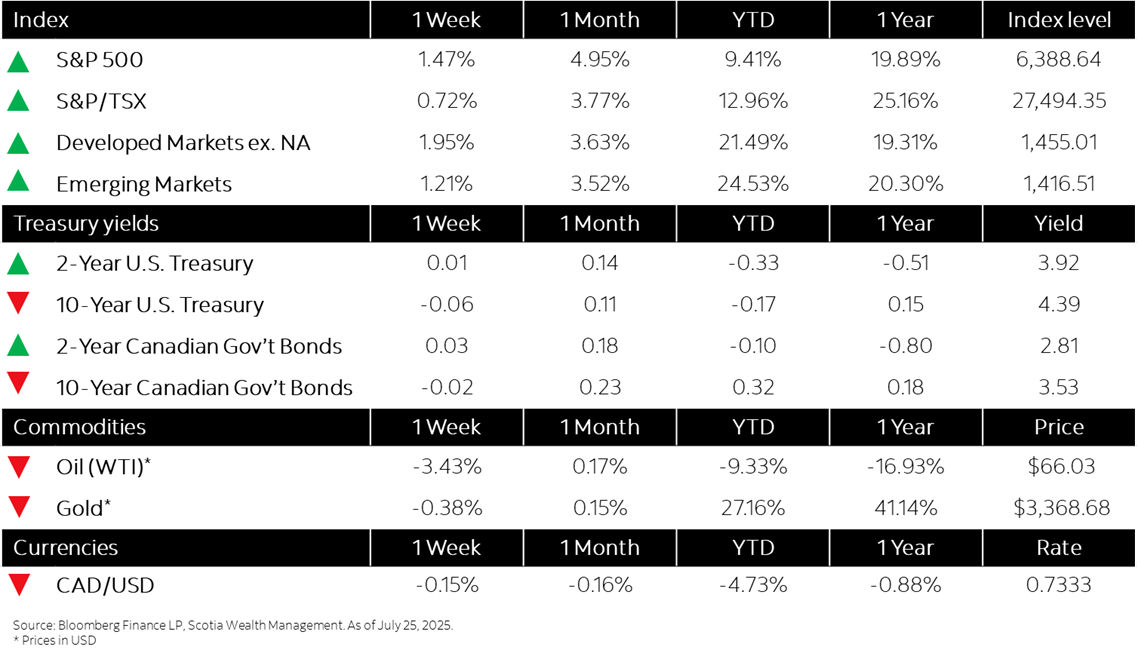
In the U.S., equity markets began the week on a cautious note amid mixed earnings and ongoing trade policy uncertainty, with sentiment lifted midweek by a U.S.-Japan trade deal that reduced auto tariffs to 15%. Thursday’s stronger-than-expected services Purchasing Manager Index (PMI) and Alphabet’s upbeat earnings further lifted sentiment. However, Tesla’s revenue miss and Friday’s weak core capital goods orders, which reinforced concerns about stalled business investment, kept a lid on performance. In Canada, equities were more muted as soft retail sales and subdued business and consumer surveys reflected persistent trade-related uncertainty and restrained domestic demand. European markets rose on upbeat PMI data and the ECB’s decision to hold rates, but the lack of a trade deal with the U.S. kept performance in check. In Asia, Japanese equities rallied on the trade deal, though political instability following the ruling coalition’s election loss capped gains, while Chinese markets found modest support from signs of de-escalation in U.S.-China trade tensions.

Highlights:

  • U.S. equities returned 1.47%1, supported by strong services PMI data and Alphabet’s earnings beat, but gains were capped by Tesla’s revenue miss and weak core capital goods orders, which reinforced concerns about investment hesitation amid tariff uncertainty.
  • Canadian markets returned 0.72%2 after facing pressure from weaker-than-expected retail sales and subdued business and consumer sentiment as firms and households remained cautious in response to trade-related cost pressures and a lack of momentum in hiring and investment.
  • European markets returned 1.95%3, rising early on upbeat PMI data and the ECB’s decision to hold rates steady, but sentiment turned somewhat as reports of EU retaliation against U.S. tariffs reignited trade tensions and weighed on risk appetite.
  • Emerging markets rose 1.21%4, with Chinese equities seeing modest gains as trade tensions eased slightly following goodwill gestures like China suspending its DuPont probe and the U.S. relaxing some AI chip restrictions.

Policy holds and PMI surprises leave rates mixed for the week

U.S. rates fell early in the week amid strong demand and limited macro data, before reversing higher following robust services PMI data and rising input costs that complicated the Fed’s rate outlook. Canadian yields tracked U.S. moves, initially drifting lower on subdued business and consumer surveys, then rising as retail sales data and ECB spillover effects lifted global rate expectations. In Europe, rates moved higher after the ECB held policy steady and signaled confidence in the inflation trajectory, though downside risks from trade tensions kept forward guidance cautious.

Highlights:

  • The 2-year U.S. Treasury yield rose 1 basis points (bps) while the 10-year yield fell 6 bps. In Canada, the 2-year yield rose 3 bps while the 10-year was down 2 bps. Bond yields and prices move inversely to one another.
  • European rates moved higher following the ECB rate decision. The ECB kept rates unchanged for the first time in more than a year as inflationary pressures have dissipated.
  • ECB President Christine Lagarde acknowledged that the risks to the European economy are to the downside factoring in the impact of U.S. tariffs. The markets are still pricing potentially one more rate cut by year end following today’s decision.
  • Credit markets remain firm as spreads drift into historically tight territory. High yield primary markets have been busy this month, likely to price a record for July sales since 2021. Investment grade primary supply has been disappointing, on the other hand, with volumes running 31% behind projections.

Weekly dashboard

Businesses downbeat but less worried about worst-case tariff scenario, BoC surveys find

U.S. President Donald Trump’s erratic trade policy has put a chill on Canadian businesses and consumers, but fewer are expecting a worst-case tariff scenario, according to a pair of surveys published by the Bank of Canada (BoC). The quarterly pulse checks, conducted in late April and May, captured the sour mood across Canada as President Trump rolled out waves of tariffs through the spring and early summer.

Highlights:

  • Canadian companies said they’re curtailing investment and hiring, and eating higher tariff-related costs because of weak consumer demand. Consumers said they are worried about their jobs and are delaying big purchases.
  • At the same time, the surveys found a sense of relief that U.S. tariffs have not bitten as hard as many feared earlier in the year when President Trump was threatening across-the-board tariffs, without the exemptions that were later introduced.
  • This hint of optimism reinforces expectations that the central bank will hold interest rates steady for the third-consecutive time when it meets next week.

U.S. home prices hit record high in June, dragging down sales

Home prices rose to a new high in June while the crucial spring sales season fizzled, signs that a housing-market recovery is unlikely in 2025. Home buyers were hesitant to jump into the market this spring, which is usually the busiest time of year for home purchases. Home sales in June fell to a 10-month low. Home prices at record highs, along with mortgage rates above 6.5%, have made home purchases unaffordable for many.

Highlights:

  • According to the National Association of Realtors (NAR) data, the national median existing-home price in June rose to US$435,300, a record going back to 1999 and a 2% increase from a year earlier.
  • Home prices are falling in some parts of the country, especially in Texas and Florida, where the inventory has climbed. But the supply of homes for sale nationally is still below pre-pandemic levels, which is pushing up prices.
  • U.S. existing-home sales fell 2.7% in June from the prior month to a seasonally adjusted annual rate of 3.93 million, the slowest pace since September.

ECB holds rates steady as U.S. tariff negotiations cloud outlook
The European Central Bank (ECB) paused its most aggressive interest-rate cutting campaign since the global financial crisis as it awaits clarity on U.S. President Trump’s tariffs. The central bank left its key deposit rate at 2%, after eight interest-rate reductions since last June. “The environment remains exceptionally uncertain, especially because of trade disputes,” the central bank wrote in its policy announcement.

Highlights:

  • The EU is working to reach a trade deal with the U.S. to avert tariffs of 30%, set to kick in on Aug. 1, a level that EU trade commissioner Maros Sefcovic warned would make trans-Atlantic trade “almost impossible.”
  • European officials expect that a potential deal with the U.S. would apply a 15% baseline tariff to exports to the U.S. Capital Economics estimates a 15% tariff would reduce growth in the EU by about 0.3%, hitting Germany’s export-dependent economy hardest.
  • Export front-loading to avoid tariffs has boosted the European economy so far this year, while a boom in defense and infrastructure spending by Berlin is expected to drive growth in the coming years.