
Get the free daily rdnewsNOW newsletter by subscribing here!
SPONSORED

Market Watch: April 25, 2025

Apr 28, 2025 | 10:18 AM

This week’s highlights

  • Equity markets shrug off U.S. uncertainty, unpredictability
  • Bond markets regain some stability following several volatile weeks
  • Canadian home sales drop in March, along with building activity
  • Tariffs restrain U.S. business activity, boost asking prices for products
  • Global economy set for slowdown, IMF says

Week in review

Equity markets shrug off U.S. uncertainty, unpredictability

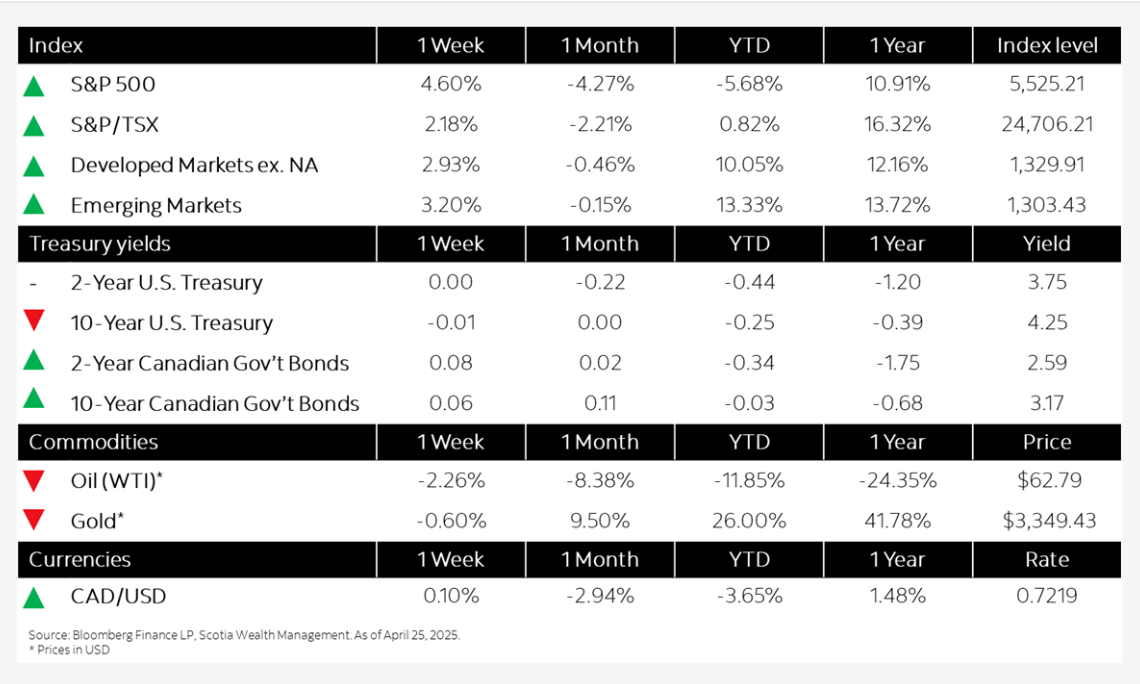
U.S. equity markets were initially pressured by President Trump’s renewed push against Federal Reserve (Fed) Chair Powell, raising concerns about monetary policy independence and trade frictions. March Purchasing Manager Index (PMI) data showed slowing business activity, further dampening sentiment. However, a statement from the White House indicating that the President would not seek to remove the Fed chair led to a risk-on rally which pushed markets higher throughout the rest of the week. Canadian markets saw mixed signals from retail sales data, with a modest rebound in March failing to establish a trend amid looming tariffs, a feature the Bank of Canada has said they are looking for before making further monetary policy adjustments. In Europe, PMI reports indicated a contraction in services, prompting speculation on further European Central Bank (ECB) easing. Chinese markets remained resilient despite trade war escalation, buoyed by strong port activity and policy easing signals from Beijing.

Highlights:

  • U.S. markets returned 4.60%1 for the week overlooking President Trump’s pressure on Fed Chair Powell and mixed PMI data that reflected trade policy uncertainty and slowing business activity.
  • Canadian markets returned 2.18%2 for the week as markets saw a modest retail sales rebound in March, but broader concerns about tariffs and consumer sentiment persisted. All eyes now turn to the results of the upcoming Federal election.
  • European markets returned 2.93%3 for the week despite PMI reports showing a contraction in services which raised expectations for further ECB policy easing amid trade policy uncertainty.
  • Emerging markets closed 3.20%4 higher with Chinese equity markets remaining resilient despite escalating trade tensions. Strong port activity and potential policy easing from Beijing supported markets.

Bond markets regain some stability following several volatile weeks

In the U.S., fixed income markets were influenced by President Trump’s pressure on Fed Chair Powell, leading to speculation about rate cuts and the potential impact that could have on Treasury yields. Canadian rates moved lower amid mixed retail sales data and tariff concerns. European rates reacted to weaker PMI reports, raising expectations for further ECB easing. In China’s bond market was impacted by resilient port activity and potential policy easing from Beijing which brought a sense of stability to the market despite escalating trade tensions and new U.S. tariffs on solar imports.

Highlights:

  • The 2- and 10-year U.S. Treasury yields were flat and 1 bps lower, respectively. In Canada, the 2- and 10-year yields were 8 bps and 6 bps higher, respectively. Bond yields and prices move inversely to one another.
  • Benchmark U.S. 10-year treasury yields are trading off their 2-week lows. After the liberation-day dip at the beginning of April, 10-year rates are back within March levels and well below the January highs. Next week may bring volatility back to rates with major macro releases due such as April ADP employment change, nonfarm payrolls, U.S. Q1 GDP and March PCE data, to mention a few.
  • Credit spreads have been tightening since April 8 following the 90-day tariff pause, which was also the pivot point for other risky assets, at least short term. Bank of America tapped the primary market on Thursday which brought primary volume in line with projections for the month.

Weekly dashboard

Canadian home sales drop in March, along with building activity

Last month, home sales slumped 9.3% to the lowest level since February 2009, a month that marked the pit of the Great Recession. In Toronto, only 5,011 units changed hands, the lowest number for any March since 1995, according to Toronto Regional Real Estate Board records. Prices also slid in March for the third straight month, with the Canadian Real Estate Association’s broad-based MLS Home Price Index down 8.5% on an annualized basis so far this year. Many Canadians who were actively house-hunting in January seem to have left the market.

Highlights:

  • While the inventory of unsold homes is building, for instance, the number of active listings in Ontario is at a 10-year high, homebuilding activity is also down. In Ontario, new housing starts fell to 39,000 on an annualized basis in March, a level not seen since the Great Recession in 2009
  • In addition to the uncertainty around trade and the economy, other forces have buffeted the sector, including slow municipal approvals, rising development charges and higher costs for building materials and labour.
  • Slower growth has eased pressure on Canada’s rental market. In March, the asking rent for new rentals fell 2.8% from the same month last year, the sixth straight month rents decreased on an annual basis.

Tariffs restrain U.S. business activity, boost asking prices for products

U.S. business activity slowed to a 16-month low in April while prices charged for goods and services soared amid uncertainty caused by tariffs, reinforcing financial market fears of stagflation that could put the U.S. Federal Reserve in a tough spot. The survey from S&P Global also showed U.S. President Donald Trump’s ever-shifting trade policy, which has boosted the United States’ average effective tariff rate to levels not seen in more than a century, and an immigration crackdown were hurting exports, including tourism.

Highlights:

  • Businesses were also reluctant to hire, which S&P Global said was down to “concerns over the economic outlook and demand environments both at home and in export markets, with rising cost concerns and labour availability.”
  • S&P Global’s flash U.S. Composite PMI Output Index, which tracks the manufacturing and services sectors, dropped to 51.2 in April. That was the lowest level since December 2023 and followed a reading of 53.5 in March.
  • The pullback in the Composite PMI suggested that economic activity was tepid at the start of the second quarter. Economists believe economic growth slowed sharply in the first quarter, with gross domestic product estimates converging below a 0.5% annualized rate.

Global economy set for slowdown, IMF says
The sharp rise in tariffs since the start of the year marks the onset of a new era that will see most economies grow more slowly than previously expected, the International Monetary Fund (IMF) reported. It said the immediate impact of the rise in tariffs will be to slow economies around the world. It lowered its forecast for global economic growth this year to 2.8% from 3.3%, a downgrade that is slightly larger than that following Russia’s invasion of Ukraine in early 2022. For 2026, it now sees global growth of 3%, down from 3.3% previously.

Highlights:

  • Mexico is set to suffer the largest reversal of the big economies for which the IMF provides forecasts. It is now expected to see its economy contract 0.3% in 2025, having previously been on course for an expansion of 1.4%.
  • The U.S. economy is also expected to suffer. Growth in 2025 is now forecast at 1.8%, down from 2.7% when the fund’s last forecasts were published in January. A further slowdown to 1.7% is expected for 2026, with the IMF having previously forecast an expansion of 2.1%.
  • The Chinese economy is also likely to suffer from higher tariffs, although to a lesser extent. The IMF cut its growth forecasts for this year and next to 4% from 4.6% and 4.5%, respectively. It projects an even more modest setback for the eurozone, with growth this year now seen at 0.8%, having been forecast at 1%.