
Subscribe to the 100% free rdnewsNOW daily newsletter!
sponsored

Market Watch: April 11, 2025

Apr 14, 2025 | 9:42 AM

This week’s highlights

  • Equity markets regain some momentum following mid-week tariff “pause”
  • Bond market flashes warning signals as longer-term risks come into focus
  • Trade uncertainty taking toll on Canadian business and consumer confidence, BoC reports say
  • U.S. inflation cooled to 2.4% in March, lower than expected
  • German industrial production declines as sector braces for tariffs

Week in review

Equity markets regain some momentum following mid-week tariff “pause”

In the U.S., equity markets were initially pressured by escalating trade tensions as the Trump administration imposed additional tariffs on Chinese imports, prompting retaliatory measures from China. The announcement of a 90-day “pause” on tariffs and the release of lower-than-expected Consumer Price Index (CPI) and Producer Price Index (PPI) data provided some support for markets, pushing them into positive territory. In Canada, markets mirrored U.S. trends, with movements influenced by the anticipation of upcoming March inflation data due on April 15th and broader trade concerns. European equities faced headwinds from the ongoing trade disputes and mixed economic data, including a stronger-than-expected U.K. GDP growth which helped soften some of the headwinds. In China and emerging markets, the focus was on the impact of U.S. tariffs and domestic policy responses aimed at bolstering internal demand and mitigating external shocks, leading to significant market fluctuations.

Highlights:

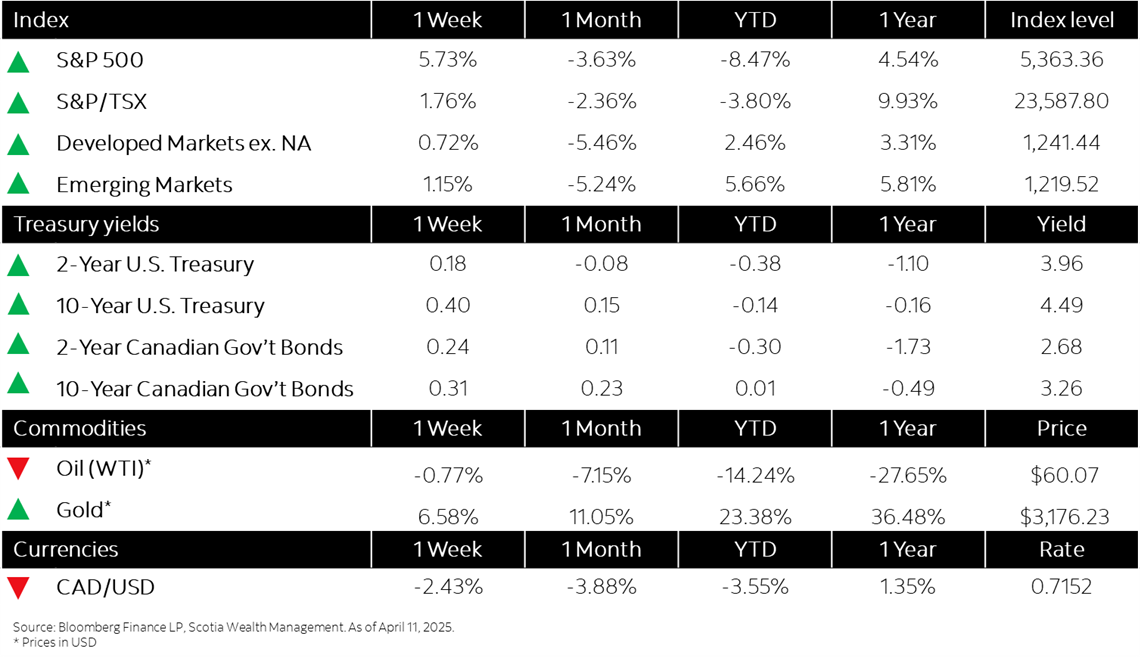
  • U.S. markets returned 5.73%1 for the week following a dramatic escalation of trade tensions with China, a reduction in tariffs on many countries, and mixed economic data, including lower-than-expected CPI and PPI figures, which provided some relief but maintained overall market volatility.
  • Canadian markets returned 1.76%2 for the week, mirroring U.S. trends, with movements driven by trade concerns, aniticipated inflation data, and the broader impact of U.S. tariffs on global economic sentiment, leading to cautious investor behavior.
  • European markets returned 0.72%3 for the week, faced with headwinds from ongoing trade disputes, mixed economic data, and stronger-than-expected U.K. GDP growth providing some relief but not enough to keep the index in the black.
  • Emerging markets closed 1.15%4 lower, impacted by U.S. tariffs and but bolstered by domestic policy responses aimed at supporting internal demand, with significant market fluctuations as investors reacted to the evolving trade landscape and government measures.

Bond market flashes warning signals as longer-term risks come into focus

U.S. rates experienced significant volatility, with the yield curve steepening and the 2-year to 10-year spread widening due to escalating trade tensions and mixed economic data. Rates volatility spiked, particularly in response to risk-off sentiment from Asia. Lower-than-expected CPI and PPI data provided some relief, but overall market jitters persisted. Canadian rates mirrored U.S. trends, while European bond yields rose amid mixed economic data and trade disputes. Credit spreads widened, with investment grade (IG) and high yield (HY) bonds under pressure. Primary markets were largely inactive due to broader market volatility, though some activity resumed later in the week. The sharp rise in rates and trade-related uncertainties kept investors cautious, impacting new issuance and overall market sentiment. Fixed income markets were characterized by increased volatility, widening spreads, and cautious investor behavior amid ongoing trade tensions and mixed economic data.

Highlights:

  • The 2- and 10-year U.S. Treasury yields were 18 basis point (bps) and 40 bps higher, respectively. In Canada, the 2- and 10-year yields were 24 bps and 31 bps higher, respectively. Bond yields and prices move inversely to one another.
  • While US Treasuries auctions generally went well this week, the secondary market is experiencing selling pressures likely due to the correlations with risky assets breaking down, the unwinding of leveraged trades, concerns about lasting inflation and US deficit funding..
  • Credit continues to trade weaker as spreads continue to drift higher. High yield bonds are likely headed for a third week of losses. Primary markets are operating at reduced capacity as weekly volume is running well below projections with the overall risk-off environment.

Weekly dashboard

Trade uncertainty taking toll on Canadian business and consumer confidence, BoC reports say

A pair of reports from the Bank of Canada (BoC) pointed to declining business and consumer sentiment in the first quarter and increased worries about a recession even before U.S. President Donald Trump announced the latest round of tariffs. The central bank’s business outlook survey said that 32% of firms are now planning with the assumption that a recession will occur in Canada over the coming year, up from 15% over the past two quarters. Meanwhile, the Canadian survey of consumer expectations said concerns about job security increased because of the trade conflict.

Highlights:

  • According to the business outlook survey, a smaller proportion of businesses expected sales growth to improve over the coming year at 43% compared with 53% in the fourth quarter of 2024, while plans for investment in machine equipment declined.
  • The proportion of businesses expected to increase their headcount over the next year also fell to 32% compared with 45% in the fourth quarter of last year.
  • The consumer expectations survey also reported that, for the first time since the first half of 2024, the share of consumers who said they are reducing or planning to reduce their overall spending increased.

U.S. inflation cooled to 2.4% in March, lower than expected

U.S. inflation cooled last month, with a year-over-year measure of underlying prices falling to its lowest level in four years. According to the U.S. Labor Department, consumer prices were up 2.4% in March from a year earlier, cooler than February’s gain of 2.8% and well below the 2.6% rise that economists expected. Prices fell from a month earlier by 0.1%.

Highlights:

  • Prices, excluding food and energy categories, rose 2.8%, below forecasts for a 3% increase. That was the smallest increase in the core measure since March 2021.
  • Over the month, energy prices declined steeply, with gasoline prices plunging 6.3%. Prices also fell in categories including airline fares, vehicle insurance, and used cars and trucks. Prices picked up for food, medical care, clothing and new vehicles.
  • Economists expect tariffs will dent economic growth and raise prices for consumers and businesses in the months ahead, teeing up a new battle for the U.S. Federal Reserve, which has spent the past few years struggling to bring inflation down to its 2% target.

German industrial production declines as sector braces for tariffs
Industrial production in Germany fell back into contraction in February, reflecting the persistent weakness of the sector even before U.S. President Trump’s tariff measures were imposed. Output declined 1.3% in February, German statistics agency Destatis reported, contrasting with the 2.0% increase in the first month of 2025. Economists expected a smaller 1.0% drop.

Highlights:

  • According to Destatis, the construction, food, and energy sectors dragged production down. Energy-intensive industrial output declined 0.6%. However, on a less volatile three-month comparison, production ticked up slightly.
  • Germany, whose economy is more export-driven than many of its peers, is among the European nations most exposed to U.S. tariffs on imports.
  • Separate Destatis data showed that exports rose 1.8% in February, more than expected. In particular, exports to the U.S. jumped 8.5%, a potential signal that firms across the Atlantic imported more products than would usually be expected to get ahead of tariffs.