Subscribe to the 100% free rdnewsNOW daily newsletter!
sponsored

Market Watch: Jan. 24, 2025

Jan 27, 2025 | 2:03 PM

This week’s highlights

  • Equity markets move higher even as trade and growth issues simmer
  • Bond markets tread water amid interest rate uncertainty
  • Canada’s annual inflation rate drops to 1.8% in December on sales tax relief
  • IMF raises U.S. growth estimates
  • U.K. jobs market weakens as BoE prepares to ease rates

Week in review

Equity markets move higher even as trade and growth issues simmer

In the U.S., equity markets were initially buoyed by strong corporate earnings and toned down tariff threats under President Trump, but were tempered mid-week as technology stocks declined. In Canada, markets were influenced by mixed economic data, including a deceleration in Consumer Price Index (CPI) inflation and stagnant retail sales, which increased the odds of a rate cut by the Bank of Canada (BoC). European equities saw gains driven by better-than-expected Purchasing Manager Index (PMI) data, though manufacturing remained in contraction. In Japan, a dovish tone from Governor Ueda – despite the Bank of Japan’s rate hike – and positive economic forecasts supported market optimism. In China and emerging markets, investor sentiment was bolstered by easing trade tensions and positive economic indicators, though concerns over global demand persisted.

Highlights:

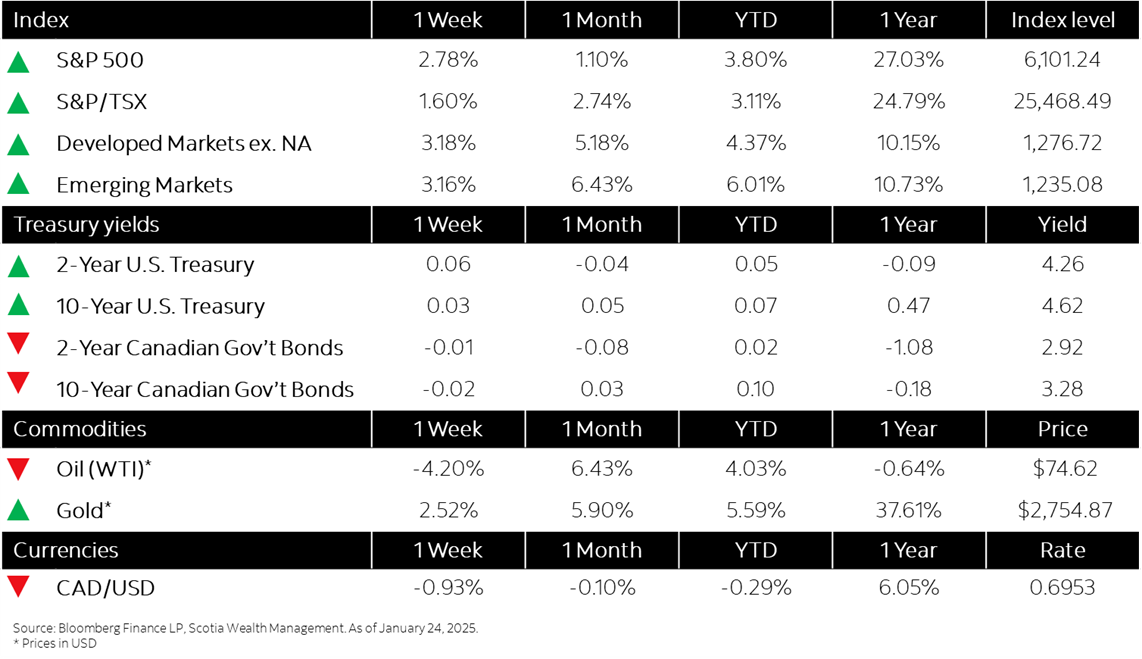
  • U.S. markets returned 2.78%1 for the week after strong corporate earnings and tempered tariff threats put a bid under equities. However, volatility resurfaced mid-week as tech stocks declined and investors re-assessed economic growth prospects.
  • Canadian markets returned 1.60%2 for the week, influenced by mixed economic data including a deceleration in CPI and stagnant retail sales which increased the odds of a rate cut by the BoC.
  • European markets returned 3.18%3 for the week after better-than-expected PMI data drove gains despite ongoing weakness in the manufacturing sector.
  • Emerging markets closed 3.16%4 higher with easing trade tensions and positive economic indicators bolstering investor sentiment even as Chinese and global growth concerns linger along with a potential resurgence in inflation.

Bond markets tread water amid interest rate uncertainty

In the U.S., bond markets initially rallied on optimism over President Trump’s tempered tariff threats but faced volatility mid-week as investors reassessed economic growth prospects. Canadian yields declined following weaker-than-expected CPI inflation and retail sales data, increasing the likelihood of a Bank of Canada rate cut. In Europe, bond markets saw gains driven by better-than-expected PMI data, though manufacturing remained weak. The Bank of Japan’s rate hike and positive economic forecasts caused Japanese government bonds to decline slightly, despite a dovish tone from Governor Ueda. In China and emerging markets, easing trade tensions and positive economic indicators bolstered fixed income markets, though concerns over global demand and inflationary pressures persisted.

Highlights:

  • The 2- and 10-year U.S. Treasury yields were 6 and 3 basis points (bps) higher, respectively. In Canada, the 2- and 10-year yields were down 1 bp and 2 bps, respectively. Bond yields and prices move inversely to one another.
  • Demand for corporate debt remains robust, driving credit spreads to multi-decade tight levels. Investors are no longer forced to reach out for yield as better credit quality alternatives are offered at attractive levels.
  • The coming week is busy with major macro events including both U.S. Federal Reserve (Fed) and BoC rate decisions on Wednesday, followed by the European Central Bank (ECB) on Thursday. The latest set of December U.S. durable goods orders, the first read of Q4 GDP and December’s Personal Consumption Expenditures (PCE) data – the Fed’s preferred inflation gauge – are also due along with U.S. Treasury supply across the curve.

Weekly dashboard

Canada’s annual inflation rate drops to 1.8% in December on sales tax relief

Canada’s annual inflation rate slowed in December, helped by a sales tax break that kicked off at the midpoint of the month and brought down prices of alcohol, restaurant foods, and children’s clothing. According to Statistics Canada (StatCan), the annual inflation rate dropped to 1.8%, a slightly lower-than-expected figure and a tick below the prior month’s 1.9%. On a month-on-month basis, the CPI contracted 0.4%.

Highlights:

  • StatCan said the sales tax break, which impacted a tenth of the components of the CPI basket, will continue until mid-February, and January will see a full month of exemption versus 18 days in December.
  • On an annual basis, prices for alcoholic beverages purchased from stores declined 1.3% in December, compared with a 1.9% increase in November, and food purchased at restaurants dropped 1.6% in December from a rise of 3.4% the previous month.
  • Shelter prices (rent and mortgage costs) rose 4.5% in December on an annual basis, slightly down from the prior month but still elevated.

IMF raises U.S. growth estimates

The International Monetary Fund (IMF) has doubled down on its forecast that the U.S. economy will outpace other big Western countries this year, a path that would cap a remarkable U.S. recovery from the pandemic and a bout of high inflation. The United Nations financial agency raised its estimate for full-year U.S. growth in 2025 to 2.7%, up from 2.2% in the previous round of projections from October.

Highlights:

  • The estimates underscore a potent formula that has powered the U.S. economy through a turbulent global backdrop: a stretch of strong productivity growth, a resilient labour market and an effective policy response from the U.S. Federal Reserve to rising prices.
  • The IMF projects that U.S. gross domestic product expanded 2.8% in 2024, after rising 2.9% a year earlier. That vastly outpaced the eurozone, which likely recorded a 0.8% growth rate last year.
  • The IMF’s forecasts only account for laws already in place, so the changes that U.S. President Donald Trump has promised could impact the projections.

U.K. jobs market weakens as BoE prepares to ease rates

The U.K.’s unemployment rate rose in the three months through November, a fresh sign that its economy is faltering. This increases the likelihood that the Bank of England (BoE) will lower its key interest rate early next month. According to the Office for National Statistics (ONS), unemployment stood at 4.4% of the workforce between September and November, rising from 4.3% in the previous three-month period. That takes joblessness to its joint-highest level since 2021.

Highlights:

  • In spite of that loosening in the jobs market, average regular pay rose 5.6% over the period, an acceleration from 5.2% in the previous three-month period, the ONS reported.
  • The BoE lowered its key rate twice in 2024 and by half a percentage point in total. That was a more cautious response to cooling inflation than either the European Central Bank or the U.S. Federal Reserve.
  • One reason for that caution is the rapid rise in U.K. wages, which BoE policymakers worry could push prices higher in the labour-intensive services sector at a rate that would keep inflation above its target over the coming years.

1 S&P 500 Index CAD
2 S&P/TSX Composite Index CAD
3 Bloomberg Developed Markets ex N. America Large & Mid Cap Price Return Index CAD
4 Bloomberg EM Large & Mid Cap Price Return Index CAD