
Subscribe to the 100% free rdnewsNOW daily newsletter!
sponsored

Market Watch: September 20, 2024

Sep 21, 2024 | 12:36 PM

This week’s highlights

  • Sentiment surges mid-week sending indices to all-time highs
  • Rate cut drives repricing and spread tightening
  • Canada’s inflation rate cools to 2% in August, hitting Bank of Canada’s target
  • Fed cuts rates by half percentage point
  • German economic expectations darken further
  • In the news: GM adopts Tesla chargers to boost EV sales amid slump

Week in review

Sentiment surges mid-week sending indices to all-time highs

Equity markets experienced a significant boost mid-week, primarily driven by the U.S. Federal Reserve’s (Fed) unexpected 50 basis point (bps) rate cut. This relatively aggressive move to ease monetary policy lifted investor sentiment, pushing major U.S. and Canadian indices to all-time highs. The rate cut was seen as a pre-emptive measure to ensure a soft landing as the labour market continues to soften. This decisive action by the Fed overshadowed other economic indicators and corporate actions, leading to a notable gap higher in the markets. In Europe, however, investor confidence was dampened by Germany’s declining ZEW Survey results and lower car sales expectations from China, highlighting a divergence in market reactions globally.

Highlights:

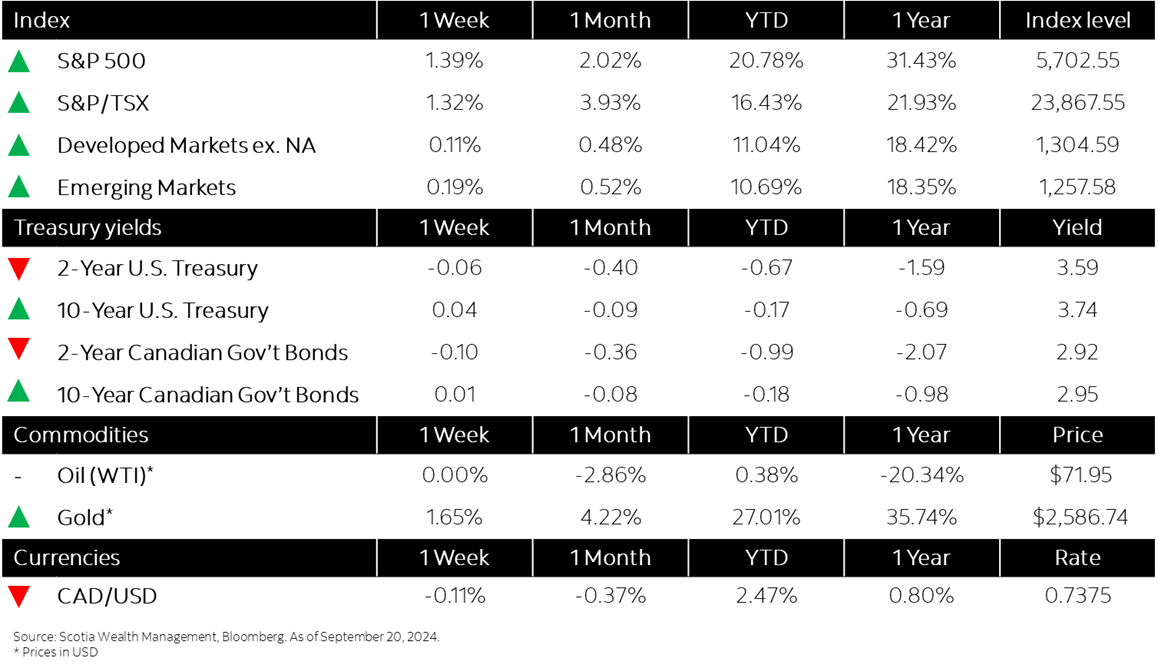
  • U.S. markets closed 1.39%1 higher for the week, driven by the Federal Reserve’s unexpected 50 bps rate cut which boosted investor sentiment and overshadowed mixed economic data and corporate actions. .
  • Canadian markets rose 1.32%2 for the week, influenced by softer inflation data which reinforced expectations of a rate cut by the Bank of Canada, and mixed housing data, reflecting regional variations in price growth..
  • European markets returned 0.11 %3 for the week, dampened by declining investor confidence in both Germany and the U.K.
  • Emerging markets closed 0.19%4 higher for the week as weak consumer demand in China continued to drive concerns about future growth prospects amid an ongoing property slump.

Rate cut drives repricing and spread tightening

The Fed’s policy shift catalyzed a significant repricing across the yield curve this week, with both short and long-term rates adjusting in response; short-term rates, which are usually more sensitive to interest rate movements, were lower, while longer-term rates, which are more sensitive to inflation, were slightly higher. Concurrently, credit spreads tightened as the market digested the implications of lower future borrowing costs, driving demand for higher-yielding corporate debt. In Canada, softer inflation data reinforced expectations of additional rate cuts by the Bank of Canada (BoC). Both the Bank of England (BoE) and the Bank of Japan’s (BoJ) decision to hold rates steady highlighted the divergence in global monetary policy regimes.

Highlights:

  • The 2-year U.S. Treasury yield was 6 bps lower while the 10-year yield was 5 bps lower. In Canada the 2-year yield was 10 bps higher while the 10-year yield was 1 bp higher. Bond yields and prices move inversely to one another.
  • The Investment grade (IG) primary market has slowed for the week with volumes running below projections. Despite that, September new issuance has already topped estimates running at $130.4bn USD versus $125.0bn
  • According to Bloomberg, average coupons on IG primary supply have dropped from 5.15% in August to 4.82% in September. Improving funding costs could potentially attract more supply and help stabilize interest coverage which has been deteriorating since Q3 2022.

Weekly dashboard

(Scotia Wealth Management/Bloomberg)

Canada’s inflation rate cools to 2% in August, hitting Bank of Canada’s target

Canada’s annual inflation rate has returned to the Bank of Canada’s (BoC) 2% target for the first time since 2021, a milestone for central bankers in their journey to restore price stability in the economy. Statistics Canada (StatCan) reported that the Consumer Price Index (CPI) rose at an annual rate of 2% in August, down from 2.5% in July. The result was a touch lower than analyst estimates of 2.1%. On a monthly basis, consumer prices fell 0.2%. While a return to 2% inflation is a major accomplishment for central bankers, they’ve also warned that coming results could be lumpy and expressed concern that inflation could drift below the 2% target.

Highlights:

  • Prices for clothing and footwear dropped 0.6% in August from July as retailers offered discounts to consumers during the back-to-school season. StatCan said this was the first monthly decline in August for this category since 1971.
  • Gasoline prices fell 5.1% on a monthly basis in August, given recent weakness in oil markets. Prices at the pump are trending lower in September, which could lead to another soft reading for overall CPI.
  • Housing costs remained high, although there was some improvement. Shelter costs rose at an annual rate of 5.3% in August, down from 5.7% in July.

Fed cuts rates by half percentage point

The Fed voted to lower interest rates by a half percentage point, opting for a bolder start in making its first reduction since 2020. The long-anticipated pivot followed the central bank’s two-year-old fight against inflation. Eleven of 12 Fed voters backed the cut, which will bring the benchmark federal funds rate to a range between 4.75% and 5%. “The committee has gained greater confidence that inflation is moving sustainably toward 2%, and judges that the risks to achieving its employment and inflation goals are roughly in balance,” policymakers on the U.S. central bank’s rate-setting committee said in a statement.

Highlights:

  • Policymakers see the Fed’s benchmark rate falling by another half of a percentage point by the end of this year, another full percentage point in 2025, and by a final half of a percentage point in 2026 to end in a 2.75%-3% range.
  • The endpoint reflects a slight upgrade, from 2.8% to 2.9%, in the longer-run federal funds rate, considered a “neutral” stance that neither encourages nor discourages economic activity.
  • Even though inflation “remains somewhat elevated,” the Fed statement said policymakers chose to cut the overnight rate to the 4.75%-5% range “in light of the progress on inflation and the balance of risks.”

German economic expectations move lower

German economic sentiment worsened unexpectedly sharply this month, another signal of weakness in Europe’s largest economy as optimism continues to dwindle. The closely watched ZEW Indicator of Economic Sentiment, which tracks analysts’ expectations for the economy in the next six months, fell 15.6 points on the month to 3.6 in September, far below expectations of 15.5 from economists forecast. The index has been in positive territory since November 2023, but the latest figures indicate that analysts judging Germany’s economy are now evenly balanced between optimists and pessimists.

Highlights:

  • ZEW’s separate indicator of the current situation of the country’s economy also tumbled, reaching a level almost as bad as at the start of the pandemic in spring 2020.
  • Germany’s economy unexpectedly contracted in the second quarter of this year, and economists are expecting only waning growth for the rest of 2024 as the country grapples with a persistent slump in its key industrial base.
  • Survey data for August showed deteriorating sentiment for business owners in the manufacturing sector, while elsewhere, consumer confidence lapsed further as the one-off boost from the European soccer championship faded.

In the news: GM adopts Tesla chargers to boost EV sales amid slump
General Motors (GM) has officially rolled out compatibility with Tesla’s North American Charging Standard (NACS), allowing GM electric vehicle (EV) owners to access Tesla’s extensive Supercharger network using an approved adapter. This move is expected to help boost EV adoption by alleviating one of the major pain points for potential buyers: charging infrastructure. With EV sales currently facing a slump, the increased accessibility to reliable and widespread charging options could make EVs more appealing to a broader audience.

Behind the headline:

  • GM EV owners can now use the roughly 61,000 public chargers, including 27,000 Tesla Superchargers, enhancing the convenience and reliability of charging.
  • Starting in 2025, GM will integrate NACS ports directly into new EV models, further simplifying the charging process and eliminating the need for adapters.
  • Several major automakers, including BMW, GM, Honda, Hyundai, Mercedes-Benz, Stellantis and Kia, are collaborating to enhance EV charging and create a high-powered charging network across North America in urban and highway locations in an effort to make EV charging more convenient and accessible.

1 S&P 500 Index CAD
2 S&P/TSX Composite Index CAD
3 Bloomberg Developed Markets ex N. America Large & Mid Cap Price Return Index CAD
4 Bloomberg EM Large & Mid Cap Price Return Index CAD

For local news delivered daily to your email inbox, subscribe for free to the rdnewsNOW newsletter by visiting rdnewsNOW.com. You can also download the rdnewsNOW mobile app on Google Play and the Apple App Store for all the latest updates on this and other stories.