
Subscribe to the 100% free rdnewsNOW daily newsletter!
SPONSORED

Market Watch: August 9

Aug 12, 2024 | 11:00 AM

This week’s highlights

  • Global markets close a turbulent week on a cautious note
  • Bond yields face a volatile week as markets continue to parse economic trends
  • Canada’s services economy contracted further in July as activity, new business declined
  • U.S. service sector rebounds in July
  • Eurozone retail sales mark disappointing backslide
  • In the news: Disney’s streaming services post profits for the first time

Week in review

Global markets close a turbulent week on a cautious note

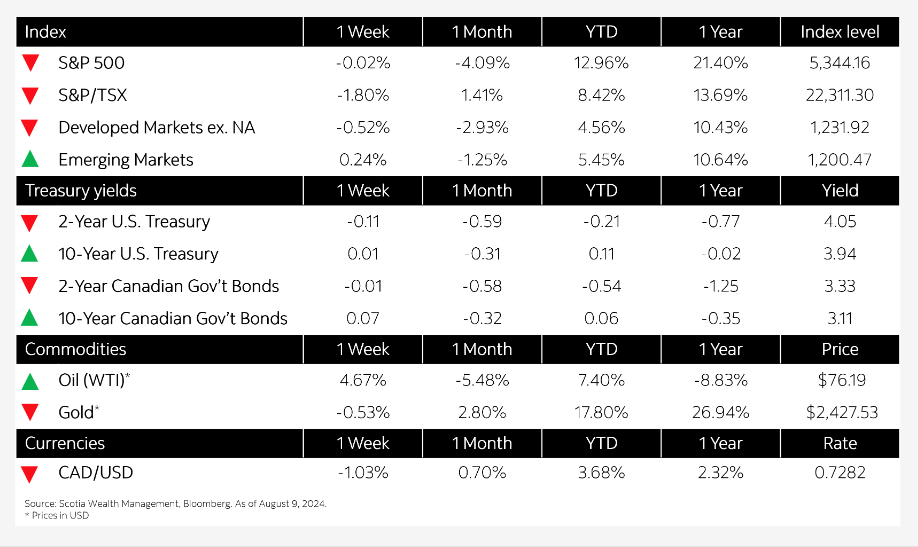
Global indices recovered some of the week’s early losses as concerns of a potential U.S. recession subsided. This was mainly due to the weekly U.S. unemployment claims data, which helped calm investors’ nerves about labour market weakness. The markets also responded positively to the Bank of Japan Deputy Governor Shinichi Uchida’s dovish message. Equity markets experienced a sell-off that started late last week, continuing into this week as muted U.S. payrolls data from the prior week and the unwinding of yen-carry trade positions led to a sense of unease in the markets. This week marked the most volatile week of 2024 for the market.

Highlights

  • U.S. markets were -0.02 per cent1 lower for the week, as fresh labour market data bolstered investor trust in the U.S. economy and alleviated worries of a potential recession.
  • Canadian markets declined -1.80 per cent2 for the week, as markets evaluated Statistics Canada data indicating an unexpected loss of 2,800 jobs in July and a persistent unemployment rate of 6.4 per cent.
  • European markets returned -0.52 per cent3, as markets recouped some of the initial weekly losses, boosted by gains in the real estate, healthcare, travel and leisure sectors.
  • Emerging markets returned 0.24 per cent4 as investors analyzed key economic data out of China that showed a faster-than-expected rise in imports in July and a year-on-year increase in the consumer price index.

Bond yields face a volatile week as markets continue to parse economic trends

U.S. Treasury yields trended lower by the end of the week after ticking up initially as the markets continued to assess the state of the U.S. economy as recent reports indicated a decrease in the weekly jobless claims showed a positive sign for the labour market after last week’s weaker-than-expected jobs report heightened concerns about a broader economic slowdown. First-time filings for jobless benefits were reported at a seasonally adjusted figure of 233,000 for the week, marking a decrease of 17,000 from the preceding week’s revised level. Markets have now shifted their attention towards crucial inflation data for next week – U.S. producer price index reading and consumer price index report – to assess the potential of a rate reduction in September.

Highlights

  • The 2-year U.S. Treasury yield was 11 basis points (bps) lower, while the 10-year yield was up by 1 bp. In Canada, the 2- yield was 1 bp lower, whereas the 10-year was higher by 7 bps.
  • Since last week, bond markets have experienced significant volatility due to concerns about a slowing U.S. economy triggered by labour data, amidst economic and geopolitical uncertainties, and thus the MOVE index, a measure of implied yield volatility, surpassed the low range observed in Q2 this year.
  • Credit spreads remain elevated as primary bond markets saw a surge in transactions following a brief pause at the beginning of the week, driven by investment grade issuers, who are potentially bracing for a volatile market throughout the remainder of the summer.

Weekly dashboard

Canada’s services economy contracted further in July as activity, new business declined

Canada’s services economy deteriorated in July as activity and new business declined, while elevated wage costs contributed to increased inflation pressures, S&P Global Canada services purchasing manager’s index (PMI) data showed. The headline business activity index edged up to 47.3 from 47.1 in June but was holding well below the 50 no-change threshold, signalling reduced activity. “The latest PMI report on the Canadian services economy paints a subdued picture of sector performance, with activity and new business falling again,” Paul Smith, economics director at S&P Global Market Intelligence, said in a statement. “That said, there were some positive developments, with sales volumes moving towards stabilization and a slight pick-up in confidence for the first time in five months.”

Highlights

  • The new business index rose to 49.2 from 47.9 in June, and the measure of future activity was at 60.4, up from 59.0 in the prior month. This was the first increase since February.
  • The input prices climbed to 58.1 from 56.2 in June. “Inflation remains stubborn and is largely driven by elevated wage pressures …That’s the kind of development that will make the Bank of Canada a little wary of enacting further rate cuts,” Smith said.
  • The S&P Global Canada Composite PMI Output Index, which captures manufacturing as well as service sector activity, fell to 47.0 last month from 47.5 in June, marking its lowest level since March. Manufacturing PMI came in at 47.8 in July, its lowest level this year, down from 49.3 in June.

U.S. service sector rebounds in July

U.S. services sector activity rebounded from a four-year low in July amid a bounce back in new orders and the first increase in employment in six months, which could help to quash fears of a recession that have been sparked by a surge in the unemployment rate last month. The Institute for Supply Management (ISM) reported that its nonmanufacturing purchasing managers (PMI) index increased to 51.4 last month from 48.8 in June, which was the lowest level since May 2020. A PMI reading above 50 indicates growth in the services sector, which accounts for more than two-thirds of the economy. The ISM views readings above 49 over time as generally indicating an expansion of the overall economy.

Highlights

  • The ISM survey’s new orders measure rebounded to 52.4 from 47.3 in June, the lowest since December 2022. Its measure of services employment increased to 51.1, growing for the first time since January, from 46.1 in June. The five-point rise in the index was the second-largest in more than three years after January’s 6.7-point increase.
  • That increase supports views that the slowdown in nonfarm payrolls in July did not signal the start of labour market deterioration. Nonfarm payrolls increased 114,000 last month, the second smallest gain this year, while service providers added just 72,000 jobs, the fewest since December 2020, when both services and overall employment fell.
  • Services inflation picked up a bit in July, but probably not enough to alter the picture of subsiding price pressures. The ISM’s prices paid measure for services inputs edged up to 57.0 from 56.3 in June.

Eurozone retail sales mark disappointing backslide

Retail sales unexpectedly fell in June in the eurozone as a consumption-led recovery continued to prove elusive. Total retail trade was 0.3% lower than in May, figures from the EU statistics agency showed, bucking economists’ expectations for a continued rise in sales. So far this year, the eurozone has failed to book two consecutive months of higher retail sales despite a steady increase in real incomes as inflation eases and wages rise.

Highlights

  • Spending both on food and other goods declined compared with May, while fuel sales increased.
  • The figures don’t include Germany, the eurozone’s most important economy. Of the bloc’s other major economies, France and Italy both booked falling sales, while Spain registered an increase.
  • Hopes for a pickup in consumer spending remain in the second half of the year. In July, confidence among eurozone households reached its highest level since before the Ukraine-Russia conflict and a possible second cut to interest rates by the European Central Bank in September would ease the cost of credit and boost investment.

In the news: Disney’s streaming services post profits for the first time
Disney’s combined streaming business, which consists of the flagship Disney+, general entertainment service Hulu and the sports-focused ESPN+, turned a profit for the first time, a feat which only Netflix has been able to achieve consistently. The combined streaming business posted an operating profit of US$47 million compared with a loss of US$512 million in the same quarter last year. Although Disney’s quarterly streaming profits may appear modest, the positive shift in this sector is significant, given that historical streaming losses, coupled with a dwindling traditional pay TV business and numerous box office failures, had previously burdened the profitability generated by the company’s theme parks and resorts. The advancement of Disney’s streaming business towards profitability, a universal objective among media companies, has been largely due to a widespread transition in consumer and advertiser preferences towards digital and streaming platforms.

Behind the headline:

  • Since its November 2019 launch, Disney+ has experienced an over US$11 billion deficit due to the escalating streaming industry competition and increasing content production and licensing costs.
  • Over the past few years, the company has strategically increased the pricing of its streaming services multiple times to enhance subscription revenue growth, and just this week, Disney declared another round of price hikes, set to take effect in October.
  • Disney is also planning to implement a crackdown on password sharing starting in September, a strategy aimed at generating new subscribers and additional revenue, a tactic that has proven successful for Netflix in acquiring new customers over the past year.

1S&P 500 Index CAD
2S&P/TSX Composite Index CAD
3Bloomberg Developed Markets ex N. America Large & Mid Cap Price Return Index CAD
4Bloomberg EM Large & Mid Cap Price Return Index CAD