
Subscribe to the 100% free rdnewsNOW daily newsletter!
sponsored

Market Watch: August 2, 2024

Aug 3, 2024 | 10:00 AM

This week’s highlights

  • Global markets fall as cooling labour data sparks slowdown concerns
  • Bond yields fall as key data indicate a softer labour market
  • Canada’s GDP likely to surpass central bank’s second-quarter forecast
  • U.S. Fed clears path for September rate cut
  • Eurozone inflation picks up pace in blow to rate-cut hopes
  • In the news: OPEC+ sticks to output cuts while signalling possible future increases

Week in review

Global markets fall as cooling labour data sparks slowdown concerns

Global indices fell for the week as investors unpacked economic data revealing a sharper-than-expected slowdown in the U.S. job market in July and a rising unemployment rate, intensifying concerns of a potential economic slowdown. Initial optimism from the U.S. Federal Reserve’s (the Fed) meeting earlier in the week, which suggested a potential rate cut in September, dissipated due to weak economic data, leading to a sell-off in global equity markets on Thursday and Friday. While this sell-off was broad-based, large-cap technology firms and global semiconductor companies experienced a significant fall as concerns over their muted earnings growth and the feasibility of further investments in artificial intelligence (AI) during an economic slowdown contributed to the negative sentiment.

Highlights:

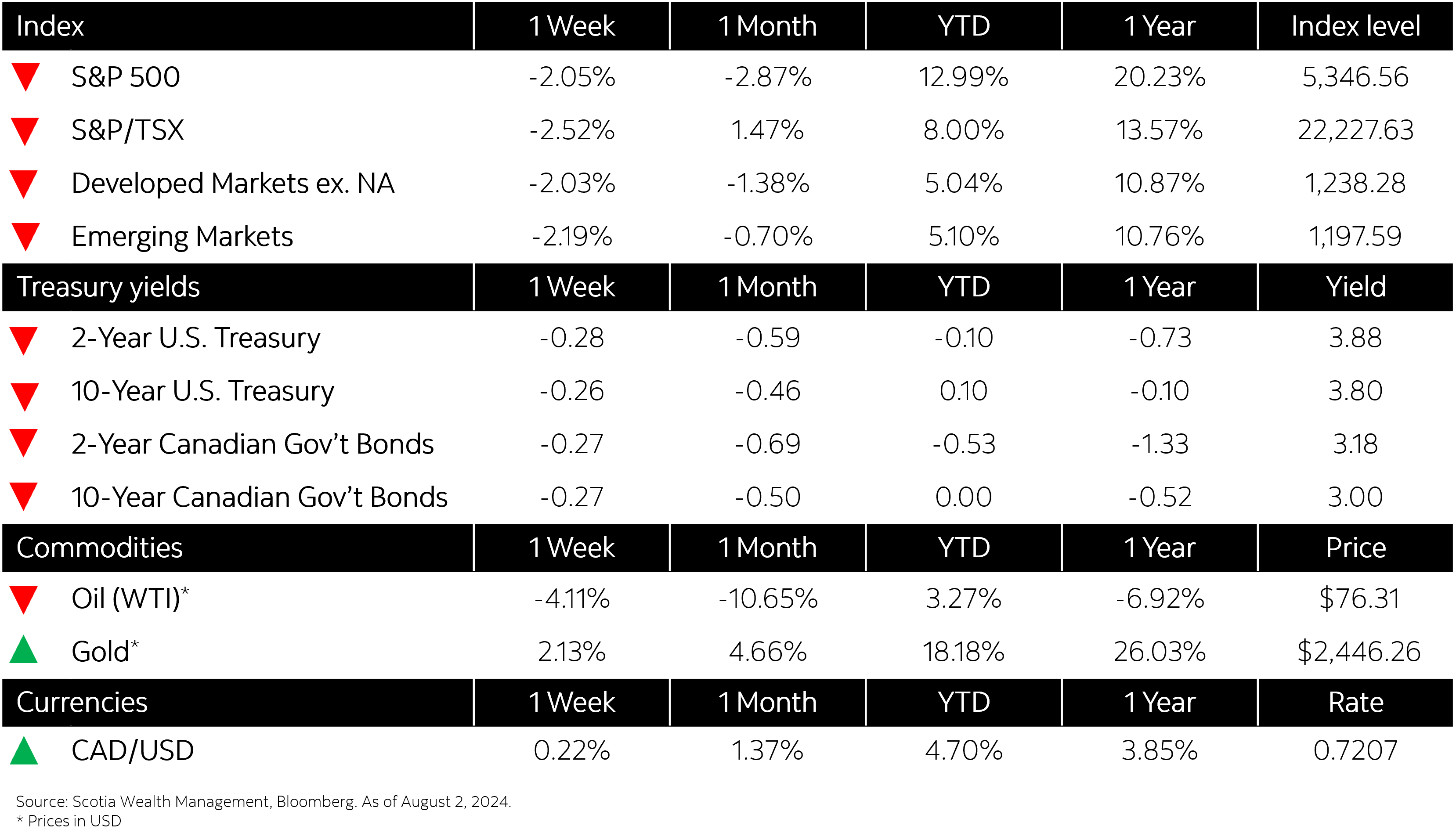
  • U.S. markets were -2.05%1 lower for the week, driven by a sharp drop in technology shares following muted earnings from tech giants Intel and Amazon.com and economic data released this week indicating a faster-than-expected cooling of the labour market.
  • Canadian markets returned -2.52%2 for the week, fuelled by broader declines across the index except for materials, which benefited from rising gold prices and utilities.
  • European markets returned -2.03%3 for the week, with markets reacting negatively to U.S. labour market data and were weighed down by weak earnings reports in the technology sector.
  • Emerging markets declined -2.19%4 driven by global growth concerns stemming from disappointing economic data from the U.S. and further fuelled by China’s ongoing economic slowdown.

Bond yields fall as key data indicate a softer labour market

U.S. Treasury yields declined this week as markets absorbed remarks from Federal Reserve Chair Jerome Powell, who suggested a potential rate cut in September. Additionally, a weaker-than-expected jobs report heightened concerns about broader economic challenges. The 10-year treasury yields traded close to the 12-month lows as nonfarm payrolls increased by 114,000 in July, lower than a downwardly revised 179,000 in June. The unemployment rate edged higher to 4.3%, its highest level since October 2021, further indicating a potentially weakening labour market. On the back of the data releases this week, credit spreads are wider, with high yield underperforming relative to investment grade.

Highlights:

  • The 2-year U.S. Treasury yield was 28 basis points (bps) lower, while the 10-year yield was down by 26 bps. In Canada, the 2- and 10-year yields were 27 bps and 27 bps lower, respectively.
  • The Institute of Supply Management (ISM) Manufacturing Purchasing Managers Index (PMI), a critical indicator for the Federal Reserve, fell to 46.8% in July, marking its fourth consecutive month of contraction. Additionally, initial unemployment claims rose to 245,000, reaching their highest level in nearly a year.
  • High-yield new issuance has increased by 79% year-over-year. However, according to Bloomberg data, August, with a decade-long history of mixed performance, may experience volatility due to seasonally low volumes.

Weekly dashboard

Canada’s GDP likely to surpass central bank’s second-quarter forecast

Canada’s economy likely gathered some momentum in the second quarter and surpassed Bank of Canada (BoC) growth estimates, data showed, as high interest rates failed to dampen an uptick in manufacturing and oil transportation. However, retail and wholesale sales continue to be subdued, weighing on growth. Statistics Canada (StatCan) reported that Canada’s gross domestic product grew 0.2% in May, adding that a preliminary estimate for June shows the economy probably expanded 0.1 %, taking the quarterly economic growth rate to 2.2%. In the previous quarter, growth was 1.7%, and BoC forecasted a growth of 1.5% in the second quarter ended June 30.

Highlights:

  • Growth in May was led by the manufacturing sector, which posted its largest gain since January 2023, and educational services, health care and social assistance, and public administration.
  • The opening of the expanded Trans Mountain pipeline in May also contributed to growth, helping the pipeline transportation sector post a 0.6% gain in the month, StatCan said.
  • Gains were partly offset by contractions in retail trade and wholesale trade, as well as the mining, quarrying and oil and gas extraction sectors.

U.S. Fed clears path for September rate cut

U.S. Federal Reserve (Fed) Chair Jerome Powell said interest rates could be cut as soon as September if the U.S. economy follows its expected path, putting the central bank near the end of a more than two-year battle against inflation. The Fed ended its latest two-day policy meeting with a decision to hold its benchmark interest rate steady in the 5.25%-5.50% range that was set a year ago, but its statement softened the description of inflation and said the risks to employment were now on a par with those of rising prices, neutral language that opens the door for rates to fall after more than two years of tightening credit.

Highlights:

  • Powell pushed the message even further forward in his post-meeting press conference saying, “If we were to see inflation moving down in line with expectations, growth remains reasonably strong, and the labour market remains consistent with current conditions, then I think a rate cut could be on the table at the September meeting.”
  • Powell said some Fed policymakers even discussed the logic of cutting rates at this session, but “the sense of the committee was not at this meeting, but as soon as the next meeting, depending on how the data comes in.”
  • Powell’s remarks affirmed what investors had come to see as a near certainty: that the Fed would pivot in September from an era of restrictive interest rates to a steady easing of credit policy that would eventually see inflation reach the 2% level without undue damage to the labour market.

Eurozone inflation picks up pace in blow to rate-cut hopes

Inflation unexpectedly heated up in the eurozone in July, presenting a fresh challenge to policymakers looking for signs that eurozone price rises are easing sustainably. Consumer prices were 2.6% higher on year in July, picking up pace from June, according to EU figures. That defied economists’ expectations for a slight decrease in inflation over the month and leaves the rate further from the European Central Bank’s (ECB) elusive 2% target. Inflation heated up over the month in Germany, France and Italy, the eurozone’s three largest economies. Core inflation, which strips out the often volatile effects of food and energy prices, meanwhile stayed stable, against expectations for a slight decrease. But services, a key focus for policymakers at the ECB, did fall slightly.

Highlights:

  • The decline in services makes a cut to interest rates a possibility in September. However, the higher headline rate may give pause to the central bank as it mulls its next steps in the 20-member eurozone.
  • The ECB cut interest rates for the first time in five years last month but has refused to be drawn on when and how quickly it will continue to lower rates from their current heights.
  • Markets still expect a second cut to rates at the bank’s next policy meeting in September, but with less certainty than earlier in the summer.

In the news: OPEC+ sticks to output cuts while signalling possible future increases
OPEC+ ministers have decided to maintain the current oil output policy, which includes beginning to roll back one layer of production cuts starting in October. They also reiterated that this increase could be paused or reversed if necessary. Several ministers from the Organization of the Petroleum Exporting Countries (OPEC) and their allies, led by Russia, convened an online Joint Ministerial Monitoring Committee (JMMC) meeting on Thursday, noting high overall conformity among OPEC and non-OPEC countries participating in the Declaration of Cooperation (DoC). The committee highlighted the commitment of Iraq, Kazakhstan, and Russia to achieve full conformity and acknowledged their compensation plans for overproduced volumes since January 2024. OPEC+ members reiterated that the gradual phase-out of the voluntary production cuts could be paused or reversed based on market conditions. The JMMC will continue monitoring production adjustments and retains the authority to convene additional meetings as necessary.

Behind the headline:

  • OPEC+ is currently reducing oil production by 5.86 million barrels per day, which represents approximately 5.7% of global demand. This reduction is part of a series of measures implemented since 2022 to support the market in response to uncertainties surrounding global demand and increasing supply from outside the group.
  • Oil prices have dropped from a 2024 peak of ~$87 USD per barrel in April to ~$74 USD in July, driven by concerns about demand strength. However, this week, prices found some support due to rising tensions in the Middle East.
  • “Starting from the fourth quarter, if the balance of supply and demand is positive, a partial increase in production is possible,” Russian Deputy Prime Minister Alexander Novak said.

Disclaimer

This publication has been prepared by The Bank of Nova Scotia for Scotia Wealth Management clients. It is for general information purposes only and should not be considered or relied upon as personal and/or specific financial, tax, pension, insurance, legal or investment advice. We are not tax or legal advisors, and we recommend that individuals consult with their qualified advisors, including tax and legal advisors, before taking any action based upon the information contained in this publication. The opinions and projections contained in this publication are our own as of the date hereof and are subject to change without notice. Scotia Wealth Management is under no obligation to update this commentary, and readers should assume the information contained herein will not be updated. While care and attention has been taken to ensure the accuracy and reliability of the material in this publication, neither The Bank of Nova Scotia nor any of its affiliates or any of their respective directors, officers or employees make any representations or warranties, express or implied, as to the accuracy or completeness of such material and disclaim any liability resulting from any direct or consequential loss arising from any use of this publication or the information contained herein. This commentary may contain forward-looking statements based on current expectations and projections about future general economic factors. Forward-looking statements are subject to inherent risks and uncertainties which may be unforeseeable and such expectations and projections may be incorrect in the future. Forward-looking statements are not guarantees of future performance and you should avoid placing undue reliance upon them. This publication and all the information, opinions and conclusions contained herein are protected by copyright. This publication may not be reproduced in whole or in part without the prior express consent of The Bank of Nova Scotia.

® Registered trademark of The Bank of Nova Scotia, used under licence. ™ Trademark of The Bank of Nova Scotia, used under licence. Scotia Wealth Management® in Canada consists of a range of financial services provided by The Bank of Nova Scotia (Scotiabank®); The Bank of Nova Scotia Trust Company (Scotiatrust®); Private Investment Counsel, a service of 1832 Asset Management L.P.; 1832 Asset Management U.S. Inc.; Scotia Wealth Insurance Services Inc.; and ScotiaMcLeod®, a division of Scotia Capital Inc. Private banking services are provided by Scotiabank. Estate and trust services are provided by The Bank of Nova Scotia Trust Company. Portfolio management is provided by 1832 Asset Management L.P. and 1832 Asset Management U.S. Inc. Insurance services are provided by Scotia Wealth Insurance Services Inc. Wealth advisory and brokerage services are provided by ScotiaMcLeod, a division of Scotia Capital Inc. International investment advisory services are provided by Scotia Capital Inc. Financial planning services are provided by Scotiabank and ScotiaMcLeod. Scotia Capital Inc. is a member of the Canadian Investor Protection Fund and regulated by the Canadian Investment Regulatory Organization. Scotia Wealth Insurance Services Inc. is the insurance subsidiary of Scotia Capital Inc., a member of the Scotiabank group of companies. When discussing life insurance products, ScotiaMcLeod advisors are acting as Life Insurance Agents (Financial Security Advisors in Quebec) representing Scotia Wealth Insurance Services Inc.

Scotia Wealth Management® in The Bahamas consists of a range of financial services provided by Scotiabank (Bahamas) Limited and The Bank of Nova Scotia Trust Company (Bahamas) Limited. International private banking and international investment advisory services are provided by Scotiabank (Bahamas) Limited, an entity licensed with The Central Bank of The Bahamas and The Securities Commission of The Bahamas. International wealth structuring solutions are provided by The Bank of Nova Scotia Trust Company (Bahamas) Limited, an entity licensed with The Central Bank of The Bahamas.

Scotia Wealth Management® in the Cayman Islands consists of a range of financial services provided by Scotiabank & Trust (Cayman) Ltd., an entity licensed by the Cayman Islands Monetary Authority. Scotiabank & Trust (Cayman) Ltd. provides international private banking services, international investment advisory services, and international wealth structuring solutions.

For local news delivered daily to your email inbox, subscribe for free to the rdnewsNOW newsletter by visiting rdnewsNOW.com. You can also download the rdnewsNOW mobile app on Google Play and the Apple App Store for all the latest updates on this and other stories.