Subscribe to the 100% free rdnewsNOW daily newsletter!
Sponsored

Market Watch: January 12

Jan 16, 2024 | 3:30 PM

This week’s highlights

  • Bank earnings buoy markets amid geopolitical events and inflation readings
  • Sovereign yields move lower, strong demand for investment grade credit
  • Canada’s trade surplus narrowed in November as imports rose on nuclear fuel
  • U.S. inflation edged up in December after rapid cooling most of 2023
  • Eurozone inflation rises less than expected
  • In the news: First of its kind Bitcoin ETF approved by regulators

Week in review

Bank earnings buoy markets amid geopolitical events and inflation readings

It was a volatile week for global equities with major events on a number of fronts. For December, U.S. consumer price inflation came in higher than expected, while producer price inflation came in lower than expected, leaving investors’ rate outlook unchanged. A coalition of Western nations launched a series of airstrikes in Yemen following missile attacks in the Gulf of Aden and Red Sea which resulted in a jump in energy prices. Finally, major U.S. banks began reporting fourth quarter earnings which investors have been closely watching to assess the impact that higher interest rates are having on the nation’s financial health.

Highlights:

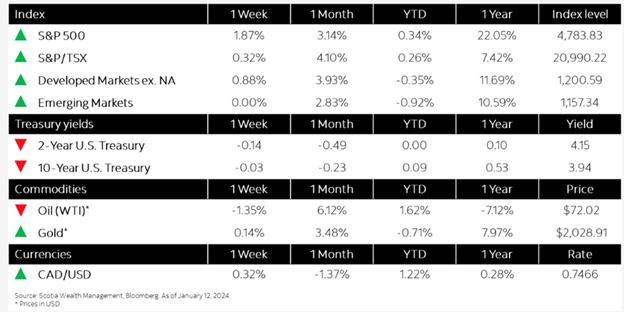
  • U.S. markets returned 1.87%1 following mixed inflation figures, initial jobless claims that point to continued strength in the labour market, and fourth quarter earnings from major banks that indicate a financially solid footing.
  • Canadian equities moved higher for the week, closing 0.32%2 higher, buoyed by strong returns in the info tech and consumer discretionary sectors.
  • European equities advanced 0.88%3 following a better-than-expected November GDP reading out of the U.K. The data implies that the U.K. would require a flat December GDP reading to avoid a fourth quarter contraction.
  • Emerging markets were flat4 given the risk-neutral environment.

Sovereign yields move lower, strong demand for investment grade credit

Despite some volatility throughout the week following the release of both the Consumer Price Index (CPI) and Producer Price Index (PPI) readings, bond yields settled slightly lower for the week. Despite a slight uptick in headline inflation, expectations about Fed policy rate forecasts have not changed significantly, with markets pricing in a rate cut as early as March. The U.S. credit market continues to do well despite heavy volume in the primary market, particularly in investment grade which has been in high demand as primary issuance is on pace to beat projections running at $99.8bn USD month-to-date.

Highlights:

  • The 2-year U.S. Treasury yield fell 14 basis points (bps) while the 10-year yield was down 3 bps. In Canada, the 2-year yield was down 7 bps and 10-year yield up 1 bps.
  • December PPI came in mostly higher than the previous period and at or below expectations on both headline and core month-over-month and year-over-year measures.
  • Downgrade potential has built up in the last few months for a good part of investment grade space. Bonds rated AA-, A and high BBBs are mostly biased to move to lower quality grade, along with the entire speculative space. On the other hand, mid and low BBBs are predominantly positioned for upgrades, according to Bloomberg.

Weekly dashboard

Canada’s trade surplus narrowed in November as imports rose on nuclear fuel

Canada posted a smaller-than-expected trade surplus of $1.57-billion in November, as nuclear fuel and other energy products spurred an increase in imports while exports were dragged down by precious metals and aircraft. The decline in exports, the first since June, was mainly due to lower exports of unwrought gold, silver, and platinum group metals, as well as exports of aircraft and other transportation equipment and parts.

Highlights:

  • According to Statistics Canada, total exports fell 0.6%, while imports were up 1.9%, and overall it was the fourth consecutive monthly surplus.
  • On the imports side, energy products and industrial machinery were the main drivers of growth.
  • Imports of motor vehicles and parts and consumer goods declined however, in a sign of slowing demand.

U.S. inflation edged up in December after rapid cooling most of 2023

Inflation firmed up at year’s end after the pace of price gains fell by nearly half in 2023. The U.S. Labor Department reported that the consumer-price index climbed 0.3% in December from the prior month and increased 3.4% from a year earlier. That compares with November’s 0.1% monthly gain and marks an acceleration from that month’s 3.1% annual increase. The report isn’t likely to change the Federal Reserve’s near-term policy outlook.

Highlights:

  • Prices rose in December as Americans paid more for rent, auto insurance and dental visits, while furniture, toys and sporting goods fell. Energy costs increased 0.4% on the month, driven by a rise in gasoline and electricity prices on a seasonally adjusted basis.
  • Core prices, which strip out volatile food and energy items, rose 0.3% in December from the prior month, the same monthly increase as November. Core prices increased 3.9% from a year earlier, a modest slowing from November’s 4% annual increase.
  • Overall inflation is well down from 6.5% at the end of 2022, and wages have grown, meaning many consumers are seeing their dollars go further.

Eurozone inflation rises less than expected

Eurozone inflation rebounded in December but by less than expected, potentially fueling further speculation that the European Central Bank (ECB) could soon signal its readiness to cut interest rates. According to preliminary data published by the European Union’s statistics agency Eurostat, the bloc’s consumer price index rose 2.9% on the year from 2.4% in November. Although a bounce back in inflation was expected, it came in lower than economists expected. Inflation had fallen for five straight months until November.

Highlights:

  • Core inflation, which removes volatile energy, food, alcohol, and tobacco prices, dipped to 3.4% in December from 3.6% in November.
  • The cooler-than-expected readings for both headline and core inflation could lead to calls for earlier rate cuts by the ECB, amid stronger disinflationary signs and that the rate will soon close in on the central bank’s 2% target.
  • In a further signal of easing price pressures, industrial producer prices were down 0.3% in November, according to Eurostat data.

In the news: First-of-its-kind Bitcoin ETF approved by regulators

On Thursday 11 newly approved exchange traded funds (ETF) tied to Bitcoin began trading on primary exchanges such as the Nasdaq in a watershed moment for the industry. In a statement following the announcement, the chair of the Securities and Exchange Commission (SEC), Gary Gensler, said the move does not mean the agency “approves or endorses Bitcoin”. Early trade volume was nonetheless robust indicating significant interest in the new ETFs which led to a jump in Bitcoin prices followed by some profit taking; it will likely take several months to assess the long-term impact these new products have on the crypto industry which has recently gone through phases of boom and bust and who’s regulatory future remains uncertain amid heightened scrutiny.

Behind the headline:

  • Historically, if investors wanted to invest in cryptocurrencies, they had to purchase and store the asset in digital “wallets” or on exchanges such as Coinbase or Binance which was often a complicated and cumbersome process.
  • Now, however, rather than having to buy the assets outright, investors can purchase shares of an ETF that holds the virtual currency.
  • The 3-2 vote to approve the new Bitcoin ETFs has exposed divisions within the SEC, with those against the move citing investor protection concerns, while those in favor of the move said it was an important step in regaining the trust of an industry the SEC had alienated.

Geopolitical risk shifts into high gear

This week’s risk dashboard:

  • Taiwan’s election could stoke tensions with China
  • Comparing Biden to past Presidents on the economy and markets
  • Trump is poised to crush the start of the US election calendar
  • Why Biden’s base is deserting him
  • Middle East tensions on heightened alert
  • Canadian inflation expectations likely to remain too high
  • Will underlying Canadian inflation come in hot again?
  • US earnings season accelerates

Read the full publication here

  • China’s central bank is expected to ease
  • Chinese GDP, activity readings to inform momentum
  • Are UK wages and CPI still trending cooler?
  • Australian job market has been on fire ahead of an update
  • Hoping for stability in Eurozone inflation expectations
  • Bank Indonesia likely to stay on hold
  • Global macro reports
  • US shut for M.L.K. Jr Day on Monday

1 S&P 500 Index CAD
2 S&P/TSX Composite Index CAD
3 Bloomberg Developed Markets ex N. America Large & Mid Cap Price Return Index CAD
4 Bloomberg EM Large & Mid Cap Price Return Index CAD

Download the rdnewsNOW mobile app on Google Play and the Apple App Store for all the latest updates on this and other stories.