Subscribe to the 100% free rdnewsNOW daily newsletter!
Sponsored

Market Watch: December 15

Dec 15, 2023 | 4:38 PM

This week’s highlights

  • Following long awaited Fed pivot global markets gap higher
  • Bonds rally as end of monetary policy tightening appears on the horizon
  • Canadians are paying highest portion of disposable income toward debt on record
  • U.S. Federal Reserve keeps key interest rate unchanged, foresees three cuts next year
  • China’s exports snap half-year slide
  • In the news: Oil and gas prices continue to slide ahead of the holidays

Week in review

Following long awaited Fed pivot global markets gap higher

In a long-awaited announcement, the U.S. Federal Reserve (Fed) seems to have indicated a pivot away from restrictive monetary policy, acknowledging the progress that has been made on reining in inflation. While they kept rates at current levels for the time being, rate hikes no longer seem to be the base case and the dot plot – a chart that forecasts policymakers’ projection for appropriate monetary policy – points towards rate cuts in 2024. As sentiment becomes progressively better and global markets extend gains, there is some percolating concern that equities may be moving into overbought territory in which case there could be some consolidation going into the New Year.

Highlights:

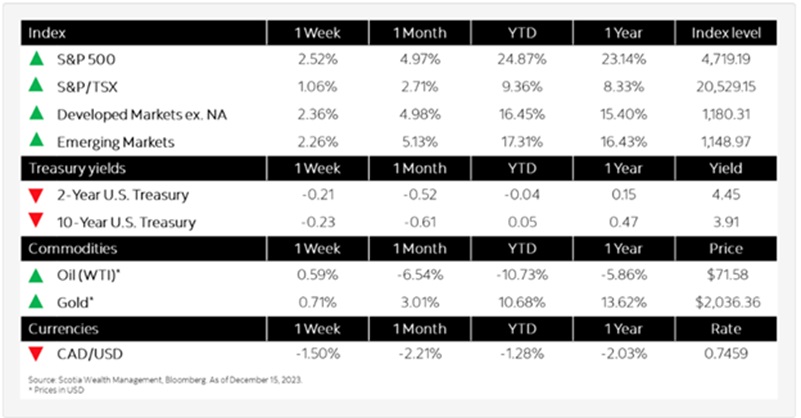
  • S. markets pushed to not only a new 52-week high but a new all time high, closing 2.52%1 higher.
  • Canadian equities moved in lockstep with their U.S. counterparts, closing 1.06%2 higher for the week led by the more rate sensitive real estate and financial sectors.
  • Despite private sector activity worsening in France and Germany, the bloc’s largest economies, European markets extended weekly gains rising 2.36%3. Miners and automobile manufacturers were the largest contributors.
  • Emerging markets closed on the front foot, rising 2.26%4 after a steep slide in the U.S. dollar and Treasury yields fueled a risk-on buying frenzy.

Bonds rally as end of monetary policy tightening appears on the horizon

U.S. Treasury yields moved lower across the full spectrum following dovish statements and a press conference that sparked the week’s rally across asset classes. The U.S. 10-year benchmark yield is trading at four-month lows while Credit spreads are trading at 20-month tights amid a strong risk-on sentiment. The European Central Bank (ECB) and the Bank of England (BoE) followed suit and kept rates unchanged, pushing yields down across Europe. Barring any major events, both rates and credit are likely to trade at current levels for the rest of the year as markets slow going into the holiday season.

Highlights:

  • The 2-year U.S. Treasury yield fell 21 basis points (bps) while the 10-year yield was down 23 bps. In Canada, the 2- and 10-year yields were down 15 bps.
  • The investment grade primary market has slowed this week, with only a bit more than $2.3bn USD priced.
  • 10-year U.K. Gilt and German Bund yields were down 35 bps and 26 bps, respectively, as the BoE and ECB held rates steady. While markets are keen for European policymakers to pivot alongside the Fed, ECB President Christine Lagarde has pushed back saying “we should absolutely not lower our guard” against inflation.

Weekly dashboard

Canadians are paying highest portion of disposable income toward debt on record

Canadians are directing a record portion of their disposable income to debt payments, a sign of increasing financial pressure on households after an abrupt end to near-zero interest rates. According to a Statistics Canada (StatCan) report, the household debt service ratio, measured as total obligated debt payments as a proportion of disposable income, rose to 15.22% in the third quarter. Put another way, the average household is spending around 15 cents of every after-tax dollar to service their debt.

Highlights:

  • The latest figure is up from 15.08% in the second quarter and marks the highest ratio in records that date back to 1990. And it’s likely that the financial strain on Canadian households will worsen, given that many homeowners have yet to renew their mortgages at higher interest rates.
  • Since the early 2000s, Canadians have dramatically ramped up their debt levels, partially overlapping with a period of rock-bottom interest rates. Now, borrowers face a reckoning over their debt accumulation because of a dramatic shift in lending conditions.
  • According to StatCan, total mortgage interest payments have increased 90% since the first quarter of 2022. However, the amount of mortgage principal paid has declined 16.8%. Overall, Canadians are directing 9.26% of their disposable income to interest payments for all types of debt, the highest proportion since 1995.

Fed keeps key interest rate unchanged, foresees three cuts next year

The Fed kept its key interest rate unchanged for a third straight time, a sign that it is likely done raising rates after having imposed the fastest string of increases in four decades to fight high inflation. Policymakers also signalled that they expect to make three quarter-point cuts to their benchmark interest rate in 2024. Those envisioned rate cuts likely wouldn’t begin until the second half of 2024, suggesting that the officials think high borrowing rates will still be needed for much of next year to further slow spending and inflation.

Highlights:

  • The Fed’s quarterly economic projections showed that officials envision a “soft landing” for the economy. Policymakers expect to cut their benchmark rate to 4.6% by the end of 2024, three quarter-point reductions from its current level.
  • In its quarterly projections the Fed now expects core inflation to fall to just 2.4% by the end of 2024, down from a 2.6% forecast in September. Core inflation excludes volatile food and energy costs.
  • Policymakers also foresee unemployment rising to 4.1% next year from its current 3.7%, which would still be low relative to historical levels. They project that the economy will expand at a modest 1.4% next year and 1.8% in 2025.

China’s exports snap half-year slide

China’s exports grew in November after six straight months of declines, though economists cautioned the uptick in trade wouldn’t be enough to offset weakness in the world’s second-largest economy. China’s exports in recent months have been supported by the country’s manufacturers slashing prices to gain global market share, as elevated interest rates and wars in the Middle East and Ukraine weigh on global demand. Trade volumes have been hitting record highs, even as exports, as measured by value, had been falling prior to November.

Highlights:

  • According to figures released by China’s General Administration of Customs, exports edged up 0.5% in November compared with a year earlier versus a 6.4% decline in October. Economists had expected exports to stay flat from a year earlier.
  • China’s imports, meanwhile, showed fresh weakness, falling 0.6% from a year earlier. The drop came after a 3% gain in October. As a result, China’s trade surplus expanded to US$68.4 billion in November from US$56.5 billion in October.
  • Economists expect the country’s exports to weaken in the coming months, putting pressure on Beijing to increase stimulus to make up for the shortfall in external demand.

In the news: Oil and gas prices continue to slide ahead of the holidays

Despite consumer sentiment rebounding, the likelihood of a soft landing – at least in the U.S. – becoming more likely and OPEC+ once again reducing output, oil prices continued to move lower, which is being reflected in prices consumers see at the pump. Both the U.S. Bureau of Labor Statistics and Statistics Canada have cited lower oil and gas prices as being instrumental in helping to drive down year-over-year inflation. There are several reasons for the lower prices, including the so far unusually warm winter that has depressed demand for heating fuel, record U.S. oil output, and weaker growth forecasts in China, one of the world’s largest consumers of oil and gas.

Behind the headline:

  • The national average for gas was $3.087 USD/gallon in the U.S. and $1.387/litre in Canada, well below the 52-week highs of $5.106 USD/gallon and $1.696/litre, respectively.
  • Several OPEC+ members have committed to cumulative supply cuts of 2.2M barrels per day (bpd) in the first quarter of 2024 in an effort to prop up prices.
  • According to the Energy Information Administration (EIA), while U.S. production ticked slightly lower going into December, it held steady at a record 13.2M bpd throughout most of October and November in what some have termed “America’s quiet oil boom.”

1 S&P 500 Index CAD
2 S&P/TSX Composite Index CAD
3 Bloomberg Developed Markets ex N. America Large & Mid Cap Price Return Index CAD
4 Bloomberg EM Large & Mid Cap Price Return Index CAD