Subscribe to the 100% free rdnewsNOW daily newsletter!
Sponsored

Market Watch: December 8

Dec 11, 2023 | 2:18 PM

This week’s highlights

  • Equity markets continue in their 5-week rally
  • Bond yields grasp mixed signals of labour reports
  • Bank of Canada holds key interest rate steady but warns ready to hike again
  • U.S. job openings hit more than 2½-year low as labour market cools
  • Moody’s cuts China credit outlook to negative on growing debt risks
  • In the news: Airline industry appears poised for wave of consolidation

Week in review

Equity markets continue in their 5-week rally

Markets carefully parsed the various economic reports this week indicating a soft landing for recession on the back of moderating inflation and seemingly softening labour markets. The U.S. job openings report released earlier in the week pointed to a slackening of labour demand, however, it was offset by Friday’s Labor Department’s Bureau of Labor Statistics (BLS) report indicating nonfarm payrolls increased by 199,000 jobs last month, above the 180,000 estimate. As markets assessed these mixed signals, concerns arose that a resilient job market could fuel inflation, reigniting the concerns of a “higher for longer” interest rate approach for major central banks around the world.

Highlights:

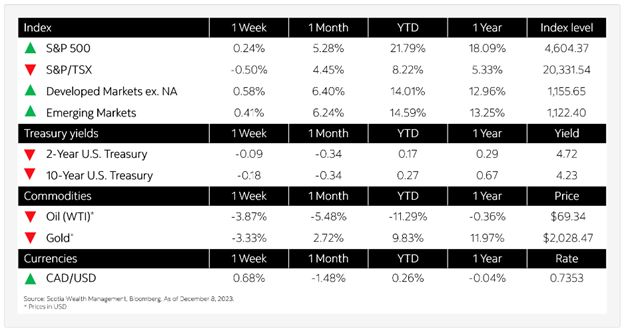
  • The week saw a rise of 0.24%1 in U.S. markets as investors weighed the economic data that showed a strong economic recovery and easing inflation, along with mixed labour market indicators, to gauge the U.S. Federal Reserve’s (Fed) likely interest rate trajectory for 2024.
  • As the Bank of Canada held its key interest rate steady, Canadian equities were -0.50%2 lower for the week as losses in energy and material stocks weighed on the markets despite strong gains in consumer discretionary and utility sectors.
  • European equities closed 0.58%3 higher as economic data indicating waning inflation and slowing growth readjusted the market’s expectation for the European Central Bank’s pathway of interest rate cuts and monetary policy for 2024.
  • Emerging markets were a mixed bag closing 0.41%4 higher for the week, despite persistent concerns over an economic slowdown in China as Moody’s cut the country’s outlook to negative due to the nation’s higher sovereign debt.

Bond yields grasp mixed signals of labour reports

While the U.S. Treasury yields continued to fall through most of this week, yields showed a mild uptick on Friday as the highly anticipated Labor Department’s BLS report indicated a better-than-expected rise in nonfarm payrolls and an unexpected drop in the unemployment rate pointing to the underlying strength of the labour market. While the data may have eased the worries of a potential recession, this may mean “higher for longer” interest rates, which pushed shorter-term Treasury yields that are more sensitive to monetary policy upwards.

Highlights:

  • The 2-year U.S. Treasury yield fell 9 basis points (bps) while the 10-year yield was down 18 bps. In Canada, the 2-year yield was down 13 bps and the 10-year yield was down 25 bps.
  • The Fed rate decision is set to be announced on December 13, and while it is expected to be on hold, the Fed is likely to continue to maintain its hawkish bias due to the recent labour reports.
  • The high yield (HY) market this month has been very active, with volumes doubling the sales of December 2022 but still well below 2020-21 levels. According to Bloomberg, issuance next year could surpass US$250 billion, exceeding this year’s levels.

Weekly dashboard

Bank of Canada holds key interest rate steady but warns ready to hike again

The Bank of Canada held interest rates steady at 5% for the third straight decision but warned that it is still prepared to hike again, continuing to talk tough about inflation in the face of market speculation that interest rates have peaked and cuts are coming next year. “Governing council is still concerned about risks to the outlook for inflation and remains prepared to raise the policy rate further if needed,” the bank said in its one-page announcement, reiterating earlier warnings. At the same time, it said that high borrowing costs are working to curb spending and that there are signs the Canadian economy is “no longer in excess demand.”

Highlights:

  • Economic weakness is feeding through to inflation. The annual rate of Consumer Price Index (CPI) growth was 3.1% in October, down from a peak of 8.1% in the summer of 2022. The bank targets 2% CPI inflation.
  • While price pressures are easing overall, there are still pockets of high inflation. Shelter costs, in particular, continue to surge. Rent was up 8.2% in October from a year before, and mortgage interest costs were up 30.5% year-on-year.
  • Looking forward, the bank said it wants to see further easing in core inflation, which strips out volatile price movements. And it “continues to focus on the balance between demand and supply in the economy, inflation expectations, wage growth and corporate pricing behaviour.”

U.S. job openings hit more than 2½-year low as labour market cools

U.S. job openings fell to more than a 2½-year low in October, the strongest sign yet that higher interest rates were dampening demand for workers and boosting financial markets expectations the Fed’s monetary policy tightening cycle was over. The larger-than-expected decline in unfilled jobs followed data last week showing inflation subsiding in October. The run of inflation-friendly reports has led financial markets to anticipate a rate cut as early as next March.

Highlights:

  • The U.S. Labor Department’s Job Openings and Labor Turnover Survey, or JOLTS report, also showed that there were 1.34 vacancies for every unemployed person in October, the lowest since August 2021 and down from 1.47 in September. Fewer workers are resigning, which over time, could help ease wage inflation.
  • Job openings, a measure of labour demand, fell 617,000 to 8.733 million on the last day of October, the lowest level since March 2021 and down from 9.350 million in September, the U.S. Labor Department’s Bureau of Labor Statistics said.
  • Job openings decreased 168,000 in the finance and insurance industry, while real estate, rental and leasing had 49,000 fewer positions. However, job openings increased 39,000 in the information sector. The job openings rate dropped to 5.3% from 5.6% in September.

Moody’s cuts China credit outlook to negative on growing debt risks

China’s mounting local government debt woes are putting pressure on the country’s credit ratings. Moody’s Investors Service lowered its outlook for China’s credit rating from stable to negative, warning that the financial stresses of some regional and local governments will require Beijing to provide support to them. That could weigh on China’s government finances at a time when its economy is slowing.

Highlights:

  • The New York-based credit-ratings firm kept its long-term rating of A1 on the nation’s sovereign debt, a level that is four notches below its top Aaa rating. But the outlook change signalled how the risks from China’s local government debts have become too big to ignore.
  • Chinese cities and provinces have as much as US$11 trillion in off-balance-sheet debt, according to estimates. Many economists have warned that a large chunk of it is at a high risk of default and could cause significant losses for banks and investors that have lent money to local governments.
  • China’s central government said last month that it places great importance on preventing and resolving the risks of these hidden debts and said it would provide emergency funding to highly indebted local governments.

In the news: Airline industry appears poised for wave of consolidation

For the past decade, the airline industry has been dominated by several large carriers – American Airlines, Delta Airlines, Southwest Airlines, and United Airlines – with smaller operators having to operate in their shadow. Facing ever-increasing competition, these smaller carriers are under pressure to merge with others to gain access to more planes and airport gates. JetBlue is currently in court attempting to persuade a judge to allow the acquisition of Spirit Airlines for $2.8bn USD, while Alaska Airlines recently proposed acquiring Hawaiian Airlines for $1.9bn USD. The Department of Justice opposes the former’s merger on grounds it would reduce competition. The result of these deals, should they go through, could have a profound impact on the airline industry. The big four control more than two-thirds of the market, leveraging their dominant position to control large hubs such as Atlanta, Dallas-Fort Worth and Newark, all but ensuring travellers will use their airlines for one or more legs of their journey.

Behind the headline:

  • If the merger between JetBlue and Spirit Airlines is allowed to proceed, the new carrier would have a market share of ~10%. Alaska Airlines and Hawaiian Airlines together would have a market share of ~8%. For comparison, United Airlines, the smallest of the big four, has a market share of ~16%.
  • This recent wave of consolidation follows the last one that ended in 2013 after American Airlines merged with U.S. Airways to form the nation’s largest carrier.
  • The consolidations are not exclusive to the U.S. either. In Canada, WestJet acquired Sunwing Airlines in early 2023 and is going through the motions of merging the two businesses under the WestJet brand while also folding its budget carrier Swoop into its main operation.

Haste Makes Waste

This week’s risk dashboard:

  • Global central banks to clear the decks before the holidays
  • Patience now could offer more handsome rewards later
  • FOMC probably won’t deliver on market expectations
  • How low could US core CPI go?
  • BoC’s Macklem will probably say it’s much too soon
  • ECB—Uncle! Now what?
  • The BoE’s exercise in futility
  • The PBOC may defer to other policy levers
  • SNB likely to hold

Click here to read the full publication

  • Banxico only partly waiting for the Fed
  • Peru’s central bank expected to cut again
  • Norges Bank’s decision could hinge upon CPI
  • Brazil’s central bank expected to continue -50bps pace
  • Philippines’ central bank has a cagey definition of hawkish
  • CBCT likely to stay on hold
  • Russian central bank—it serves you right!
  • Global macro indicators

1 S&P 500 Index CAD
2 S&P/TSX Composite Index CAD
3 Bloomberg Developed Markets ex N. America Large & Mid Cap Price Return Index CAD
4 Bloomberg EM Large & Mid Cap Price Return Index CAD

Download the rdnewsNOW mobile app on Google Play and the Apple App Store for all the latest updates on this and other stories.