Subscribe to the 100% free rdnewsNOW daily newsletter!
Sponsored

Market Watch: December 1

Dec 1, 2023 | 4:57 PM

This week’s highlights

  • Major indices cap best month in more than a year
  • Bond yields continue to cool after biggest monthly drop in four years
  • Canadian economy sees surprise contraction but avoids technical recession
  • U.S. consumer spending cools, labour market begins to show slack
  • Eurozone inflation approaches ECB target following larger than expected decline
  • In the news: OPEC+ agrees on additional output cuts in 2024

Week in review

Major indices cap best month in more than a year

The November equity rally continued into the first day of December with most major indices extending gains and many notching new 52-week highs as the likelihood of a “soft landing” becomes more of a reality. Recent comments from U.S. Federal Reserve Chairman Jay Powell tempered expectations somewhat, but not enough to override the positive sentiment that seems to be accompanying what many believe to be the elements needed for policy makers to take their foot off the brakes. In his remarks, Powell did however push back against the burgeoning expectations of interest rate cuts ahead saying it is too soon to say whether monetary policy is “sufficiently restrictive”.

Highlights:

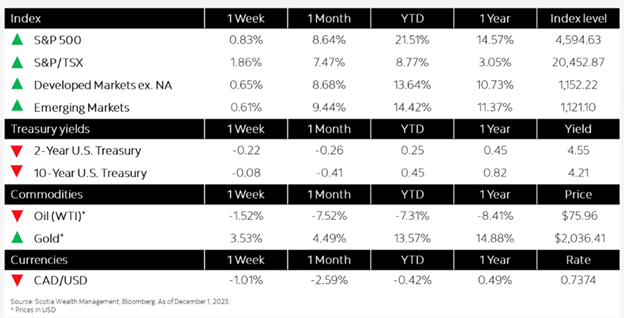
  • U.S. markets rose 0.83%1 for the week led by names such as Ulta Beauty, Boston Properties and Paramount. General Motors also had a strong week after they announced a $10bn USD buyback, dividend hike and reinstatement of 2023 guidance following the UAW strikes.
  • Amid the backdrop of a cooling economy, Canadian equities were 1.86%2 higher for the week as strength in the material, industrial and financial sectors helped propel the index higher.
  • European equities closed 0.65%3 higher as November data pointed towards a further moderation in inflation which, in combination with positive U.S. data, contributed to a risk on sentiment throughout the bloc.
  • Emerging markets also capped a strong November, returning 0.61%4 for the week, rallying as investors warmed to riskier assets on optimism that monetary policy tightening may be near an end.

Bond yields continue to cool after biggest monthly drop in four years

U.S. Treasury yields, which move opposite to prices, turned lower for the week contributing to the largest one-month decline since August 2019. The rally may, however, be a tenuous one, as it could easily be upended if a stubbornly hot domestic economy or inflation reading compels policy makers to hold or even further tighten interest rates. Credit is mostly firm, trading at the tight end of the 12-month range. Investment grade and high yield debt both gained for November, according to Bloomberg.

Highlights:

  • The 2-year U.S. Treasury yield fell 22 basis points (bps) while the 10-year yield was down 8 bps. In Canada, the 2-year yield was down 24 bps and the 10-year yield down 16 bps.
  • Looking ahead to the coming week there is a busy U.S. calendar including the latest data on durable goods and PMI readings followed by ADP employment and non-farm payrolls later in the week.
  • The Bank of Canada rate decision is set to be announced on Wednesday and is expected to be on hold.

Weekly dashboard

Canadian economy sees surprise contraction but avoids technical recession

Canada’s economy experienced an unexpected contraction in the third quarter, shrinking at a quarterly annualized pace of 1.1%, a sharp deviation from the Bank of Canada’s (BoC) forecast and earlier estimates. This downturn, marked by flat household spending, signals a significant slowdown from the robust growth earlier in the year. This performance hints at an economy grappling with the impacts of the Bank of Canada’s interest rate policies, which appear restrictive enough to dampen consumption and influence inflation trends. Looking ahead, the BoC may maintain borrowing costs at the current level, with the potential for rate cuts emerging in the first half of 2024.

Highlights:

  • In the third quarter, the economy was weighed down by lower exports and slower inventory accumulation despite significant population growth due to immigration.
  • However, in a positive development, the economy avoided a technical recession as second quarter GDP was revised upwards. On a month-over-month (MoM) basis, September’s GDP growth of 0.1% surpassed expectations.
  • Preliminary data suggests a modest recovery with a 0.2% GDP increase in October, driven by gains in oil and gas extraction, retail trade, and construction but partially offset by declines in wholesale trade.

U.S. consumer spending cools, labour market begins to show slack

The U.S. Federal Reserve’s preferred measure of underlying inflation fell to 3.5% year-over-year (YoY) in October, in line with the median consensus estimate and below September’s gain of 3.7%. The impact of rising interest rates and savings decline is reflecting lower household consumption. It is difficult to see that the robust trend in consumer spending could continue in the coming months, with higher debt service costs, the resumption of student loan repayments, and higher oil prices. In addition, the jobs market is slightly weaker than at the start of the year. If core PCE continues its downward trend, it will likely end 2023 below the Fed’s projection, increasing the central bank’s confidence that rates are sufficiently restrictive.

Highlights:

  • The core personal consumption expenditure (PCE) gauge was up 0.2% MoM compared to the prior month’s pace of 0.3%. Headline PCE also dropped to 3.0% YoY from 3.4% the previous month.
  • inflation-adjusted personal spending eased to 0.2% MoM, while personal income fell to 0.2% MoM. The report shows that U.S. consumers adjusted their spending in October as inflation continued to cool.
  • The U.S. economy added fewer jobs than expected in October, and the unemployment rate ticked higher to 3.9% in the same period, suggesting an increase in unemployed people and a shrinking labour force.

Eurozone inflation approaches ECB target following larger than expected decline

Eurozone inflation decelerated to 2.4% YoY in November, lower than October’s advance of 2.9% and the median consensus estimate of 2.7%. The data may assure the European Central Bank (ECB) that monetary policy tightening is helping to restore price stability, allowing them to keep policy rates on hold at the December meeting. Despite the progress, the ECB’s Governing Council has warned that it is premature to think about rate cuts at this juncture. Indeed, while this month’s data showed that the inflation target is within reach, subsequent months should see annual price growth reaccelerate due to base effects.

Highlights:

  • Annual price growth for all major underlying categories slowed from October, with food/alcohol/tobacco decelerating to 6.9%, services falling to 4.0%, and non-energy industrial goods easing to 2.9%.
  • Energy remained in deflation territory, contracting by 11.5% YoY after October’s decline of 11.2%. Core inflation, which excludes the volatile food and energy categories, fell to 3.6% YoY from 4.2%, also lower than expectations of 3.9%
  • The disinflation momentum was also observed in the region’s largest economies, with headline inflation in Germany and France falling to 2.3% YoY and 3.8% YoY, respectively.

In the news: OPEC+ agrees to additional output cuts in 2024

OPEC+ (Organization of the Petroleum Exporting Countries), an expanded group of 23 oil-producing nations, met on Thursday to discuss the levels of oil output for next year amidst concerns about slowing global demand, tighter financial conditions, and weak trade growth. Led by Saudi Arabia, the group’s de facto leader, OPEC+ have agreed to cut back oil output by an additional 900,000 barrels per day (bpd), totalling a cut of 2.2 million bpd for 1Q24.

Behind the headline:

  • Though set to expire at the end of this year, Saudi Arabia would be rolling over its voluntary production cut of 1 million bpd, and Russia would deepen its current export cut of 300,000 bpd to 500,000 bpd.
  • With indications of a mild slowdown in 2024, the demand for crude oil is set to be lower than the projected supply in the first quarter of 2024, underpinning the rationale for a further reduction in oil output to support price levels.
  • Reflecting concerns about oversupply in a weakening global economy and the growing oil supply outside OPEC+, oil prices have retreated from their 52-week highs seen in September.

1 S&P 500 Index CAD
2 S&P/TSX Composite Index CAD
3 Bloomberg Developed Markets ex N. America Large & Mid Cap Price Return Index CAD
4 Bloomberg EM Large & Mid Cap Price Return Index CAD

Important Information · Privacy Policy · Legal · Security · Accessibility Iconic Group
© 2023 The Bank of Nova Scotia. All rights reserved.

® Registered trademark of The Bank of Nova Scotia, used under licence. Scotia Wealth Management® consists of a range of financial services provided by The Bank of Nova Scotia (Scotiabank®); The Bank of Nova Scotia Trust Company (Scotiatrust®); Private Investment Counsel, a service of 1832 Asset Management L.P.; 1832 Asset Management U.S. Inc.; Scotia Wealth Insurance Services Inc.; and ScotiaMcLeod®, a division of Scotia Capital Inc. Private banking services are provided by The Bank of Nova Scotia. Estate and trust services are provided by The Bank of Nova Scotia Trust Company. Portfolio management services are provided by 1832 Asset Management L.P. and 1832 Asset Management U.S. Inc. Insurance services are provided by Scotia Wealth Insurance Services Inc. Wealth advisory and brokerage services are provided by ScotiaMcLeod, a division of Scotia Capital Inc. International investment advisory services are provided by Scotia Capital Inc. Financial planning services are provided by The Bank of Nova Scotia and ScotiaMcLeod. Scotia Capital Inc. is a member of the Canadian Investor Protection Fund and the Investment Industry Regulatory Organization of Canada. Scotia Wealth Insurance Services Inc. is the insurance subsidiary of Scotia Capital Inc., a member of the Scotiabank group of companies. When discussing life insurance products, ScotiaMcLeod advisors are acting as Life Insurance Agents (Financial Security Advisors in Quebec) representing Scotia Wealth Insurance Services Inc. Scotia iTRADE®(Order-Execution Only Accounts) is a division of Scotia Capital Inc. (“SCI”). SCI is a member of the Investment Industry Regulatory Organization of Canada and the Canadian Investor Protection Fund. Scotia iTRADE does not provide investment advice or recommendations and investors are responsible for their own investment decisions.

This publication has been prepared by Scotia Capital Inc. and is intended as a general source of information only and should not be considered as personal and/or specific financial, tax, pension, legal or investment advice. We are not tax or legal advisors and we recommend that individuals consult with their qualified advisors before taking any action based upon the information contained in this publication. Opinions and projections contained in this publication are our own as of the date hereof and are subject to change without notice. While care and attention has been taken to ensure the accuracy and reliability of the material in this publication, neither Scotia Capital Inc. nor any of its affiliates make any representations or warranties, express or implied, as to the accuracy or completeness of such material and disclaim any liability resulting from any direct or consequential loss arising from any use of this publication or the information contained herein. This publication and all the information, opinions and conclusions contained herein are protected by copyright. This publication may not be reproduced in whole or in part without the prior express consent of Scotia Capital Inc.

Download the rdnewsNOW mobile app on Google Play and the Apple App Store for all the latest updates on this and other stories.