Subscribe to the 100% free rdnewsNOW daily newsletter!
Sponsored

Market Watch: November 10

Nov 12, 2023 | 4:08 PM

This week’s highlights

  • Stocks extend weekly gains following bond market tumult
  • Sovereign yields flat in wake of weak 30-year Treasury auction
  • Canada’s trade surplus doubled to $2.04-billion in September on energy price surge
  • U.S. lending standards tightened further in 3Q
  • China’s exports tumble again in fresh sign of economic trouble
  • In the news: Office-sharing company WeWork files for bankruptcy protection

Week in review

Stocks extend weekly gains following bond market tumult

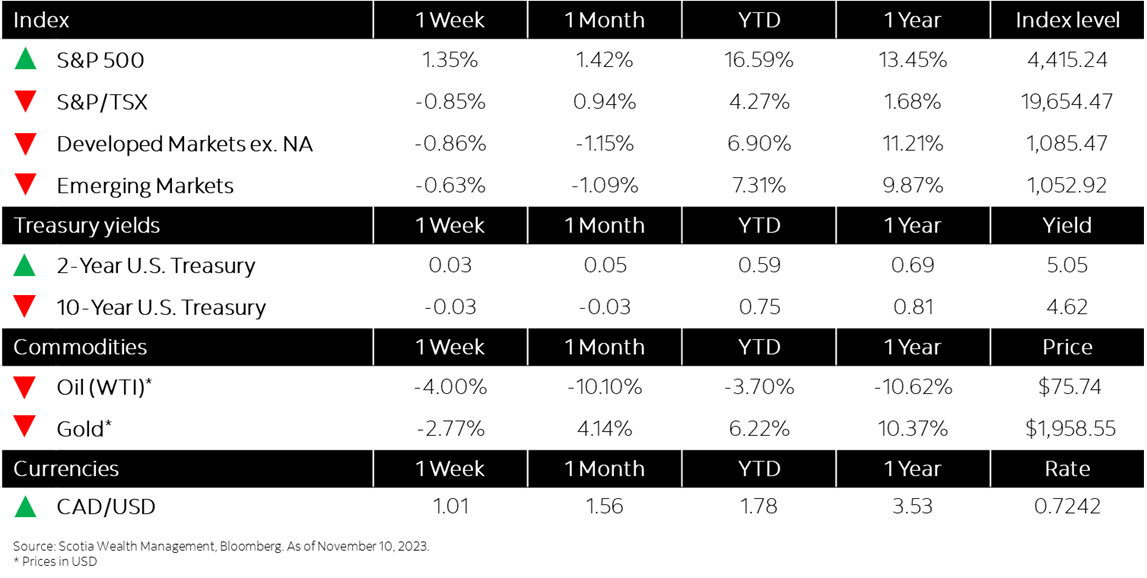
Equity markets were mixed for the week, experiencing a small correction Thursday as higher bond yields sparked a short-lived sell-off. Strong earnings continue to be accretive to U.S. benchmarks; with most S&P 500 companies now reporting results for the third quarter, the index is on track to report positive annual earnings per share growth for the first time since the third quarter of 2022. Energy prices rebounded slightly on Friday but traded lower for the week as the outlook for global demand waned and concerns about a spillover from war in the Middle East receded.

Highlights:

  • S. markets closed 1.35%1 higher for the week despite weak demand for 30-year Treasurys causing a mid-week correction.
  • In contrast to their southern peers, Canadian markets were down -0.85%2 for the week, mainly led by a slump in energy shares as oil prices moved off recent highs to close below $80 USD/barrel.
  • The European equity rally came to an end with markets closing -0.86%3 lower despite German chemical and industrial companies outperforming on news of a potential electricity price support package
  • Emerging markets also moved -0.63%4 lower for the week following Fed Chair Powell’s comments that fuelled concerns over additional rate hikes.

Sovereign yields flat in wake of 30-year Treasury auction

U.S. Treasurys were relatively flat for the week following Thursday’s selloff on the back of a weak 30-year Treasury bond auction that saw yields spike while highlighting investors’ reluctance to own long-dated government bonds. Monetary policy-sensitive two-year Treasury yields fell below 5% as investors looked past recent hawkish comments from U.S. Federal Reserve (Fed) Chair Jerome Powell. Credit spreads were also soft following higher-than-expected primary supply. The coming week’s economic calendar is busy and includes the latest U.S. Consumer Price Index (CPI) and Producer Price Index (PPI) scheduled on Tuesday and Wednesday, respectively.

Highlights:

  • The 2-year U.S. Treasury yield rose 3 basis points (bps) while the 10-year yield was down 3 bps. In Canada, the 2-year yield was up 3 bps while the 10-year yield was flat.
  • There are reports that weak demand for 30-year Treasurys may be related to a ransomware attack against the Industrial & Commercial Bank of China, with reports that the disruption may have led to some failed transactions.
  • The Fed Chairman reiterated the central bank’s position, saying that the Fed is wary of “head fakes” from inflation and that rates may not be high enough to reach to 2% inflation target.

Weekly dashboard

Canada’s trade surplus doubled to $2.04bn in September on energy price surge

Canada’s trade surplus with the world increased more than expected to $2.04bn in September, as higher crude prices helped exports outpace a rise in imports, Statistics Canada (StatCan) reported. Analysts in a Reuters poll had forecast a $1.00-billion surplus. August’s surplus was upwardly revised to $949-million from $718-million initially. Exports rose 2.7% in September and were up 0.4% on a volume basis, as prices increased for the third consecutive month.

Highlights:

  • Energy products led the gains, mainly due to higher crude oil prices that coincided with the extension of voluntary production cuts by OPEC+. Wheat exports also contributed with a more than 50% rise, as favourable weather conditions allowed for a more rapid harvest in 2023.
  • Partly offsetting the gains, exports of metal and non– metallic mineral products fell 10.7% in September from an all-time high in August.
  • Total imports increased 1.0%, driven by passenger cars and light trucks. Overall, motor vehicles and parts recorded its sixth consecutive monthly rise, despite strike disruptions in the U.S., Canada’s biggest trade partner.

U.S. lending standards tightened further in Q3

According to the U.S. Federal Reserve’s latest Senior Loan Officer Opinion Survey on bank lending practices, U.S. lending standards tightened in the third quarter. Survey respondents reported tighter standards and weaker demand for commercial and industrial loans to firms of all sizes, along with tighter standards for household loans, including credit cards and auto loans. The October survey also included questions about banks’ reasons for changing standards.

Highlights:

  • The main concerns that respondents cited were a less favourable or more uncertain economic outlook, reduced tolerance for risk, deterioration in the credit quality of loans and collateral values, and concerns about funding costs.
  • Despite personal spending surprising to the upside in the latest U.S. gross domestic product report, households are less willing to rely on credit to support consumption as a larger share of banks reported waning credit card demand. In comparison, the previous report showed that credit card demand was flat.
  • Given the increase in unemployment, a shrinking labour force, cooling wage growth, along with tighter credit standards, bank credit is unlikely to continue supporting the economy, potentially weakening consumption in the following months.

China’s exports tumble again in fresh sign of economic trouble

China’s exports fell for the sixth straight month, adding to pressure on Beijing to boost spending at home as a big rise in global interest rates and wars in Ukraine and the Middle East weigh on the world economy. The figures add to signs the Chinese economy is still facing difficulties despite a recent pickup in growth. Though officials have expanded stimulus in recent weeks, reflected in a rise in imports, economists say that Beijing will need to do more in the final months of the year to prevent another slowdown as a drawn-out property slump squeezes investment and consumer spending.

Highlights:

  • According to China’s General Administration of Customs, exports fell 6.4% in October compared with a year earlier, to US$275 billion, a steeper decline than the 6.2% fall recorded in September.
  • Imports rose 3%, snapping seven months of decline. That suggests Beijing’s stimulus measures are beginning to feed into healthier household and business spending, economists said, while cautioning that officials need to keep up stimulus.
  • Recent signals from business surveys have shown factory orders dropping and construction and services activity slowing, suggesting the economy still struggling.

In the news: Office-sharing company WeWork files for bankruptcy protection

WeWork, the much-feted office-space-sharing start-up, filed for Chapter 11 protection on Monday, saying that it had reached agreements with the majority of its lenders and intends to trim “non-operational leases.” The announcement likely didn’t come as a surprise to investors since WeWork warned earlier in the year that its ability to remain solvent was at risk amid efforts to restructure, which saw the company burn through $530m of cash in the first half of 2023 alone. The confluence of venture capital funding drying up combined with the pandemic upheaval of office work means the company joins a host of others that epitomize the era of start-ups that simply couldn’t survive once funding ran dry.

Behind the headline:

  • The company was once one of the largest leaseholders of prime office space in cities like London and New York, boasting a portfolio of 777 locations across 39 countries.
  • In 2019, it was valued at $47bn USD in a funding round led by SoftBank. When it ultimately went public two years later via a Special Purpose Acquisition (SPAC) merger, investors assessed its value at only $9bn USD.
  • According to filings, WeWork was buckling under $10bn USD in lease obligations and another $15bn USD starting in 2028. As of June 2023, the company had only $205m USD of cash on hand.

1 S&P 500 Index CAD
2 S&P/TSX Composite Index CAD
3 Bloomberg Developed Markets ex N. America Large & Mid Cap Price Return Index CAD
4 Bloomberg EM Large & Mid Cap Price Return Index CAD

® Registered trademark of The Bank of Nova Scotia, used under licence. Scotia Wealth Management® consists of a range of financial services provided by The Bank of Nova Scotia (Scotiabank®); The Bank of Nova Scotia Trust Company (Scotiatrust®); Private Investment Counsel, a service of 1832 Asset Management L.P.; 1832 Asset Management U.S. Inc.; Scotia Wealth Insurance Services Inc.; and ScotiaMcLeod®, a division of Scotia Capital Inc. Private banking services are provided by The Bank of Nova Scotia. Estate and trust services are provided by The Bank of Nova Scotia Trust Company. Portfolio management services are provided by 1832 Asset Management L.P. and 1832 Asset Management U.S. Inc. Insurance services are provided by Scotia Wealth Insurance Services Inc. Wealth advisory and brokerage services are provided by ScotiaMcLeod, a division of Scotia Capital Inc. International investment advisory services are provided by Scotia Capital Inc. Financial planning services are provided by The Bank of Nova Scotia and ScotiaMcLeod. Scotia Capital Inc. is a member of the Canadian Investor Protection Fund and the Investment Industry Regulatory Organization of Canada. Scotia Wealth Insurance Services Inc. is the insurance subsidiary of Scotia Capital Inc., a member of the Scotiabank group of companies. When discussing life insurance products, ScotiaMcLeod advisors are acting as Life Insurance Agents (Financial Security Advisors in Quebec) representing Scotia Wealth Insurance Services Inc. Scotia iTRADE®(Order-Execution Only Accounts) is a division of Scotia Capital Inc. (“SCI”). SCI is a member of the Investment Industry Regulatory Organization of Canada and the Canadian Investor Protection Fund. Scotia iTRADE does not provide investment advice or recommendations and investors are responsible for their own investment decisions.

This publication has been prepared by Scotia Capital Inc. and is intended as a general source of information only and should not be considered as personal and/or specific financial, tax, pension, legal or investment advice. We are not tax or legal advisors and we recommend that individuals consult with their qualified advisors before taking any action based upon the information contained in this publication. Opinions and projections contained in this publication are our own as of the date hereof and are subject to change without notice. While care and attention has been taken to ensure the accuracy and reliability of the material in this publication, neither Scotia Capital Inc. nor any of its affiliates make any representations or warranties, express or implied, as to the accuracy or completeness of such material and disclaim any liability resulting from any direct or consequential loss arising from any use of this publication or the information contained herein. This publication and all the information, opinions and conclusions contained herein are protected by copyright. This publication may not be reproduced in whole or in part without the prior express consent of Scotia Capital Inc.