Subscribe to the 100% free rdnewsNOW daily newsletter!
Sponsored

Market Watch: September 29

Oct 3, 2023 | 5:18 PM

This week’s highlights

  • Global equities appraise key economic indicators
  • Bond yields inch higher in anticipation of morehawkish monetary policy
  • Canadian GDP flat in July as growth falters
  • Feds preferred inflation indicator rises less than expected
  • Eurozone inflation eased more than expected in September
  • In the news: The U.S. braces for a Government shutdown

Week in review

Global equities appraise key economic indicators

Global equities continued to selloff as economic challenges showed little signs of easing. Throughout the week, markets adjusted to the idea of a prolonged high-interest rate environment and energy prices that have recently moved higher. Markets rose marginally on Friday with both U.S. and Eurozone inflation data came in lower-than-expected, a positive sign for the future path of monetary policy.Though some of the week’s losses were recovered on Friday, the overall markets posted a negative return for the week, ending the quarter on a bleaker note.

Highlights:

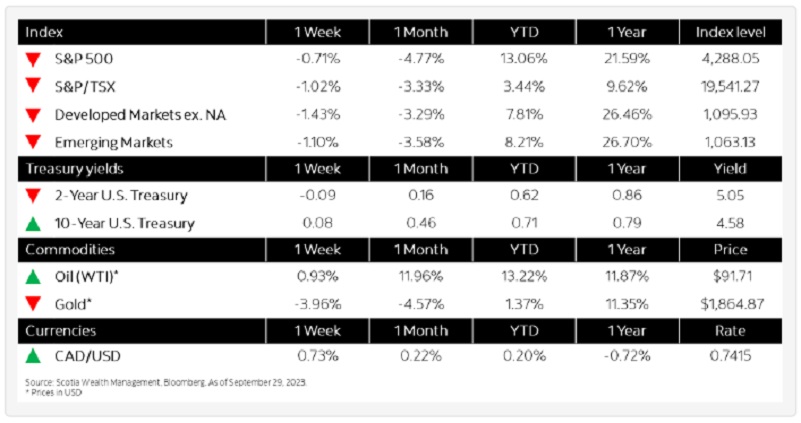
U.S. markets closed -0.71% lower for the week as rising yields and continued economic uncertainty dampened investor sentiment.

Canadian markets logged their first quarterly decline in a year as markets posted a weekly loss of -1.02% despite regaining some of their recent losses as metal prices lifted materials stocks.

European markets extended their previous week’s losing streak, down -1.43%, even though there was a slight uptick on Thursday and Friday driven by mining, banking and luxury stocks.

Emerging market equities closed -1.10% lower for the week amid ongoing property concerns in China. Markets closed the quarter with their biggest three-month decline in a year.

Bond yields inch higher in anticipation of more hawkish monetary policy

While U.S. Treasury yields continued to climb for the first half of the week, they retreated slightly on Thursday and Friday fueled byexpectations that the Federal Reserve (the Fed) will maintain its hawkish stance well into next year and possibly beyond. However, thetwo-year Treasury yield, which more closely tracks expectations for the Federal Reserve’s action, declined marginally indicatingsubdued expectations for imminent monetary policy tightening. Despite the recovery in the last two trading sessions, longer-termU.S. and Canadian treasury yields were poised to end the quarter at their 15-year highs.

Highlights:

The 2-year U.S. Treasury yield fell 9 basis points (bps) while the 10-year yield was up 8 bps. In Canada, the 2-year yield was down 4 bps and 10-year yields rose 10 bps.

High yield credit spreads have widened since the beginning of September driven by renewed high supply in the primary market.However, they are still within the tighter 12-month range.

According to Bloomberg, U.S. Investment Grade corporate bonds are down -2.7% month-to-date, which is in line with a seven-year streak of September losses.

Weekly dashboard

(Supplied)

The global week behind

Canadian GDP flat in July as growth falters

Statistics Canada (StatsCan) reported that Canadian Gross Domestic Product (GDP) was virtually unchanged in July as growth in theservice sector was offset by a contraction in goods-producing industries. Growth was weaker than economists were expecting, whilepreliminary data for August also points to growth coming in weaker than forecasted, a further sign the economy is slowing in the wakeof the Bank of Canada’s interest rate hikes. While inflationary pressures remain sticky and above the Bank of Canada’s target, slowinggrowth may give central bankers confidence to hold interest rates steady at their next meeting in October.

Highlights:

Following a -0.2% contraction in June, Canadian GDP was unchanged in July and is expected to grow a modest 0.1% in August according to preliminary data.

The largest relative contributors to growth came from the mining and oil and gas sectors which grew by 4.2% and 1.5%,respectively. Manufacturing had the largest deleterious effect on growth, contracting -1.5% in July.

If September growth comes in flat or negative it would likely set the economy on track for its second consecutive quarterly contraction.

Feds preferred inflation indicator rises less than expected

Core Personal Consumption Expenditures (PCE) rose less than expected in August, highlighting the impact tighter monetary policy is having on price pressures. Core PCE excludes volatile items such as food and energy. Headline PCE – which includes food and energy –increased during August following the increase in oil prices as OPEC+ continues to restrain output. While the Fed looks at many inputs to measure inflation, PCE is considered a particularly valuable one because it accounts for shifts in consumer behavior such as substituting lower-priced goods for more expensive items.

Highlights:

Core PCE increased 0.1% during August, lower than the expected 0.2% gain. On a 12-month basis, the annual increase for core PCE was 3.9%, in line with forecasts.

Headline PCE increased 0.4% in August, up 3.5% from the same period last year. Headline PCE has been creeping higher in recent months as the price of food and energy, which often move in tandem, continues to increase.

Year-over-year core PCE was under 4.0% for the first time in nearly two years and may encourage the Fed to continue to hold off on further interest rate hikes as it assesses the ongoing impact of the past dozen.

Eurozone inflation eased more than expected in September

Eurozone headline inflation eased more than expected during September, both on a month-over-month (MoM0 and year-over-year(YoY) basis. Core inflation fell to its lowest level in a year as well. The data strengthens the case for the European Central Bank (ECB) to pause interest rate hikes at the upcoming monetary policy meeting in October. Signs of an economic slowdown are materializing as business sentiment surveys point to weaker economic activity across the bloc. However, it may be premature to definitively call the latest policy rate increase the final one as oil prices have surged in recent months and threaten to thwart the disinflation trend.

Highlights:

Headline inflation rose 0.3% MoM and 4.3% YoY, with both decreasing from their previous levels of 0.5% and 5.2%, respectively.

Core inflation fell to its lowest level in a year, rising 4.5% YoY, down from 5.3% in August, below the median consensus estimate of 4.8%.

The data strengthens the case for the European Central Bank (ECB) to pause interest rate hikes at the upcoming monetary policymeeting in October.

In the news – The U.S. braces for a Government shutdown

The U.S. Government is days away from a potential shutdown which would result in a suspension of government services and a furlough of federal employees. Lawmakers have until midnight on September 30 to pass a new law to extend Government funding, ora wide range of critical federal services will come to a halt. This comes at a delicate moment for the U.S. economy as the shutdown would add to the already existing headwinds such as high energy prices, lingering impact of inflationary pressures, striking autoworkers and the lagged effects of tighter monetary policy.

Behind the headline:

A shutdown will also delay vital economic data releases such Labor Department’s monthly employment report and key inflation data from the Commerce Department, which may contribute to financial market volatility.

The shutdown would be the fourth in a decade and comes just four months after a similar standoff that brought the federal government within days of defaulting on its ~$33tn USD in debt.

Moody’s Investors Service has warned that a shutdown would negatively affect the country’s debt rating. According to Bloomberg, a 2-week shutdown would result in a 0.5% hit to quarterly gross domestic product (GDP) growth.

The Global Week Ahead

Shutting Down

This week’s risk dashboard:

  • US government headed for 11th shutdown in four decades
  • US nonfarm payrolls could be a shutdown casualty
  • Canadian jobs and wages to further inform inflation pressures
  • China PMIs could impact Monday’s market open
  • Peru’s central bank expected to cut again
  • RBA, RBI, RBNZ all likely to hold
  • CPI: Chile, Colombia, Peru, Switzerland, Australia, Indonesia,Philippines, SK, Taiwan, Thailand

Read full publication from Scotia Economics

(https://www.scotiabank.com/ca/en/about/economics/economics-p ublications/post.other-publications.global-week-ahead.september-2 9–2023.html)

© 2023 The Bank of Nova Scotia. All rights reserved.

® Registered trademark of The Bank of Nova Scotia, used under licence. Scotia Wealth Management® consists of a range of financial services provided by The Bank of Nova Scotia (Scotiabank®); The Bank of Nova Scotia Trust Company (Scotiatrust®); Private Investment Counsel, a service of 1832 Asset Management L.P.; 1832 Asset Management U.S. Inc.; Scotia Wealth Insurance Services Inc.; and Scotia McLeod®, a division of Scotia Capital Inc. Private banking services are provided by The Bank of Nova Scotia. Estate and trust services are provided by The Bank of Nova Scotia Trust Company. Portfolio management services are provided by 1832 Asset Management L.P. and 1832 Asset Management U.S. Inc. Insurance services are provided by Scotia Wealth Insurance Services Inc. Wealth advisory and brokerage services are provided by Scotia McLeod, a division of Scotia Capital Inc. International investment advisory services are provided by Scotia Capital Inc. Financial planning services are provided by The Bank of Nova Scotia and Scotia McLeod. Scotia Capital Inc. is a member of the Canadian Investor Protection Fund and the Investment Industry Regulatory Organization of Canada. Scotia Wealth Insurance Services Inc. is the insurance subsidiary of Scotia Capital Inc., a member of the Scotiabank group of companies. When discussing life insurance products, Scotia McLeod advisors are acting as Life Insurance Agents (Financial Security Advisors in Quebec) representing Scotia Wealth Insurance Services Inc. Scotia iTRADE®(Order-Execution Only Accounts) is a division of Scotia Capital Inc. (“SCI”). SCI is a member of the Investment Industry Regulatory Organization of Canada and the Canadian Investor Protection Fund. Scotia iTRADE does not provide investment advice or recommendations and investors are responsible for their own investment decisions.

This publication has been prepared by Scotia Capital Inc. and is intended as a general source of information only and should not be considered as personal and/or specific financial, tax, pension, legal or investment advice. We are not tax or legal advisors and we recommend that individuals consult with their qualified advisors before taking any action based upon the information contained in this publication. Opinions and projections contained in this publication are our own as of the date hereof and are subject to change without notice. While care and attention has been taken to ensure the accuracy and reliability of the material in this publication, neither Scotia Capital Inc.nor any of its affiliates make any representations or warranties, express or implied, as to the accuracy or completeness of such material and disclaim any liability resulting from any direct or consequential loss arising from any use of this publication or the information contained herein. This publication and all the information, opinions and conclusions contained herein are protected by copyright. This publication may not be reproduced in whole or in part without the prior express consent of Scotia Capital Inc.

This publication has been prepared by Scotia Capital Inc. and is intended as a general source of information only and should not be considered as personal and/or specific financial, tax, pension, legal or investment advice.

We are not tax or legal advisors and we recommend that individuals consult with their qualified advisors before taking any action based upon the information contained in this publication. Opinions and projections contained in this publication are our own as of the date hereof and are subject to change without notice. While care and attention has been taken to ensure the accuracy and reliability of the material in this publication, neither Scotia Capital Inc. nor any of its affiliates make any representations or warranties, express or implied, as to the accuracy or completeness of such material and disclaim any liability resulting from any direct or consequential loss arising from any use of this publication or the information contained herein. This publication and all the information, opinions and conclusions contained herein are protected by copyright. This publication may not be reproduced in whole or in part without the prior express consent of Scotia Capital Inc.