Subscribe to the 100% free rdnewsNOW daily newsletter!
(Supplied)
Sponsored

Market Watch: September 15

Sep 18, 2023 | 12:23 PM

WEEK IN REVIEW

GLOBAL SENTIMENT BOOSTED DESPITE MIXED ECONOMIC DATA

Though equities continued to demonstrate volatility as key domestic and global economic data released this week gave mixed signals, major indices posted a positive return. The overall global sentiment was boosted due to stronger than expected industrial production, retail sales and inflation data from China after the government increased its efforts to stimulate the world’s second largest economy. U.S. equity markets were steady throughout the week but were perturbed Friday as investors digested a fresh batch of economic data which also coincided with a ‘triple witching’ event.

Highlights:

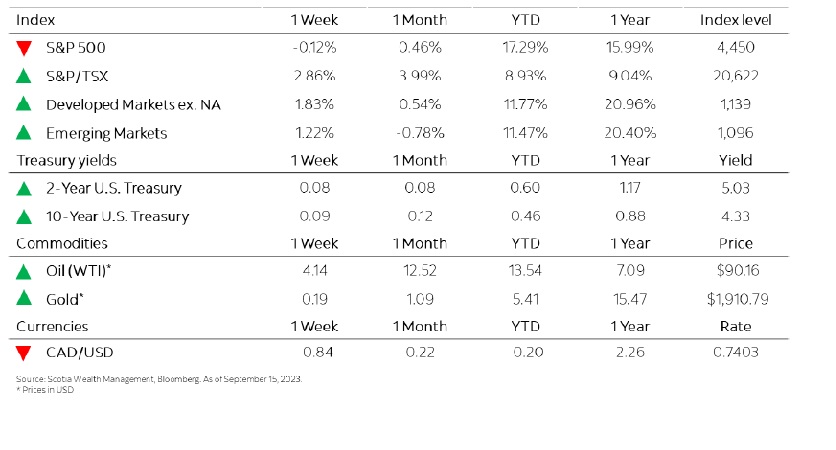
• U.S. markets closed -0.12%1 lower as investors parsed through a mixed batch of economic data including a higher-than-expected inflation reading ahead of the Federal Reserve’s (the Fed) next meeting on September 20.

• Canadian markets closed 2.86%2 higher in a broad-based rally led by the Materials sector as prices for metals rose due to optimistic economic data from China and an increase in global crude oil prices.

• European markets rose 1.83%3 as investors responded positively to the European Central Bank’s (ECB) decision to hike interest rates. Mining stocks also contributed to the rally as industrial production in China rose.

• The Chinese economy showed signs of stabilization on the back of stimulus measures put in place to revive a weak post-pandemic recovery, pushing emerging market equities to close 1.22%4 higher for the week.

BOND YIELDS RISE AMID RENEWED INFLATIONARY PRESSURES

U.S. Treasury yields rose on Friday after remaining unchanged for most of the week. The U.S. Consumer Price Index (CPI) and the Producer Price Index data for August was released this week and came in higher than expectations. Consumer demand remained resilient, as retail sales rose by 0.6% in August, higher than the 0.1% estimates. Despite slowing over the previous year, corporate bond market activity remains healthy amid the new interest rate environment, with markets pricing $38bn worth of bonds on Tuesday alone – the highest daily amount since April 2020.

Highlights:

• The 2-year U.S. Treasury yield rose 6 basis points (bps) while the 10-year yield was up 4 bps. In Canada, the 2- and 10-year yields were up 8 bps and up 5 bps, respectively.

• Credit remains resilient, with U.S. high yield spreads leading the way trading at 17-month tight levels.

• According to Bloomberg, the elevated cost of capital has slowed the primary bond issuance this year, 6% lower than last year’s volume. The current refinancing costs are ~5.8%, setting the rollovers for a spike in interest expenses.

ECONOMIC SNAPSHOT

CANADIAN MANUFACTURING SALES ON THE RISE DESPITE PORT STRIKE

Statistics Canada (StatsCan) reported that Canadian manufacturing rose for the month of July following a decline in June. Sales were boosted by an increase in the sale of food products, petroleum and coal products, and transportation equipment. The increase in sales comes despite a port strike in British Columbia which disrupted supply chains primarily on the west coast. At the national level, the strike did have an impact on manufacturing, primarily through shortages of raw materials and disruptions in transportation which mostly affected the paper product and chemical subsectors.

Highlights:

• At a national level, manufacturing sales increased 1.6% in July to $71.9bn, primarily from higher sales of food products (+3.1%), petroleum and coal products (+4.6%), and transportation equipment (+2.4%).

• As a result of the port strike affecting raw materials and transportation, paper products (-4.6%) and plastics and rubbers (-3.4%) were the largest detractors from sales figures.

• Total inventory levels and unfilled orders also declined 0.7% and 1.0%, respectively; the former being the result of a decline in chemicals inventories (-4.7%) and the latter lower unfilled orders of computer and electronic products (-2.7%).

U.S. INFLATION PRINT HIGHER THAN EXPECTED FOR AUGUST

U.S. consumer prices increased the most in more than a year in August on the back of rising energy costs. Core inflation – which excludes volatile energy and food – also rose more than expected. The single largest contributor to the monthly CPI reading was energy costs which accounted for more than half of the increase. Shelter costs also added to price pressures after increasing for the 40th straight month. With inflation trending further from the 2.0% target, it complicates the picture for Fed policymakers who are set to meet on September 20.

Highlights:

• U.S. CPI rose 0.6% month-over-month (MoM) and 3.7% year-over-year (YoY) in August, outpacing economists’ expectations. Core prices rose 0.3% MoM and 4.3% YoY, also above expectations.

• Other notable contributors to headline CPI included airline fares, auto-insurance costs, new cars, and food.

• At their upcoming meeting Fed policymakers may decide to overlook a temporary jump in energy prices, however high shelter costs and a labor market that remains strong despite some cracks may support another hike.

EUROPEAN CENTRAL BANK RAISES INTEREST RATE DESPITE RECESSION THREAT

The European Central Bank (ECB) raised its reference rates by 25 bps each, taking the closely watched deposit facility rate to 4.0%, contrary to survey medians but in line with market expectations. This was the 10th consecutive hike the bank has undertaken since June 2022. The hike reflects the upward revision for inflation projections which anticipates inflation remaining higher than both the 2.0% target and previous projections for 2023 and 2024, mainly as a result of higher energy prices. The ECB has, however, revised down the projected path for core inflation which excludes energy and food.

Highlights:

• Indications of tighter supply and higher prices in energy markets throughout the rest of 2023 have fueled inflation concerns and caused the upwards revision in inflation projections.

• The ECB’s macroeconomic projections now expect headline inflation to average 5.6% in 2023 from a prior forecast of 5.4%, and 3.2% in 2024 from a previous forecast of 3.0%.

• The ECB has revised down the projected path for core inflation to an average of 5.1% in 2023, 2.9% in 2024, and 2.2% in 2025, reflecting a moderation in underlying price pressures.

IN THE NEWS

U.S. AIRLINES REVISE EARNINGS ESTIMATES DOWNWARDS ON RISING COSTS

Leading aerospace manufacturers, supply chain giants and automobile companies indicated that higher labour and fuel costs would likely reduce profit estimates for the rest of the year. The Airline industry, whose biggest expenses are jet fuel and labour, has experienced the most significant impact. Major U.S. airlines such as Delta Air Lines, American Airlines and Southwest Airlines announced a cut in their forecasted earnings per share (EPS) by up to 74% for the third quarter.

Behind the headline:

• The Organization of the Petroleum Exporting Countries (OPEC) and its allies have cut down oil production propelling crude oil prices to a 10-month high of $90 USD a barrel.

• Heavier fuels that planes use are more easily refined from denser Russian and Middle Eastern crude meaning the oil production cut has boosted the premiums refiners charge to process jet fuel making it more expensive.

• While the demand for global travel has picked up substantially since the pandemic, a decline in discretionary spending amid high interest on things like travel has weakened domestic and international travel bookings.

WEEKLY DASHBOARD

(Supplied)

DISCLAIMER

This publication has been prepared by The Bank of Nova Scotia for Scotia Wealth Management clients and may not be redistributed. It is for general information purposes only and should not be considered or relied upon as personal and/or specific financial, tax, pension, insurance, legal or investment advice. We are not tax or legal advisors and we recommend that individuals consult with their qualified advisors, including tax and legal advisors, before taking any action based upon the information contained in this publication. Opinions and projections contained in this publication are our own as of the date hereof and are subject to change without notice. Scotia Wealth Management is under no obligation to update this commentary and readers should assume the information contained herein will not be updated. While care and attention has been taken to ensure the accuracy and reliability of the material in this publication, neither The Bank of Nova Scotia nor any of its affiliates or any of their respective directors, officers or employees make any representations or warranties, express or implied, as to the accuracy or completeness of such material and disclaim any liability resulting from any direct or consequential loss arising from any use of this publication or the information contained herein. This commentary may contain forward-looking statements based on current expectations and projections about future general economic factors. Forward-looking statements are subject to inherent risks and uncertainties which may be unforeseeable and such expectations and projections may be incorrect in the future. Forward-looking statements are not guarantees of future performance and you should avoid placing undue reliance upon them. This publication and all the information, opinions and conclusions contained herein are protected by copyright. This publication may not be reproduced in whole or in part without the prior express consent of The Bank of Nova Scotia. To the extent this document contains information or data obtained from third party sources, it is believed to be accurate and reliable as of the date of publication, but 1832 Asset Management L.P. does not guarantee its accuracy or reliability

Scotia Wealth Management® consists of a range of financial services provided by The Bank of Nova Scotia (Scotiabank®); The Bank of Nova Scotia Trust Company (Scotiatrust®); Private Investment Counsel, a service of 1832 Asset Management L.P.; 1832 Asset Management U.S. Inc.; Scotia Wealth Insurance Services Inc.; and ScotiaMcLeod®, a division of Scotia Capital Inc. Private banking services are provided by Scotiabank. Estate and trust services are provided by The Bank of Nova Scotia Trust Company. Portfolio management is provided by 1832 Asset Management L.P. and 1832 Asset Management U.S. Inc. Insurance services are provided by Scotia Wealth Insurance Services Inc. Wealth advisory and brokerage services are provided by ScotiaMcLeod, a division of Scotia Capital Inc. International investment advisory services are provided by Scotia Capital Inc. Financial planning services are provided by Scotiabank and ScotiaMcLeod. Scotia Capital Inc. is a member of the Canadian Investor Protection Fund and the Canadian Investment Regulatory Organization. Scotia Wealth Insurance Services Inc. is the insurance subsidiary of Scotia Capital Inc., a member of the Scotiabank group of companies. When discussing life insurance products, ScotiaMcLeod advisors are acting as Life Insurance Agents (Financial Security Advisors in Quebec) representing Scotia Wealth Insurance Services Inc.

Scotia Wealth Management® is a Registered trademark of The Bank of Nova Scotia, used under licence.

© Copyright 2023 The Bank of Nova Scotia. All rights reserved.

1 S&P 500 Index CAD

2 S&P/TSX Composite Index CAD

3 Bloomberg Developed Markets ex N. America Large & Mid Cap Price Return Index CAD

4 Bloomberg EM Large & Mid Cap Price Return Index CAD