Subscribe to the 100% free rdnewsNOW daily newsletter!
OLYMPUS DIGITAL CAMERA
Sponsored

Market Watch: July 14

Jul 17, 2023 | 3:01 PM

WEEK IN REVIEW

Strong earnings, low inflation set the stage for risk asset rally

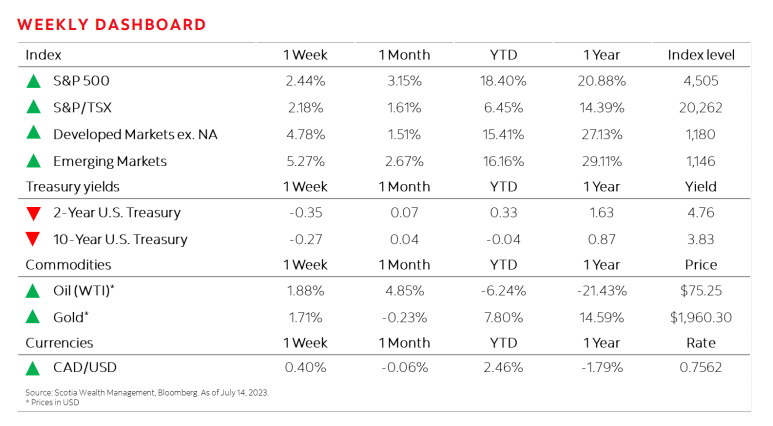
U.S. equities returned 2.44 per cent1 following a spate of strong earnings and low inflation in June, while Canadian equities seemed unfazed by yet another rate hike from the Bank of Canada (BoC), returning 2.18 per cent2. Developed markets, like North America for example, and emerging markets were by far the best-performing regions for the week returning 4.78 per cent3 and 5.27 oer cent4, respectively. European markets – which had their best week since March – rallied along with other risk assets as U.S. inflation eased, riding a wave of optimism that the U.S. Federal Reserve (Fed) may be near the end of its tightening cycle.

Highlights:

  • In the U.S., large banks such as JPMorgan Chase and Wells Fargo posted better-than-expected Q2 results, significantly beating earnings per share (EPS) and revenue expectations. Default rates also remained historically low, pointing to a resilient consumer and economy.
  • The strong start to second-quarter earnings stands in contrast to expectations of a roughly seven per cent year-over-year drop in S&P 500 earnings which would mark the worst earnings since the second quarter of 2020.
  • In Canada, markets shook off a 0.25 per cent hike in the key interest rate from the BoC, following global markets higher. All sectors posted positive returns, but info tech and materials were the best performers for the week.
  • European and emerging markets appear to be pinning a lot of hope on improving U.S. inflation and its impact on lowering rate expectations everywhere. This optimism may, however, be short-lived as European economies continue to face a manufacturing slump and the prospects of further monetary tightening while China’s economy continues to lose momentum.

Sovereign bond yields fall on prospect fed nearing end of hiking cycle

On Friday, global sovereign bonds reversed some of the sharp declines seen throughout the latter half of the week following lower-than-expected consumer and wholesale inflation. Credit spreads are tightening amid limited supply in the primary market over the past few weeks. Only about $8 billion USD of new investment-grade debt sold off last week, well below the projected $17 billion USD. Bank issuance could spike over the next few trading sessions, which typically occurs after earnings releases.

Highlights:

  • In North America, sovereign yields were broadly lower across the entire curve. Two-year yields were down anywhere from 17 basis points (bps) to 35 bps, while 10-year yields were anywhere from 14 bps to 27 bps lower.
  • Investors are closely monitoring various inflation indicators ahead of the Fed’s July 26 rate decision, such as import prices (-0.2 per cent) and the University of Michigan’s consumer sentiment report (+13.0 per cent), both of which have moved in a positive direction.
  • Despite most data pointing to a continued moderation in inflation, the growing likelihood of a “soft landing,” as well as investors’ optimism for a pause in rate hikes, markets are pricing in a 0.25 per cent increase at the Fed’s July 26 meeting.

MARKET SNAPSHOT

BoC hikes rates, warns downward momentum of inflation could stall

The Bank of Canada (BoC) increased its benchmark interest rate to five per cent and pushed out the timeline for getting consumer prices under control, warning that the downward momentum of inflation could stall over the next year as the economy proves surprisingly resilient to higher borrowing costs. The BoC is grappling with the surprising strength of the Canadian economy. Many analysts expected the economy to be in a recession by now, squeezed by the most aggressive interest rate increases in a generation. However, consumer spending, job creation and the housing market have turned out to be less responsive to rate hikes than anticipated.

Highlights:

  • The quarter-point increase, which analysts widely expected, brings the policy rate to a level last seen in April 2001. This further squeezes Canadians’ finances and pushes up costs for mortgage holders.
  • In an updated forecast, the central bank said it expects the annual rate of inflation to remain around three per cent for the next year, declining to the bank’s two per cent by the middle of 2025.
  • The bank gave no hints about future rate decisions but left the door open to further hikes, saying it “will continue to assess the dynamics of core inflation and the outlook for CPI inflation.”

U.S. inflation eased to three per cent in June, lowest since early 2021

U.S. inflation eased last month to its slowest pace in more than two years as underlying price pressures moderated more than expected. Fed officials have signalled that they are likely to raise interest rates to a 22-year high at their July 25-26 meeting, following recent signs of stronger-than-anticipated economic activity. This week’s inflation report isn’t expected to change that outcome.

Highlights:

  • The Consumer Price Index (CPI) climbed three per cent in June from a year earlier, the U.S. Labor Department reported, sharply lower than the recent peak of 9.1 per cent in June 2022 and down from four per cent in May. Inflation was last close to three per cent in March 2021. However, inflation remains above the U.S. Federal Reserve’s (Fed) two per cent target.
  • So-called core consumer prices, which exclude volatile food and energy categories, rose 4.8 per cent in June from a year earlier, the slowest pace since October 2021 and down from 5.3 per cent in May.
  • On a monthly basis, core consumer prices climbed 0.2 per cent, the smallest one-month increase since August 2021, suggesting underlying price pressures are gradually easing. Prices for used cars and airline fares fell sharply, while car insurance and recreation prices rose. Rent increased in June, though at the slowest one-month pace since early 2022.

Deflation looms in China as rebound loses steam

China’s consumer inflation flatlined in June after two months of meager growth, stirring fears among economists and investors that the world’s second-largest economy is on the verge of slipping into deflation. Declining prices in China can offer a measure of relief for central bankers battling inflation. Lower prices for goods charged at the factory gate in China translate into lower import costs on Chinese goods for retailers in the West. At the same time, subdued consumer inflation also curbs China’s appetite for commodities from iron ore to crude oil, all of which helps to rein in inflation elsewhere.

Highlights:

  • The National Bureau of Statistics reported that the country’s manufacturing sector saw factory-gate prices fall at their fastest pace in more than seven years, reflecting soft demand abroad to match the weak demand at home.
  • The data is the latest evidence of the twin toll on the Chinese economy of a stalled post-reopening recovery in China and interest-rate hikes by central banks in the West that have curtailed consumer spending.
  • Economists worry that the broad-based decline in prices will weigh on already fragile confidence in the country, leaving the economy stuck in a vicious cycle whereby weak demand and lower prices reinforce each other.

IN THE NEWS

Amazon Inc. held its annual Prime Days shopping event last week, marking the online retailers’ 10-year anniversary, which saw inflation hit shoppers on the hunt for deals. The event also marked the single largest day of sales in the company’s history. The results reinforce data that indicates consumer spending is strong and confidence high, despite economic uncertainty and tightening monetary conditions. Continued strength in consumer spending could give the Fed an additional data point to justify yet another rate increase at its next meeting.

Behind the headline:

  • U.S. online sales rose 6.1 per cent to $12.7 billion USD, according to Adobe Analytics. Shoppers purchased more than 375 million items, up from 300 million the previous year, with the average order size rising $2.20 to $54.06.
  • Despite the strong showing, sales fell short of analysts’ expectations. Adobe had forecast total sales growth of 9.5 per cent year-over-year to $13.1 billion USD during the two-day event.
  • At its last meeting, the Fed cited the resilience of consumer spending (+0.1 per cent in May) as one of the factors it is closely monitoring to assess the impact of rate hikes. Consumer confidence is also up, rising to 109.7 in June from 102.5 the previous month, according to The Conference Board’s Consumer Confidence Survey.
    (Scotia Wealth Management)

DISCLAIMER

This publication has been prepared by The Bank of Nova Scotia for Scotia Wealth Management clients and may not be redistributed. It is for general information purposes only and should not be considered or relied upon as personal and/or specific financial, tax, pension, insurance, legal or investment advice. We are not tax or legal advisors and we recommend that individuals consult with their qualified advisors, including tax and legal advisors, before taking any action based upon the information contained in this publication. Opinions and projections contained in this publication are our own as of the date hereof and are subject to change without notice. Scotia Wealth Management is under no obligation to updatethis commentary and readers should assume the information contained herein will not be updated. While care and attention has been taken to ensure the accuracy and reliability of the material in this publication, neither The Bank of Nova Scotia nor any of its affiliates or any of their respective directors, officers or employees make any representations or warranties, express or implied, as to the accuracy or completeness of such material and disclaim any liability resulting from any direct or consequential loss arising from any use of this publication or the information contained herein. This commentary may contain forward-looking statements based on current expectations and projections about future general economic factors. Forward-looking statements are subject to inherent risks and uncertainties which may be unforeseeable and such expectations and projections may be incorrect in the future. Forward-looking statements are not guarantees of future performance and you should avoid placing undue reliance upon them. This publication and all the information, opinions and conclusions contained herein are protected by copyright. This publication may not be reproduced in whole or in part without the prior express consent of The Bank of Nova Scotia. Scotia Wealth Management® consists of a range of financial services provided by The Bank of Nova Scotia (Scotiabank®); The Bank of Nova Scotia Trust Company (Scotiatrust®); Private Investment Counsel, a service of 1832 Asset Management L.P.; 1832 Asset Management U.S. Inc.; Scotia Wealth Insurance Services Inc.; and ScotiaMcLeod®, a division of Scotia Capital Inc. Private banking services are provided by Scotiabank. Estate and trust services are provided by The Bank of Nova Scotia Trust Company. Portfolio management is provided by 1832 Asset Management L.P. and 1832 Asset Management U.S. Inc. Insurance services are provided by Scotia Wealth Insurance Services Inc. Wealth advisory and brokerage services are provided by ScotiaMcLeod, a division of Scotia Capital Inc. International investment advisory services are provided by Scotia Capital Inc. Financial planning services are provided by Scotiabank and ScotiaMcLeod. Scotia Capital Inc. is a member of the Canadian Investor Protection Fund and the Canadian Investment Regulatory Organization. Scotia Wealth Insurance Services Inc. is the insurance subsidiary of Scotia Capital Inc., a member of the Scotiabank group of companies. When discussing life insurance products, ScotiaMcLeod advisors are acting as Life Insurance Agents (Financial Security Advisors in Quebec) representing Scotia Wealth Insurance Services Inc. © Copyright 2023 The Bank of Nova Scotia. All rights reserved.

1 S&P 500 Index USD

2 S&P/TSX Composite Index CAD

3 Bloomberg Developed Markets ex N. America Large & Mid Cap Price Return Index USD

4 Bloomberg EM Large & Mid Cap Price Return Index USD