Subscribe to the 100% free rdnewsNOW daily newsletter!
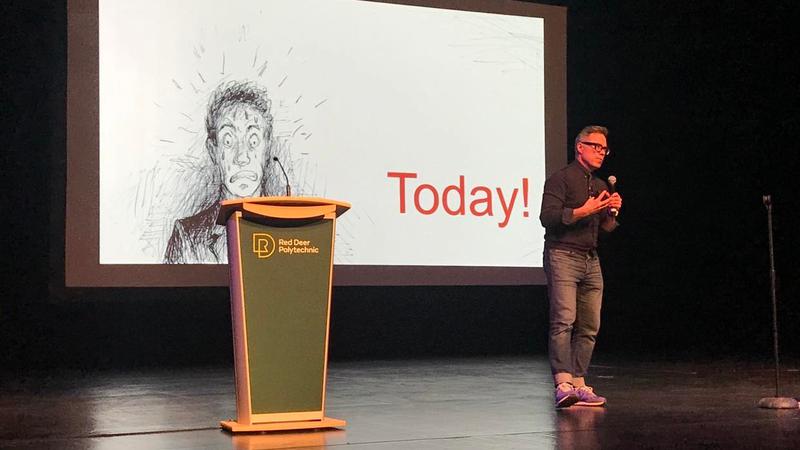
Timothy Caulfield, Canada Research Chair in Health Law and Policy and Professor of law at the University of Alberta, speaks at Red Deer Polytechnic on Thursday. (rdnewsNOW/Alessia Proietti)
Thinking critically

Pro-Russia and 5G vaccines? Timothy Caulfield speaks at RDP about misinformation during pandemic

Feb 2, 2023 | 11:55 AM

They call it the “infodemic”: the rapid spread of misinformation.

According to Timothy Caulfield, Canada Research Chair in Health Law and Policy and Professor of law at the University of Alberta, among other titles, this is THE issue of the generation.

Caulfield spoke to Red Deer Polytechnic (RDP) students in his seminar “Relax: A Guide to Life in the Age of Misinformation” last Thursday as part of the institution’s return of their “Perspectives: Canada in the World” public lecture program.

Caulfield’s lecture focused on various angles of misinformation throughout the pandemic found in studies.

“One of the ironic things is, often, it’s that community [non-vaccinated] that wants to keep re-litigating this,” he said. “They’re not the ones moving forward; they want to re-litigate it, they want ‘justice’.”

“That is really problematic because unfortunately that strategy is working. They’re creating this false vision of the past: ‘the vaccines didn’t work, the mandates weren’t necessary, there was this full lockdown that had tremendous economic impact’, when in fact, there was this gradation that happened across Canada.”

He referenced a recent report that he participated in titled “Fault Lines” by the Council of Canadian Academies (CCA), which claims that if it were not for the spread of misinformation, at least 2,800 lives lost to COVID-19 and $300 million in hospital costs could have been saved.

He says that other studies have shown that misinformation has caused widespread distrust in media and the healthcare system, leading to decreasing vaccination rates among pregnant women and for measles and polio, which can adversely impact public health and the economy.

Caulfield explained that two main factors have greatly contributed to the infodemic: social media and political ideology.

SOCIAL MEDIA

“If you get your information primarily from social media, you’re more likely to believe misinformation or likely to spread misinformation,” he said. “It’s the reward structures built into, inherent, in the social media framework that help to promote the spread of misinformation: the likes, the follows, the retweets.”

He says studies have shown that on a Google search, 93 per cent of people do not look past the first page. However, due to the algorithms, the first page is either filled with biased or misinformation from a searcher’s history.

Caulfield said 20 per cent of TikTok’s content, where users post short videos, is misinformation with that percentage rising to 50 for the topic of vaccination. He says out of the social media platform’s two billion users, a large portion of the younger demographic use it as their main source of news.

He believes misinformation should be debunked from celebrities and pop culture, even if it seems absurd, as it often plays on biases to cause fear.

“A good testimonial, a good anecdote, a good story will override our ability to think scientifically,” he said, with studies showing “that misinformation is emotional, it’s negative, it’s focused on morality and it’s easy to process.”

He says citizens should look at trusted sources for information such as scientific resources, scholarly articles, and mainstream media. However, he says studies show that “anti-vaxxers” get their news from naturalnews.com and YouTube, among others.

When asked what exactly an “anti-vaxxer” was, Caulfield said research shows that they are individuals who have accepted misinformation for a particular agenda and use it as justification for not receiving a vaccine.

He says he would not use the term for people who do not view themselves as an “anti-vaxxer”, who have reasonable questions, have access issues to vaccines, historical justifications to not trust institutions, or those with needle phobia. He adds that he does not believe it is a pejorative or divisive term as it was an “effective tool” during the pandemic.

Caulfield says that misinformation used to be a fringe topic but is no longer.

During the pandemic, he said conspiracies were created that vaccines caused human magnetism, were put in salad dressing, and injected microchips for 5G technological tracking from Bill Gates. He said some believed people were being vaccinated due to mass hypnosis and could be de-vaccinated through snake poison and cupping.

“There aren’t always right answers, and that’s what we often highlight, but there are some answers that are clearly wrong,” he said.

He said “anti-vaxxers” believed Buffalo Bills’ Damar Hamlin of the NFL collapsed during a game due to the COVID-19 vaccine and had a doppelganger play in his place, others refuse blood transfusions from vaccinated donors and that drinking urine or taking the Ivermectin drug cured the virus.

Lastly, he said studies have shown that, when “moderately interpreting data”, a correlation, not causation, exists that “anti-vaxxers” are more likely to be pro-Russia in the current war.

According to Reuters, Ukraine’s population is roughly 36 per cent fully vaccinated with a history of vaccine hesitancy.

When asked about the segment of the population that lie in the centre of extremist views, Caulfield said conspiracy theorists are having an impact on them.

“One of the reasons we don’t hear from the middle is because our information economy plays to the extremes,” he said. “It’s a lot of these voices on the side that speak the most and are also shared the most and I also think that middle is lost because they’re not speaking up.”

IDEOLOGY

“I don’t want to pick on a particular ideological leaning because there’s misinformation that pops up across the ideological spectrum,” he said, “a vibrant democracy needs that; it needs different ideological points of view.”

“People come for the ideological spin,” he said. “They’re drawn to that ideological community and then they stay despite the science.”

“Think of something like GMOs [genetically modified organisms], lots of misinformation on GMOs; it resides predominantly, not totally, on the left. There’s other issues that reside in the middle, but right now, in this cultural moment, it is largely on the political right.”

Caulfield says studies show the strongest predictor of vaccination is partisanship as it becomes part of their personal brand. In 1975, he says research showed that democrats were suspicious of science more than republicans whereas the opposite trend is found today.

However, Caulfield also said a false balance in the media of fringe beliefs being portrayed as equal to scientific ones has had an adverse effect on society. He says this trend contradicts the belief that people’s views are being silenced as popular shows are discussing such beliefs like The Joe Rogan Experience and Tucker Carlson Tonight.

SOLUTIONS

Caulfield said the good news is that studies are showing the public is aware that they see misinformation daily online.

He says countries like Finland are starting to introduce critical thinking classes to children in kindergarten, and he believes post-secondary institutions should do the same.

“I’m not talking about some kind of partisan view of the world or ‘this is what is information, this isn’t’; I’m talking about teaching critical thinking skills and giving people the tools to allow them to do it themselves,” he said.

Other steps to debunk misinformation, he says, include highlighting scientific consensus, have ongoing conversations with a humble attitude, and focusing on clear and sharable data from trusted sources. He says scientists need to learn how to use art and narratives to get information across in a more interesting and anecdotal way to spark interest in the public.

“Science is not a list of facts and when one of those facts is wrong, science isn’t wrong; it’s a process,” he said.

Lastly, he says sometimes all it takes is a pause when reading information. According to Kate Starbird from the University of Washington, “If it feels like your team got a touchdown, that should be a moment to pause. Check your emotions because that means it’s playing to your cognitive biases.”

So, what do YOU think?