Subscribe to the 100% free rdnewsNOW daily newsletter!
(rdnewsNOW/Sheldon Spackman)
That's a Wrap

Harvest 99 per cent complete throughout central Alberta

Oct 14, 2022 | 1:55 PM

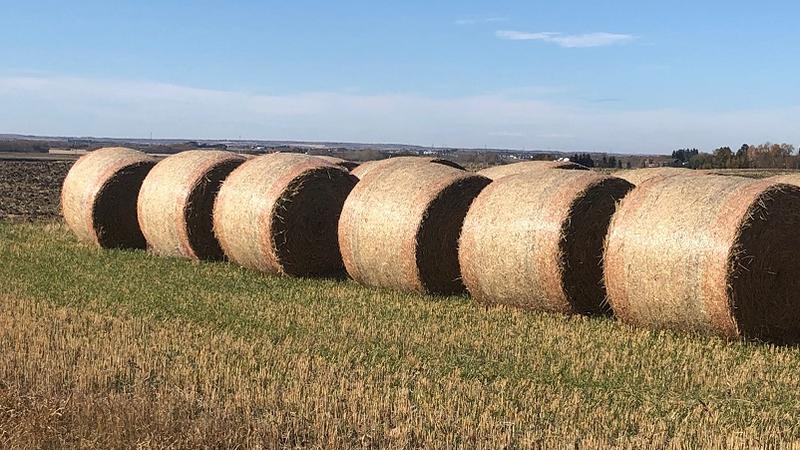
Harvest of major crops is 99 per cent complete throughout central Alberta, and fall fieldwork is near completion.

That according to the latest and final Crop Report of the season from Agriculture Financial Services Corporation (AFSC) and Alberta Agriculture, Forestry, and Rural Economic Development.

As of Oct. 11, 2022, officials say some shower activities over the past week have helped to maintain and even improve soil moisture reserves in some parts of the region. No killer frost, however, has yet to been reported.

Forage reserve estimates in this region are said to be 2 per cent deficit, 6 per cent shortfall, 87 per cent adequate and 5 per cent surplus, while feed grain supplies are 2 per cent deficit, 2 per cent shortfall, 91 per cent adequate and 5 per cent surplus.

Fall-seeded crops are rated as 10 per cent poor, 42 per cent fair, 47 per cent good and 1 per cent excellent.

Across Alberta, harvest is practically complete for the 2022 season; two to three weeks ahead of the 10-year average. According to the report, harvest is even ahead of last year, which was another advanced year with respect to harvest progress.

Provincially, about 99 per cent of all crops have been harvested, 23 per cent ahead of the 5-year average (2017-2021) and 17 per cent ahead of the 10-year (2012-2021) average. About 0.3 per cent of major crops are in swath and 0.5 per cent remain standing.

Feed and forage availability is mostly described as adequate, with some livestock producers having surplus. Provincially, forage reserves are estimated at 3 per cent deficit, 12 per cent shortfall, 69 per cent adequate, and 16 per cent surplus, while feed grain supplies are 2 per cent deficit, 8 per cent shortfall, 74 per cent adequate and 16 per cent surplus.

According to the report, the growing season in 2022 started with dry conditions and cool temperatures for most parts of the province. The Peace Region was the exception where there was a cool wet spring. By the end of May, dry conditions were the dominant weather feature in southern Alberta and there was no excess moisture anywhere in the province.

June is typically the wettest month of the year in Alberta and June 2022 was wetter than normal. This was followed by above average temperatures from the beginning of July towards the end of season.

While spring wheat had an almost normal growth, canola had some issues, leading to delay in growth. Canola had a rough start with the dry spring, flea beetles and cut worms, flowering later in the season when heat returned, and was impacted by dry conditions in July and August. In addition, selected seed emergence was a serious issue in many fields.

Precipitation during June and early July improved soil moisture reserves and benefited sub-surface soil moisture as well. Officials say, however, that soil moisture reserves started to deteriorate in mid-July.

On May 4, 2022, provincial surface soil moisture was rated as 49 per cent good or excellent, with 1 per cent excessive, and improved to 77 per cent good or excellent with 5 per cent excessive as of July 12, 2022.

Late summer and fall drying of soils continued across the province into mid-October. As of October 11, 2020, surface soil moisture was rated as 40 per cent poor, 32 per cent fair, 27 per cent good and 1 per cent excellent.

The report recounts that the weather remained warm and dry over the harvest season, advancing harvest progress by two to three weeks. As of October 11, 2022, about 99 per cent of major crops across the province were combined, with provincial dryland yields estimated at 10 per cent above the 5-year averages.

Provincially, quality for hard red spring wheat, canola and dry peas was above their 5-year averages, while for durum wheat and oats, quality was lower. Quality for malt and feed barley was on par with the 5-year average.

Growing conditions for pasture and tame hay improved with timely precipitation and warmer temperatures in the month of June. While qualitative rankings are said to have improved for the provincial feed supply, conditions in some areas remained poor to fair due to heavy grazing last year and challenging conditions over the past few growing seasons. Overall, livestock feed supplies are sufficient for this winter, and there is a large amount of straw baled up to complement the feed.

The report indicates about 89 per cent of dryland hay in the province was from the first cut, with yield estimated at 1.6 tons per acre, above the 5-year average of 1.4 tons per acre. Some producers, particularly in the South Region, however, failed to harvest a second cut, or harvested very little. The remaining 11 per cent was from the second cut, with yield estimated at 1.0 ton per acre, compared to the 5-year average of 1.1 tons per acre.

For irrigated hay, first cut accounted for 60 per cent of the total (with yield estimated at 2.1 tons per acre), second cut accounted for 36 per cent (with yield reported at 1.4 tons per acre), and third cut accounted for the remaining four per cent (with yield estimated at 0.4 ton per acre).