Sign up for our free daily newsletter!
(rdnewsNOW)
Conditions As Of Sept. 6, 2022

About 40 per cent of local crops now in the bin

Sep 9, 2022 | 2:54 PM

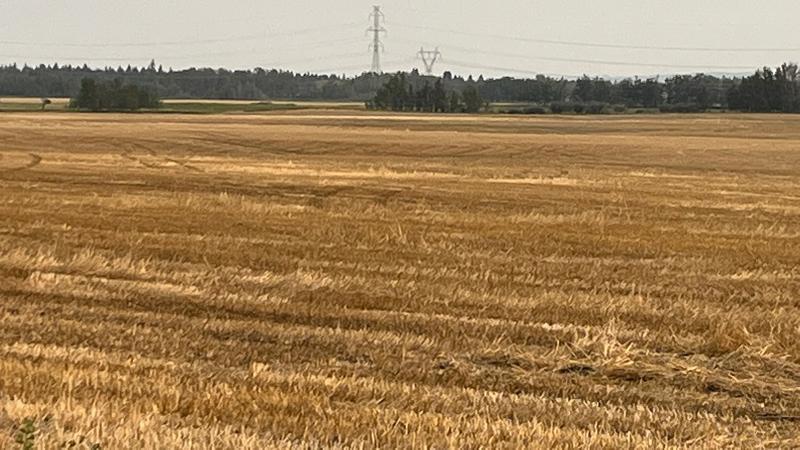
Showers over the weekend slowed harvest operations throughout central Alberta, but high temperatures dried up the fields quickly and harvest resumed, and advanced progress by 20 per cent.

That according to the latest Crop Report from Agriculture Financial Services Corporation (AFSC) and Alberta Agriculture, Forestry and Rural Economic Development.

Conditions as of Sept. 6, 2022 indicate that grasshoppers and flea beetle infestations are still a concern in the region.

Regionally, about 40 per cent of crops are now said to be in the bin (compared to the 5-year average of 24 per cent), with another 18 per cent swathed and 42 per cent of crops still standing.


To date, the quality for the top two grades of all harvested crops are described as better than their 5-year averages, with number one oats on par with the 5-year average and number one dry peas below average.

Second cut haying on dryland is 76 per cent complete (well ahead of the 5-year average of 52 per cent), with yield estimated at 1.4 tons per acre, on par with the 5-year average.

For irrigated haying, it is 40 per cent complete (compared to the 5-year average of 21 per cent), with yield estimated at 1.3 tons per acre, slightly above the 5-year average of 1.2 tons per acre. Quality for dryland hay (irrigated hay shown in brackets) is rated as 23 (10) per cent fair, 76 (90) per cent good and 1 (0) per cent excellent.

Pasture growing conditions declined by 10 per cent and are now rated as 17 per cent poor, 54 per cent fair, and 29 per cent good.

Very hot and dry conditions over the few past weeks deteriorated surface soil moisture by 18 per cent. Surface soil moisture is now rated at 19 per cent poor, 46 per cent fair and 35 per cent good.

Over the past 30-days, officials say most parts of the province have experienced “once in 50-years” warmer than normal temperatures and received below normal rainfall. However, crop yields have been better than normal. In addition to a cool wet start to the season, which saved soil moisture reserves, June rainfalls were largely said to be responsible for supplying enough moisture for crop growth.

Harvest has been in full swing over the past week, advancing progress by 17 per cent for major crops from a week ago. As of September 6, 2022, about 37 per cent of all crops have been combined, less than last year`s progress of 45 per cent, but still ahead of both the 5-year (2017-2021) average of 27 per cent and the 10-year (2012-2021) average of 25 per cent. Another 19 per cent of crops are currently in swath, while 44 per cent is still standing. Regionally compared to the 5-year and 10-year averages, harvest is advanced for all regions.

Dryland yield indices remained similar to two weeks ago. The provincial dryland 5-year and 10-year yield indices indicate provincial yields are 12 per cent above the 5-year averages and almost eight per cent above the 10-year averages. Regionally, the South has the highest 5-year yield index (with estimated yields 21 per cent above the 5-year average), while their yields (bushel/acres) are lower than other regions.

Also, the 10-year yield index for the South is lower than the 5-year yield index, with estimated yields only two per cent above the 10-year average in 2022. Officials say this suggests that over the past 5-years, yields in the South have lagged behind due to sustained drier than normal conditions. The map of cumulative 5-year precipitation deficits relative to the long term normal is said to confirm that the South has been dry over the past five years; hence, 2022 yields are much higher than the 5-year averages. These estimates are subject to change and will be updated bi-weekly until the end of the season.

The overall production of pastures is described as limited due to dry conditions over July and August and the recent heat. Pasture growing condition ratings (tame hay ratings shown in brackets) across the province are rated as 27 (24) per cent poor, 48 (43) per cent fair, and 25 (33) per cent good.

Across the province, second cut dryland hay is 57 per cent complete (ahead of the 5-year average of 38 per cent), while second cuts have been limited in the South Region. The provincial average yield for second cut dryland hay is estimated at 1.1 tons per acre, below the 5-year average of 1.3 tons per acre.

Quality is rated as 17 per cent to fair, 65 per cent good and 18 per cent excellent. Second cut hay on irrigated fields is 81 per cent complete, with yield estimated at 1.5 tons per acre, and below the 5-year average of 1.8 tons per acre.

Quality for baled irrigated hay is rated as 30 per cent poor to fair, 52 per cent good and 18 per cent excellent. Some hay fields in the North West and Peace Regions are likely to be grazed instead of second cut.