Get the free daily rdnewsNOW newsletter by subscribing here!
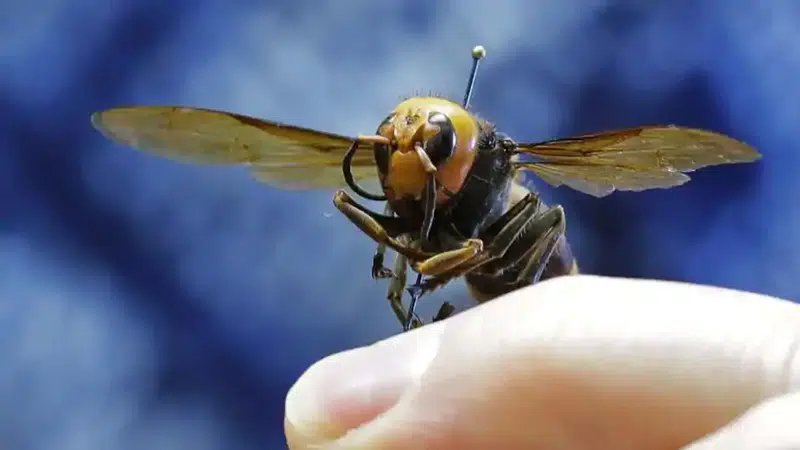
An Asian giant hornet from Japan is seen at the Washington state Department of Agriculture, on May 4. (Associated Press photo)
ALL THE BUZZ

‘Don’t panic’ over giant hornets flying into Red Deer

May 6, 2020 | 5:28 PM

They’re creating quite a buzz, thanks in part to their menacing nickname, but a local nature expert says there’s not much worry that “murder hornets” will be flying into central Alberta anytime soon.

So far, the Asian giant hornet (Vespa mandarinia), as it’s formally known, has only been spotted in North America in small numbers in B.C. and Washington state. Normally found in the forests and low mountains of eastern and southeast Asia, it’s not yet known how they arrived on this continent.

The insects are most definitely an imposing figure. They’re as big as a man’s thumb, or a AA battery, and boast a wing span of up to seven centimetres. They carry a large orange head, black eyes and a sting that could seriously injure or prove fatal to humans.

Todd Nivens, Executive Director at the Waskasoo Environmental Education Society, says there are two insects commonly found in our region – the banded horntail and elm sawfly – that could easily be confused for the Asian giant hornet.

“Especially with horntails, when you get west of the city people who camp see them all the time,” Nivens says. “Sawflies we see more in the city because we have elm trees, and their larvae feed off those trees.”

Nivens says there are notable differences in size between sawflies and horntails compared to the Asian giant hornet.

“Sawflies are about the same length, but they’re thinner. They’re much more slender and have a uniform profile,” Nivens explains. “The horntail has a head, thorax and an abdomen but it’s much more uniform in size all the way down the body (than the hornet).”

Another difference, Nivens says, is that the horntail has a black head with yellow on it while the giant hornet has a yellow head with black eyes.

“With horntails, the thing that makes them look scary is they have this structure on the back of them that looks like a big long stinger. But it’s actually a tool for laying eggs in rotting wood and has no defensive capabilities whatsoever.”

Sawflies also have a different color pattern from the giant hornet.

“They don’t have the big antennae (like the hornet) and have a white marking on the back of their thorax.”

Nivens says he receives a few calls each year about sawflies and horntails, both of which he says are harmless, non-invasive species.

“Unless you’re a tree they really have no interest in you,” he says.

His key message regarding the Asian giant hornet is simple – don’t panic.

“There hasn’t been a sighting east of the Rocky Mountains,’ he points out.

Given that these hornets prey largely on honeybees, Nivens says we have a good line of defence against the giant hornets.

“Because we have this really well-developed community of beekeepers, if the Asian giant hornet were to make it here someone is going to spot them quickly. We’re not talking about something that is going to live among us undetected for a long period of time. And because of that it’s something that would be eradicated extremely quickly.”

There’s also no evidence at this time, Nivens notes, that the Asian giant hornet would be able to survive a cold, Canadian winter.

If nothing else, given the risk of them invading our local is rather low, Nivens says Asian giant hornets are fascinating to talk about.

“You’re talking about an insect that looks like it was drawn by a cartoon artist,” he joked. “When you look at them purely as a predator, this is an animal that will decapitate the heads of its prey and then carry those bodies back to feed its own young and leave the heads behind. It’s the stuff out of horror movies.”