Get the free daily rdnewsNOW newsletter by subscribing here!
sponsored

Market Watch – Oct. 24, 2025

Oct 27, 2025 | 10:15 AM

This week’s highlights

  • Equity markets swing as CPI data and PMI divergence shape rate expectations
  • Rates ease on softer U.S. CPI while credit markets stay resilient
  • Canada’s inflation rate rises to 2.4% in September, StatCan reports
  • U.S. home sales in September rose, boosted by falling mortgage rates
  • China’s economy expands at slowest pace in a year

Week in review

Equity markets swing as CPI data and PMI divergence shape rate expectations

U.S. equities began the week higher on strong earnings and easing trade tensions, but momentum faded midweek as the prolonged government shutdown and mixed corporate headlines weighed on sentiment. A softer September Consumer Price Index (CPI) print on Friday revived expectations for near-term Fed cuts, lifting Treasurys and supporting equities into the close. In Canada, markets slipped early after hotter CPI data tempered rate-cut bets, then stabilized as retail sales pointed to underlying weakness, reinforcing expectations for BoC easing. European stocks were mixed: early gains from defense names faded as French fiscal concerns deepened and Purchasing Manager Index (PMI) data highlighted divergence—Germany firming while France contracted. U.K. equities outperformed on benign inflation, which bolstered rate-cut hopes. In China and EM, optimism from Trump-Xi meeting confirmation and strong export-driven GDP buoyed early gains, though sentiment softened later amid global risk rotation.

Highlights:

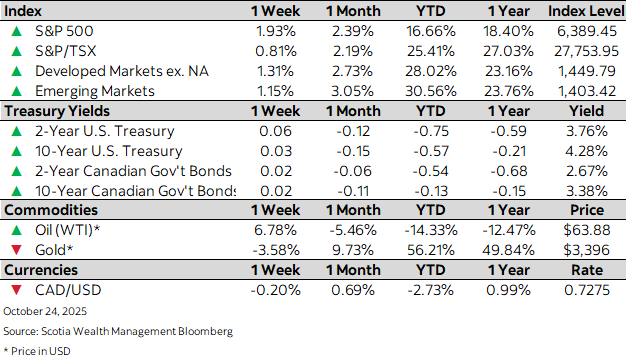
  • U.S. equities returned 1.93%1, rallying early on strong earnings and softer trade rhetoric but slipping midweek amid shutdown concerns; Friday’s cooler CPI revived Fed-cut expectations, helping markets end the week on firmer footing.
  • Canadian equities returned 0.81%2 after hotter CPI tempered easing hopes, then steadied as retail sales weakness reinforced expectations for a Bank of Canada rate cut despite lingering growth and labour softness.
  • European stocks rose 1.31%3, with defense-led gains fading as French fiscal worries and mixed PMIs weighed; Germany strengthened while France contracted, and benign U.K. inflation lifted the FTSE on renewed rate-cut bets..
  • Emerging markets were up 1.15%4 on Trump-Xi meeting confirmation and export-driven GDP resilience, but optimism faded later as global risk appetite shifted and domestic consumption concerns persisted.

Rates ease on softer U.S. CPI while credit markets stay resilient

U.S. rates drifted lower through the week as softer September CPI reinforced expectations for additional Fed cuts, while strong PMI data tempered the dovish tone. Canadian yields initially rose after hotter CPI data reduced near-term easing odds but later eased as retail sales weakness and dovish BoC commentary kept rate-cut expectations intact. In Europe, gilts rallied on benign U.K. inflation, while eurozone yields edged higher late in the week as PMIs surprised to the upside, despite lingering fiscal concerns in France. Credit markets were steady overall, with light primary issuance and spreads holding firm amid supportive rate dynamics. Emerging markets saw muted moves, with sentiment anchored by China’s growth data and trade optimism early in the week.

Highlights:

  • The 2- and 10-year U.S. Treasury yields were up 6 basis points (bps) and 3 bps, respectively. In Canada, the 2- and 10-year yields both rose 2 bps. Bond yields and prices move inversely to one another.
  • Government bond markets were driven by inflation surprises—U.S. yields fell on softer CPI, Canadian rates initially rose on a hotter print before easing, while gilts rallied on benign U.K. data and eurozone yields firmed after stronger PMIs.
  • Investment-grade and high-yield spreads held steady amid light issuance and supportive rate dynamics, with refinancing costs rising for longer maturities while demand for new deals remained robust despite muted primary volumes.

Weekly dashboard

Canada’s inflation rate rises to 2.4% in September, StatCan reports

Canada’s inflation rate accelerated more than expected in September. According to Statistics Canada (StatCan), the Consumer Price Index (CPI) rose 2.4% in September on an annual basis, up from August’s 1.9% pace. Analysts were expecting an inflation rate of 2.2%. The CPI results were heavily influenced by fluctuations in fuel costs. Year-over-year, gas prices fell 4.1% in September, but that was less than a 12.7% decline in August, putting upward pressure on headline inflation.

Highlights:

  • One of the core measures of inflation, the CPI-median, the centermost component of the CPI basket, was at 3.2% in September, unchanged from the upwardly revised number last month on an annual basis, while CPI-trim, which excludes the most extreme price changes, edged up to 3.1% in September from 3.0% in August.
  • Food prices increased 3.8% annually last month, mainly due to a 4% increase in food purchased from stores. The increase in grocery prices last month marks the largest year-over-year rise since the most recent low in April 2024
  • Rents also contributed to a year-over-year increase, with a 4.8% jump in September. That move took shelter inflation, the biggest component of the CPI basket, to 2.6%.

U.S. home sales in September rose, boosted by falling mortgage rates

Home sales rose in September to a seven-month high after buyers seized on declining mortgage rates, offering some hope that the housing market could improve. According to the National Association of Realtors, sales of existing homes rose 1.5% from the prior month to a seasonally adjusted annual rate of 4.06 million, the highest level since February. This was in line with economists’ forecasts for the month and a reversal from August’s slight decline in sales.

Highlights:

  • Lower borrowing costs boosted activity in September, which reflected contracts signed earlier in the summer when mortgage rates began to ease. The 30-year mortgage rate has gradually fallen after nearing 7% at the start of the year, and some buyers couldn’t wait any longer to act.
  • Still, many home buyers see the market as too expensive. With the Federal Reserve expected to continue cutting short-term rates, these buyers are waiting for mortgage rates to come down further.
  • The typical monthly mortgage payment for a home buyer in the four weeks ended October 12 was US$2,564, down about US$300 from May but still up from a year earlier.

China’s economy expands at slowest pace in a year

China’s economic momentum decelerated to its slowest pace in a year, putting Beijing on alert in the midst of trade negotiations with the U.S. China said its gross domestic product expanded 4.8% in the third quarter of 2025 compared with a year earlier, down from 5.2% growth in the second quarter. Over the first nine months of the year, China’s economy expanded 5.2% from the year-earlier period, according to the National Bureau of Statistics. That means that Beijing is largely on track to hit its official target of around 5.0% growth for 2025.

Highlights:

  • China’s economy has defied expectations this year thanks in large part to its resilient exports in the face of new U.S. tariffs.
  • China’s customs agency last week reported a 6.1% year-over-year increase in overall exports in the first nine months of 2025, even as exports to the U.S. fell nearly 17% for the same period.
  • Analysts are skeptical China’s exports can continue growing at such a fast clip the rest of the year and next year. Many American companies rushed to import goods before tariffs kicked in or escalated, giving a short-term boost to Chinese exporters.

1 S&P 500 Index USD
2 S&P/TSX Composite Index USD
3 Bloomberg Developed Markets ex N. America Large & Mid Cap Price Return Index USD
4 Bloomberg EM Large & Mid Cap Price Return Index USD