Get the free daily rdnewsNOW newsletter by subscribing here!
(RDP)
Winter Olympics February 2026

Red Deer Polytechnic researchers revolutionize wheelchair curling with virtual reality innovation

Oct 23, 2025 | 2:33 PM

Students and staff at Red Deer Polytechnic (RDP) are aiming to reshape the future of wheelchair curling.

Officials at RDP say what started as a conversation has evolved into a groundbreaking virtual reality applied research initiative empowering Canadian Para sport athletes on their journey to the Paralympic stage.

In November 2024, Jennifer Dornstauder, Engineering Technical Lead, and Prateeksha Aggarwal, Industrial Research Associate, both researchers within RDP’s Centre for Innovation in Manufacturing – Technology Access Centre (CIM-TAC) spoke with Tessa Gallinger, Advisor with the Canadian Paralympic Committee.

RDP says their discussion centred on a bold idea of using virtual reality (VR) to enhance Para sport training. That idea quickly gained traction. Officials say applied research in healthcare and health technology, specifically within Para sport innovation, is not new for applied researchers at RDP. The Polytechnic says it has been committed to reducing barriers for athletes through applied research.

In collaboration with the Canadian Olympic and Paralympic Sport Institute Network (COPSIN), the Canadian Paralympic Committee (CPC) and Bowhead Corp., RDP says it has acquired a Natural Sciences and Engineering Research Council of Canada (NSERC) Applied Research and Development grant worth $860,000. Leveraged to a project value of $1.15 million with in-kind contributions, RDP says this applied research project helps increase accessibility to specialized Para sport equipment across Canada through advanced design and manufacturing over the next three years.

Building on this momentum, RDP says Dornstauder and Aggarwal were invited to present their work on Adaptive Design in Paralympic Sport at the SPIN (SPort INovation) Summit in Calgary in April 2025. The Polytechnic says that presentation sparked new conversations and led to the launch of another pioneering project: Reducing Fatigue and Injury Risk in Parasport Training Through Virtual Reality, developed in partnership with Curling Canada.

“After the presentation, Prateeksha and I ended up in a few great conversations,” recalls Dornstauder, in a media release. “One was with someone from Canada’s Wheelchair Curling program, who mentioned they had been interested in virtual reality training for a while.”

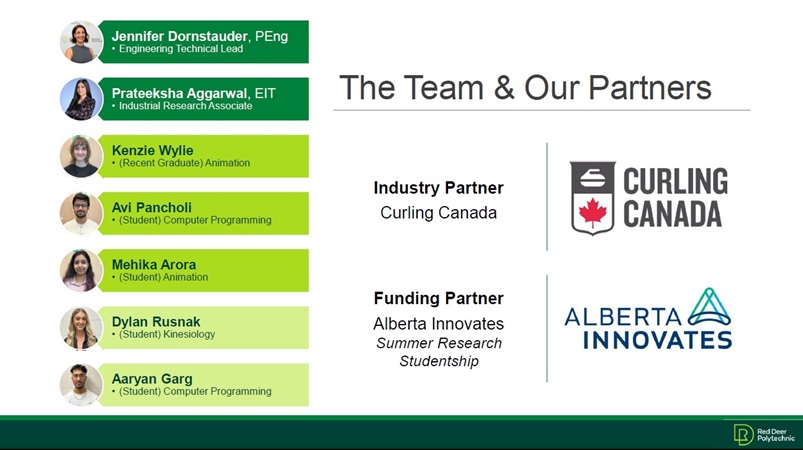
To bring this vision to life, officials say five RDP students—Kenzie Wylie and Mehika Arora (Bachelor of Applied Arts in Animation and Visual Effects), Avi Pancholi and Aaryan Garg (Computer Programming Diploma) and Dylan Rusnak (Bachelor of Kinesiology and Sport Studies – University Transfer)—were selected through the Alberta Innovates Summer Research Studentship.

(RDP)

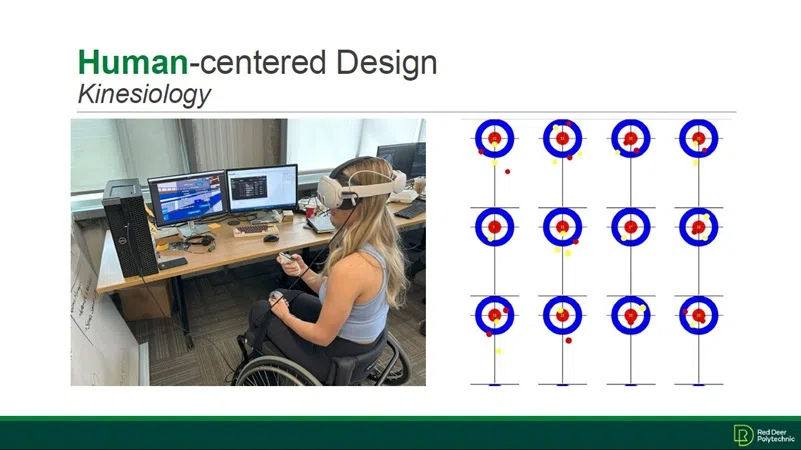
Over the course of four months, RDP says they combined their diverse academic strengths to build a fully immersive VR wheelchair curling experience, complete with realistic body and rock movements, detailed ice and arena graphics and strategic gameplay elements.

“Wheelchair Curling was a perfect fit to pilot the VR project,” explains Dornstauder. “They’re such an innovative and motivated group and the strategy side of the sport made for a really engaging challenge.”

Officials say this Red Deer Polytechnic applied research team learned about several barriers for wheelchair curling athletes: the physical demands of traveling to training facilities, limited access to ice time and coaching, and facility constraints. RDP says the VR solution directly addresses these barriers, offering athletes a safe, accessible and confidence-building training environment with real-time feedback.

Developed from scratch using the program Unity, officials say the project became a rich learning experience for the students. Beyond technical skills in animation and programming, RDP says the students honed their ability to collaborate, balance performance with visuals and integrate feedback from Curling Canada. The process is also said to have deepened their understanding of Para sport needs and the importance of inclusive design.

RDP says the team tackled programming bugs and navigated the unique challenge of creating a seated avatar—an essential feature for wheelchair curling. One notable difference between virtual and real curling is the absence of tactile feedback as athletes don’t feel the weight of the rocks when throwing, officials point out. This is said to have required creative problem-solving to simulate realistic gameplay and maintain the integrity of the training experience. This VR curling experience is said to be far more than a digital simulation.

“It provides a lot of value to the athletes,” says Dornstauder. “Virtual reality wheelchair curling not only reduces fatigue and the risk of injury, but it is designed to help prepare Canadian Para sport athletes for curling at the 2026 Winter Paralympics in Italy.”

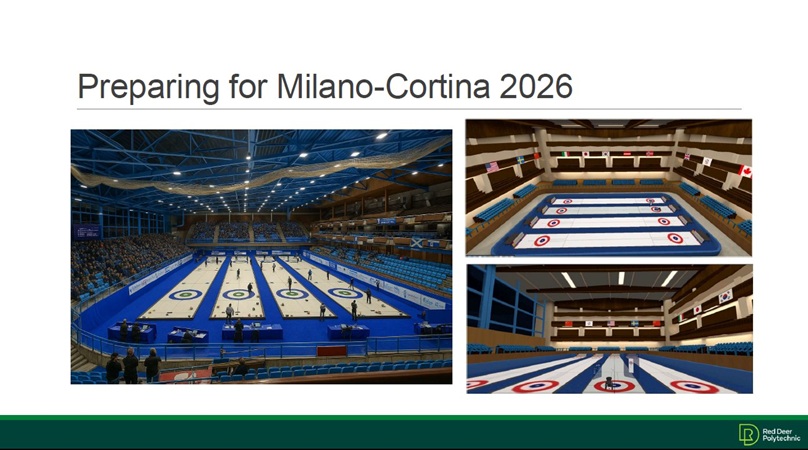
Officials say the RDP team meticulously recreated the interior of the Cortina Olympic Stadium in Cortina d’Ampezzo, Italy, the site of the Olympic and Paralympic curling events scheduled for February 4–22, 2026 and March 6-15, 2026, respectively. Officials highlight that this allows athletes to train in a virtual replica of the real-world venue.

(RDP)

RDP says Canadian curling coaches have already tested the VR system and are enthusiastic to get their athletes themselves to step into the virtual arena to sharpen their skills and build confidence ahead of the Games.

“It’s inspiring to help the athletes prepare for the Paralympic Games,” Dornstauder adds.

As the project continues to evolve, officials say the RDP team will be exploring new features, including multi-player functionality, to further enhance the training experience. The journey is said to have been transformative not only for the testers but also for the researchers.

“This project has really shown the value of interdisciplinary collaboration in Para sport and pushed the boundaries of what student teams can achieve,” reflects Dornstauder.

With their innovative spirit and commitment to accessibility, officials suggest the Red Deer Polytechnic team is not only helping Canadian Para sport athletes overcome training barriers, but may also be helping them reach the podium in Italy.

For more information about research and innovation at RDP, visit: rdpolytech.ca/research.