Get the free daily rdnewsNOW newsletter by subscribing here!
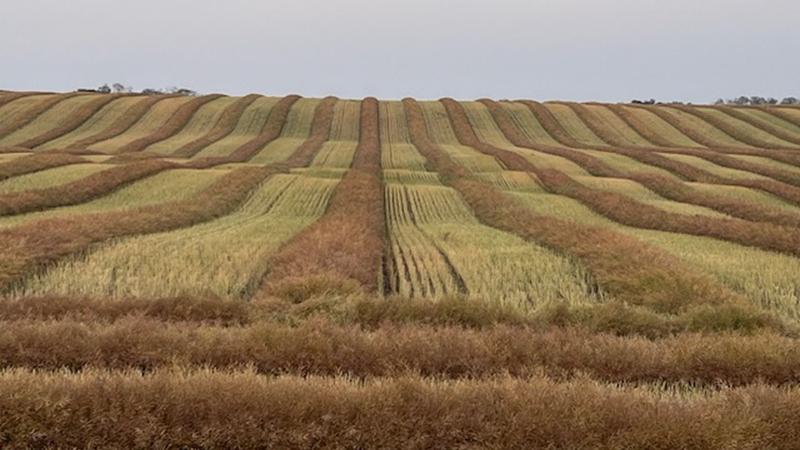
(Sheldon Spackman/rdnewsNOW)
Conditions As Of Sept. 9, 2025

Central Alberta harvest roughly one-third complete

Sep 12, 2025 | 3:55 PM

Harvest is well underway across the central Alberta region due to consistent warm, dry conditions.

According to the latest Crop Report from Agriculture Financial Services Corporation (AFSC) and the Government of Alberta, dry peas lead major crops at 89 per cent complete, with canola swathing in full swing. Progress for all crops is at 31 per cent complete, compared to the 5- year average of 42 per cent.

Soil moisture is declining across the region due to limited rainfall. Surface (sub-surface) moisture levels rated as 11 (7) per cent poor, 25 (26) per cent fair, 60 (63) per cent good, 3 (4) per cent excellent, and 0 (0) per cent excessive.

Pastures (tame hay) conditions are rated 5 (6) per cent poor, 36 (33) per cent fair, 58 (60) per cent good, and 1 (1) per cent excellent.

Elsewhere, harvest is progressing across the province, supported by warm and dry weather that has created favorable conditions for field operations. Provincial harvest for all crops is 42 per cent complete, above the 5- and 10-year averages of 40 and 32 per cent, respectively.

Most regions are above their 10-year averages, except for the South, where progress is currently 5 per cent below average. Despite this, the South Region leads all regions with 52 per cent of all crops harvested, below its 5- year average of 65 per cent. The North East and North West follows at 41 per cent complete, both above their respective 5- year averages of 22 and 24 per cent. The Peace Region is at 38 per cent complete, also ahead of its 5-year average of 21 per cent. The Central Region has made the least progress, with 31 per cent combined, compared to its 5-year average of 42 per cent. Provincially, harvest for fall rye and winter wheat are nearly complete, while dry peas and lentils are 91 per cent combined.

The first crop quality estimates for the season show varied grades, with overall quality above average for select crops such as spring wheat and canola, while durum, oats, and dry peas are rating below their 5- and 10-year averages. These variations reflect heat and moisture stress during grain fill and possibly the impact of the August 20 hailstorm, which caused damage ranging from light to severe, mainly across the western path of the South and Central regions.

While the overall provincial impact of hail appears limited, the full extent of quality and yield impacts remains uncertain until harvest is complete. Provincially, 77 per cent of spring wheat is rated as 1 C.W., above the 5-year average of 61 per cent. Durum is currently rated 47 per cent 1 C.W., below the 5- year average of 57 per cent.

For barley, malt quality is near average at 30 per cent (5-year average 31 per cent), while rated 61 per cent as 1 C.W., above the 5-year average of 57 per cent (Malt describes a 1 C.W. grade malting variety barley). As for oats, 22 per cent is estimated to be 1 C.W., compared to the 5-year average of 38 per cent.

Provincially, canola is estimated to be 91 per cent 1 Can., above the 5-year average of 84 per cent. Dry peas are estimated to have 12 per cent rated as 1 Can., compared to the 5-year average of 29 per cent.

Persistent dry conditions with little to no rainfall across the province have caused a decline in soil moisture in most regions. Surface and sub-surface soil moisture ratings show a widespread decline, with provincial surface (weekly change) moisture conditions rated good to excellent at 41 (-4) per cent, on par with the 5-year average.

Regional good to excellent surface (weekly change) moisture conditions are at 34 (-2) per cent in the South, 63 (-4) per cent in the Central, 26 (-11) per cent in the North East, 35 (0) per cent in the North West, and 38 (0) per cent in the Peace.

Similarly, sub-surface (weekly change) moisture conditions rated as good to excellent is at 42 (-4) per cent provincially, 36 (-2) per cent in the South Region, 67 (-4) per cent in the Central Region, 23 (-12) per cent in the North East Region, 31 (-1) per cent in the North West Region, and 37 (0) per cent in the Peace Region.

Provincially, dryland major crops yield estimates are projected to be above their 5-year average, except for oats, which is expected to be slightly below. Yield projection compared to the 5-year yield index is highest for dry peas (34 per cent above), followed by spring wheat (19 per cent above), canola (17 per cent above), barley (15 per cent above), and oats (2 per cent below).

Regionally, major crops in the South, Central, and North West regions are projected to exceed their 5-year averages by 37, 53, and 22 per cent, respectively. The North East Region is also estimated to yield 2 per cent above the 5- year average, while the Peace Region is projected to yield 2 per cent below the 5-year average.

Pasture and tame hay conditions are declining across most regions due to persistent dryness and reduced soil moisture. Provincially, second cut dryland (irrigated) hay is 64 (94) per cent complete, with quality rated at 74 (71) per cent good to excellent. Estimated yield for second cut dryland hay is 1.1 tons per acre, slightly above the 5-year average of 1 ton per acre, while irrigated hay yield is estimated at 2.3 tons per acre, above the 5-year average of 1.7 tons per acre.

Regionally, the South leads in second cut dryland hay quality, rated 91 per cent good to excellent, with yields at 1.8 tons per acre. The Central Region follows with 85 per cent good to excellent and 1.4 tons per acre yield. In the North West, dryland hay is 77 per cent good to excellent, with estimated yield of 1 ton per acre, while the North East reports the lowest quality at 46 per cent good to excellent, with yields of 0.6 tons per acre.

Provincially, 41 per cent of pasture is in good to excellent condition, compared to the 5-year average of 32 per cent. Regional pasture (5-year average) good to excellent condition is at 40 (20) per cent in the South, 59 (37) per cent in the Central, 19 (33) per cent in the North East, 27 (46) per cent in the North West, and 27 (45) per cent in the Peace.

Similarly, tame hay rated as good to excellent stands at 36 per cent provincially, slightly below the 5-year average of 38 per cent. Regionally, tame hay (5- year average) conditions rated as good to excellent is at 39 (19) per cent in the South, 61 (41) per cent in the Central, 15 (33) per cent in the North East, 25 (51) per cent in the North West, and 24 (45) per cent in the Peace.