Subscribe to the 100% free rdnewsNOW daily newsletter!
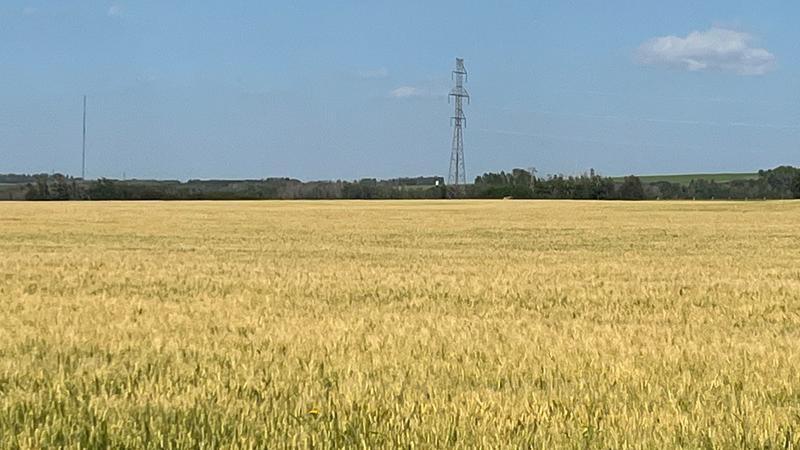
Photo credit: Sheldon Spackman/rdnewsNOW.com
Conditions as of July 29, 2025

Dryland first cut hay 74 per cent complete in Central Alberta region

Aug 1, 2025 | 6:57 PM

Early estimated yields in Alberta’s Central Region are 61 bushels per acre for durum wheat, and 54 bushels per acre for lentils.

That according to the latest Crop Report from Agriculture Financial Services Corporation (AFSC) and the Government of Alberta.

The report indicates that dryland first cut hay is 74 per cent complete, yielding 1.7 tons per acre. Producers able to take a second cut are 4 per cent complete, with an average yield of 1.5 ton per acre.

Sub-surface moisture continued to improve this week, now rated as 2 per cent poor, 13 per cent fair, 71 per cent good, 14 per cent excellent and 1 per cent excessive.

Gopher activity over threshold (gopher hills present in fields) is reported in 4 per cent of fields.

Province-wide, cool temperatures continued for the majority of the province during the past week with additional precipitation mainly falling in the South and Peace regions. With the exception of some significant hail storms, most areas welcomed moisture that continues to improve sub-soil moisture reserves while helping crops meet their yield potential.

This week’s report includes the initial yield estimates for crops. The yield estimates provided this week are expected to change before harvest. Regional dryland crop yield estimates are mostly above the 5- and 10- year averages in the South and Central regions, while dryland crop yield estimates are near or below the 5- and 10-year averages in the North East, North West and Peace regions.

Current yield expectations suggest the areas which received additional moisture through July will have higher than normal yields, offsetting yield losses from areas which expect lower than average production due to drier conditions.

Provincially, dryland major crops are expected to produce 13.7 per cent above the 5-year average and 6.2 per cent above the 10-year average, based on the respective yield indexes. Initial provincial major crops irrigated yields, which are only reported for the South and Central regions, are expected to produce 4.2 per cent above the 5-year average and 3.9 per cent above the 10- year average.

Recent cool and wet weather is slowing crop development, with major cereal crops in various stages of milk development, while canola and pulse crops moving from flowering to podding. The dryland 5-year provincial index for major cereal crops is 106.9 per cent for spring wheat, 106.8 per cent for barley, and 88.0 per cent for oats. The yield index for oats is influenced by the higher concentration of provincial oat acres planted in the North East, North West, and Peace regions. The 5-year index for canola is 109.1 per cent with all regions except the Peace expecting yields above the 5-year average. Provincial canola staging is reported as 58 per cent of crop podding and 42 per cent flowering. The dry peas 5-year index is reported as 123.6 per cent, with all regions expecting yields above the 5-year average. Dry peas staging is at 85 per cent of crop podding and 15 per cent flowering.

Provincially, 64 per cent of all crops are rated as in good to excellent condition; a decrease of 2 per cent over the past two weeks, but ahead of both the 5-year average of 53 per cent and 10-year average of 57 per cent. Regionally, crop conditions continue to vary with the percentage of all crops reported as good to excellent (change over two weeks) at 64 (+3) per cent in the South, 93 (+6) per cent in the Central, 59 (-9) per cent in the North East, 70 (-11) per cent in the Noth West and 22 (-6) per cent in the Peace.

The cool temperatures and excess moisture have also slowed the pace of the first cut of hay. Provincial first cut completion (5-year average) is at 85 (81) per cent for dryland with an average yield of 1.2 (1.4) tons per acre, while irrigated hay first cut is at 82 (90) per cent complete with an average yield of 2.5 (2.3) tons per acre. Second cuts for hay have also begun; however, fewer than average provincial producers indicate they will take a second cut. Second cuts are expected by 46 (48) per cent of dryland hay producers and by 9 (13) per cent of irrigated hay producers.

Notable rains fell in areas of the South and Peace regions over the past week, improving soil moisture conditions in those regions. Provincial surface moisture is rated 60 per cent good to excellent, a 3 per cent increase from last week, which is above the 5-year average of 48 per cent. Regional surface moisture rated as good to excellent (change from last week) is at 64 (+14) per cent for the South, 87 (-1) per cent for the Central, 37 (-10) per cent for the North East, 39 (-4) per cent for the North West, and 32 (+10) per cent for the Peace.

Provincial sub-surface moisture is rated at 51 per cent good to excellent, due to a 3 per cent increase over last week, which is above the 5-year average of 45 per cent. Regionally, sub-surface soil moisture rated as good to excellent (change from last week) is 43 (+8) in South, 84 (+4) in Central, 35 (-6) in North East, 29 (-5) in North West and 35 (+8) in Peace Region.

Pasture and tame hay provincial conditions held relatively steady this week, mainly due to improving conditions in the South and Peace regions. Provincial pasture growth conditions are reported at 53 per cent good to excellent, while provincial tame hay conditions are at 43 per cent good to excellent. Both pasture and tame hay conditions improved 1 per cent over last week.