
Subscribe to the 100% free rdnewsNOW daily newsletter!
(ID 35046640 © Tab1962 | Dreamstime.com)
four-as-of-right

City tries to dispel concerns around Red Deer’s $12 million Housing Accelerator Fund grant

Jul 17, 2025 | 3:23 PM

Red Deerians are being fairly loud these days about their concerns with how a federal housing grant will negatively impact their neighbourhoods, and even cost local taxpayers.

Except it won’t cost taxpayers in terms of the plans in place for what’s being sent Red Deer’s way, according to the municipality.

The City previously applied to the Canada Mortgage Housing Corporation (CMHC) for $30 million of its Housing Accelerator Fund (HAF), but was approved for only $12 million.

The city had allocated dollar amounts divided between eight initiatives for that $30 million, but the final agreement for 40 per cent of what they asked means they had to scale back how far they could go with each.

The goal with $30 million was to incentivize almost 1,200 units of housing, but now that number will be 352, and the city won’t be dipping into reserves to take the initiatives further at this time.

In fact, following public consultations which have already taken place, the city will release a comprehensive ‘What We Heard‘ report this fall, before first reading by city council in December, and lastly a public hearing and final decision on whether to go forward with the money in early 2026.

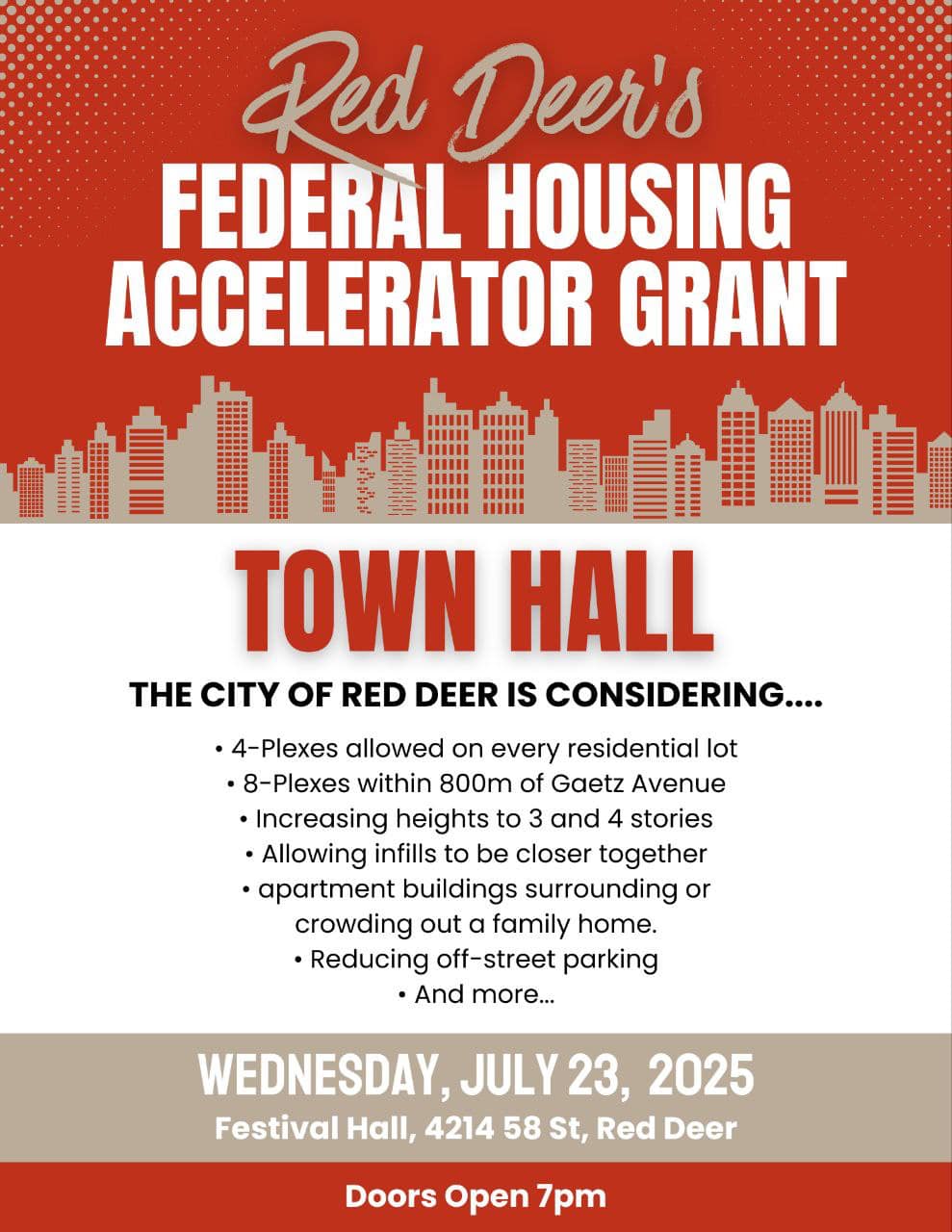
But the big catch of using the dollars is it requires a municipality receiving it to permit fourplexes as-of-right on every residential lot. In other words, a developer could have such a dwelling without rezoning approvals or public consultation, according to the city’s website.

Interestingly, Toronto city council, just this week, turned their noses up to sixplexes-as-of-right, and that will potentially cost them $30 million of the $471 million over four years from the Housing Accelerator Fund they’re slated to receive, according to The Globe and Mail.

But Kimberly Fils-Aimé, senior planner at the city, says in Red Deer’s case, four-as-of-right doesn’t preclude having developers go through other regulations.

“If the city does accept the $12 million, we have to do four units as-of-right — that’s non-negotiable. With that though, there is opportunity for the city to manage it, and what I mean by that is, for instance, on a residential property, we still have to consider height and setbacks,” she says.

“If people want to have a variance of some sort, they would still have to consult with their adjacent neighbours.”

The city conducted three meetings last month, and there could be more to come, but the fall report will ensure, she says, the city captures accurately what the community said.

“We’re by no means in a place where we’ve already made a decision. We’ve heard a wide array of opinions,” Fils-Aimé adds, also touching on the uniqueness of Parkvale, Waskasoo and Woodlea.

“There can be different regulations in different parts of the city, while still respecting our obligations to the CMHC. We know people are passionate about their neighbourhoods, especially in those three; we understand that.”

Fils-Aimé says one way or another, Red Deer is growing, and it’s wholly part of the national housing crisis, thus action at some point, in some form, must be taken.

The clarification on the dollar figures comes after a recent news release from the community associations for Parkvale, Waskasoo and Woodlea which claimed the city would still spend the $30 million it asked CMHC for, therefore costing taxpayers $18 million – over and above the grant.

While that’s not the case, as the city has explained above, the community associations for what are three of the city’s older neighbourhoods remain concerned.

“The city has begun a process of public engagement on zoning and development changes required by the terms of the HAF grant. The Parkvale, Waskasoo, and Woodlea community association boards have had serious concerns regarding this public engagement,” the trio says in their joint release.

“In our view, the city has failed to advertise the issue, to inform and educate the public adequately, and to provide genuine and meaningful opportunities for involvement. The online survey and the public ‘conversations’ around four units as-of-right have shown clear biases toward promoting a particular view of development rather than seeking the honest opinions of Red Deerians — and a good indicator of this is that at no point has the key question been put to the public: ‘Do you support the principle of four units as-of-right?'”

The associations also point to a lack of public details about the city’s eight action plans, but those can now be read about in some detail here.

One of the more comprehensive projects is dubbed ‘Dollars for Doors’ and will take up about $5 million.

Meantime, a citizen-led town hall on this topic is happening July 23 at Festival Hall. Start time is 7 p.m.

As of this writing, the city is not part of the town hall, but the city did release additional information Thursday, by way of the July 21 council agenda.

A report to council says more than 1,100 residents have participated in workshops and online engagements since May.

They note that while there is strong support for increasing housing options, early findings show significant public opposition to a city-wide four-as-of-right zoning approach. Concerns pertain to parking, compatibility, infrastructure capacity, and the lack of public input required for future development should the zoning changes proceed.

The mid-project update comes as the city wants to ensure council and the public are being kept abreast of the proposal as it moves along.

“This project is just one piece of the larger work we need to do to address housing challenges in Red Deer,” adds David Girardin, the city’s senior manager of growth and planning.

“The Housing Accelerator Fund is designed to remove barriers and speed up the delivery of new homes, but we know four units as-of-right isn’t the only solution. There are many tools and approaches to increase housing supply and ensure Red Deerians have access to a range of housing options that meet community needs.”

This new report does not ask or require council to make any decisions at this time, though they do have the power to withdraw at any time from the federal funding, or pause engagement and focus on advocacy to Ottawa for alternative options.

The full council agenda report can be found here.