Subscribe to the 100% free rdnewsNOW daily newsletter!
Sponsored

Market Watch: July 11, 2025

Jul 14, 2025 | 1:26 PM

This week’s highlights

  • Tariff volatility and mixed FOMC views reinforce investors’ cautious outlook
  • Rates muted on trade uncertainty and resilient economic data while credit holds firm
  • Canada’s economic activity reaches four-month high in June
  • U.S. small business sentiment darkens slightly
  • German exports fall again as tariffs drag on economy

Week in review

Tariff volatility and mixed FOMC views reinforce investors’ cautious outlook

In the U.S., equity markets were volatile as investors digested a steady drumbeat of tariff announcements, including new levies on imports from Japan, South Korea, Brazil and Canada, with implementation deferred to August 1. While the June payrolls report showed continued labour market resilience and jobless claims surprised to the downside, these positives were overshadowed by growing trade uncertainty and a Fed grappling with inflation ambiguity, as revealed in the June Federal Open Market Committee (FOMC) minutes. In Canada, a strong June jobs report—driven by broad sectoral gains—reduced expectations for a near-term rate cut, though sentiment soured after the U.S. imposed a surprise 35% tariff on non-USMCA goods. European equities weakened late in the week following a contraction in U.K. GDP, while in China, weak inflation and deepening Producer Price Index (PPI) deflation underscored fragile domestic demand despite policy support.

Highlights:

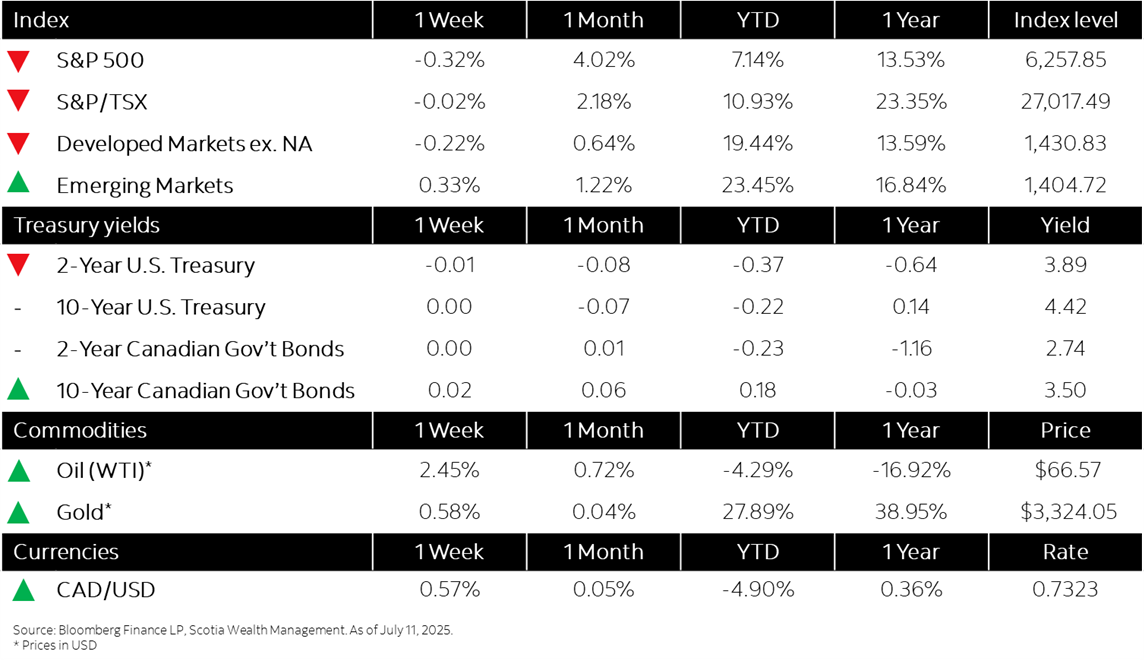
  • U.S. equities returned -0.32%1 as markets whipsawed following waves of new tariff announcements – including steep levies on key imports – that overshadowed solid labour market data which complicated the Fed policy outlook.
  • Canadian markets returned -0.02%2 despite support from a strong June jobs report after the U.S. imposed a surprise 35% tariff on Canadian goods that reignited trade war concerns.
  • European markets lost -0.22%3 following a surprise contraction in U.K. GDP and renewed tariff threats on core sectors like autos and pharmaceuticals.
  • Emerging markets rose 0.33%4 as China faced pressure from weak inflation data and deepending PPI deflation which signaled fragile domestic demand and persistent industrial margin stress despite ongoing policy support and modest credit growth.

Rates muted on trade uncertainty and resilient economic data while credit holds firm

In the U.S., Treasury yields were flat as markets absorbed a barrage of tariff announcements and parsed the June FOMC minutes, which revealed a divided committee navigating inflation uncertainty. A strong 10-year auction midweek helped anchor rates, though volatility persisted ahead of the 30-year sale. Canadian yields moved in unison with their southern counterparts, rising after a robust June jobs report tempered expectations for a near-term Bank of Canada cut. In Europe, rates were mixed amid light macro data and steady auction activity. In the Asia-Pacific region, the Reserve Bank of New Zealand struck a dovish tone, while the Reserve Bank of Australia surprised markets by holding steady. Credit markets remained resilient, with investment grade issuance running ahead of expectations and high yield supply steady despite rising borrowing costs.

Highlights:

  • The 2-year U.S. Treasury yield fell 1 basis point (bp) while the 10-year was unchanged. In Canada, the 2-year yield was flat while the 10-year was up 2 bps. Bond yields and prices move inversely to one another.
  • The FOMC minutes released this week revealed a divided committee, with some officials viewing tariff-driven inflation as transitory, while others warned of more persistent price pressures, reinforcing a cautious stance amid heightened policy uncertainty.
  • The investment grade primary market is wrapping up an active week at $30bn USD, beating sales expectations. High yield new issuance was also up this week, dominated by Nissan Motor’s multi-tranche deal.

Weekly dashboard

(Weekly Dasboard)

Canada’s economic activity reaches four-month high in June

Canadian economic activity expanded in June at the fastest pace in four months and price increases accelerated, Ivey Purchasing Managers Index (PMI) data showed. The Ivey PMI measures the month-to-month variation in economic activity as indicated by a panel of purchasing managers from across Canada.

Highlights:

  • The seasonally adjusted index rose to 53.3 last month from 48.9 in May, posting its highest level since February. A reading above 50 indicates an increase in activity.
  • The gauge of employment dipped to an adjusted 49.5 from 51.1 in May, while the prices index was at 70.2, up from 66.9.
  • The unadjusted PMI rose to 54.6 from 53.8.

U.S. small business sentiment darkens slightly

Businesses on Main Street became a little more pessimistic last month as heightened uncertainty continued to weigh. The National Federation of Independent Business (NFIB) reported that its optimism index, a gauge of sentiment among small firms, edged down 0.2 points to 98.6 in June, slightly above its long-term reading of 98. A consensus of economists expected 98.7.

Highlights:

  • An increase in respondents reporting excess inventories contributed the most to the decline in the index, NFIB said.
  • Uncertainty remains elevated, it added, contributing to falling real spending on investment and spending plans being kept low. Job creation has been creeping downward and will continue to do so, it added.
  • “Taxes remain the top issue on Main Street, but many others are still concerned about labour quality and high labour costs” NFIB chief economist Bill Dunkelberg said.

German exports fall again as tariffs drag on economy

Germany’s exports fell for a second straight month in May in response to higher U.S. tariffs as Europe’s largest economy looks set for another year of little or no growth. According to Germany’s statistics agency, Destatis, goods exports declined 1.4% on month, dragged by exports to the U.S. that slumped 7.7%.

Highlights:

  • The value of exports to the U.S. fell to €12.1 billion, equivalent to US$14.2 billion, the lowest value since March 2022, Destatis noted.
  • May’s trade data suggests that the boost to exports earlier this year was almost exclusively driven by U.S. frontloading, an effect that has now dissipated
  • The economy is expected to only more or less stagnate this year, as tariff hikes and heightened uncertainty are set to shave growth by around three-quarters of a percentage point.