Subscribe to the 100% free rdnewsNOW daily newsletter!
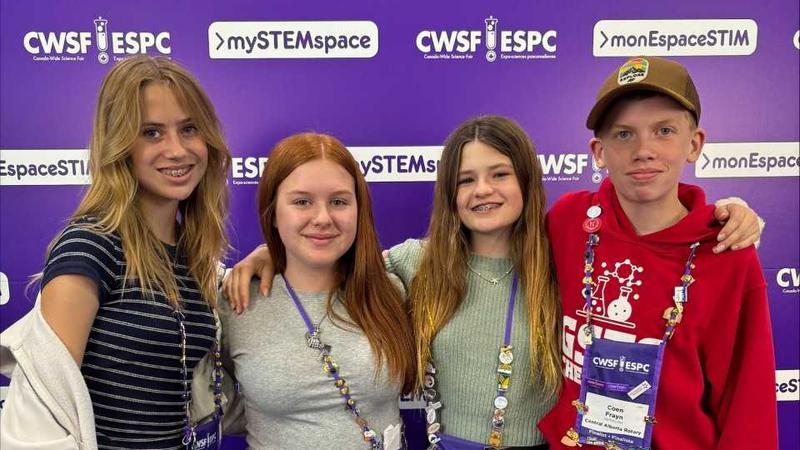
L-R: Kassidy Roberge, Danica Battenfelder, Grace Kafara and Coen Frayn -- all Grade 7 students who represented Red Deer at the recent Canada-Wide Science Fair in Fredericton, New Brunswick. (Supplied)
for science!

Red Deer quartet represent Glendale Elementary at Canada-Wide Science Fair

Jun 14, 2025 | 10:00 AM

Four Red Deer students are reflecting after taking their scientific expertise to Fredericton, NB earlier this month.

The two pairs were comprised of Danica Battenfelder and Kassidy Roberge, as well as Coen Frayn and Grace Kafara, all Grade 7 students at Glendale Science and Technology School.

They earned their way to the recent annual Canada-Wide Science Fair after strong showings at the regional science fair, held at Red Deer Polytechnic.

Battenfelder and Roberge tested growth of food in soil that contained different nutrients — one saturated with junk foods, and the other with more nutrient-rich compost.

Frayn and Kafara, meantime, attempted to come up with a perpetual motion machine with the concept of finding a new renewable energy source.

“We wanted to find the best possible way, without using chemicals, to help plants grow faster for the farming industry,” Battenfelder and Roberge shared.

“We wanted to see if we could get two harvests in one season without using chemicals. For this project, we tested growing sweet peas.”

Indeed, their hypothesis was spot on, in that they grew much better with the healthier soil.

“The world as we know it suffers from hunger, and we wanted to see if we could find more ways to produce food,” they added. “We want to help what is, really, suffering.”

Frayn and Kafara went into their project not aware a perpetual motion machine is not possible, given the laws of physics, but when they found out, they still gave it the old college try — 37 times.

“We were amazed by the idea of infinite energy, and perpetual motion is the hypothetical theory that when an object is set in motion, it won’t stop unless a physical object stops it,” they said.

“We weren’t going to stop. The last few tests, we wanted to get any energy off of it, and our hypothesis was that it may work if the inertia keeps doing its thing, but eventually the energy gets lost.”

Blame it on the friction, they concluded.

But they also praised their science teacher at Glendale, Mr. Dan Reitsma, for his constant support of all things desired to be hypothesized and tested.

They added that some of the projects at Canada-Wide were “insane,” and that it would be extremely hard to place.

But that’s not necessarily what they were in it for.

“I think that’s the goal,” said Kafara, asked if youth can have a major impact on the issues of the world as we know it.

“We just want to try and help the world solve some of its problems.”

The Red Deer students did not earn medals at Canada-Wide, but said they did perform well and had fun when the judges came along.

Winners included a treatment for schizophrenia from Calgary, an autonomous sea turtle robot for ecological monitoring, and a home smog alarm, among others.

More about the national science fair can be found here.