
Subscribe to the 100% free rdnewsNOW daily newsletter!
Sponsored

Market Watch: June 13

Jun 13, 2025 | 4:13 PM

This week’s highlights

  • Late-week geopolitical volatility wipes out much of the week’s gains
  • Bond markets rally as investors seek safe haven assets amid Middle East tensions
  • Canada’s trade deficit hits record high $7.1 billion as tariffs hit exports
  • U.S. inflation rose to 2.4% in May, in line with expectations
  • China’s exports to U.S. suffer biggest decline since 2020

Week in review

Late-week geopolitical volatility wipes out much of the week’s gains

U.S. equity markets began the week on a positive note, buoyed by progress around U.S.-China trade talks in London and softer-than-expected CPI and PPI data, which reinforced expectations for two Fed rate cuts in 2025. However, sentiment turned lower Friday amid geopolitical tensions following Israeli strikes on Iran and renewed tariff threats from President Trump, which weighed on risk assets. Following the attacks on Iran, investors are closely monitoring oil prices and how a sustained increase in oil prices could influence future inflation readings and shift interest rate cut expectations. In Canada, equity sentiment deteriorated as April’s manufacturing and wholesale data revealed broad-based weakness tied to U.S. trade frictions, raising concerns about the sustainability of recent growth. European markets were initially lifted by AI-driven optimism and dovish BoE expectations following soft labour and GDP data, but later declined on geopolitical risks and weak industrial production. In China and broader emerging markets, equities struggled under the weight of deflationary pressures, weak domestic demand, and underwhelming trade data, with limited policy support raising concerns about a prolonged lower-growth trajectory.

Highlights:

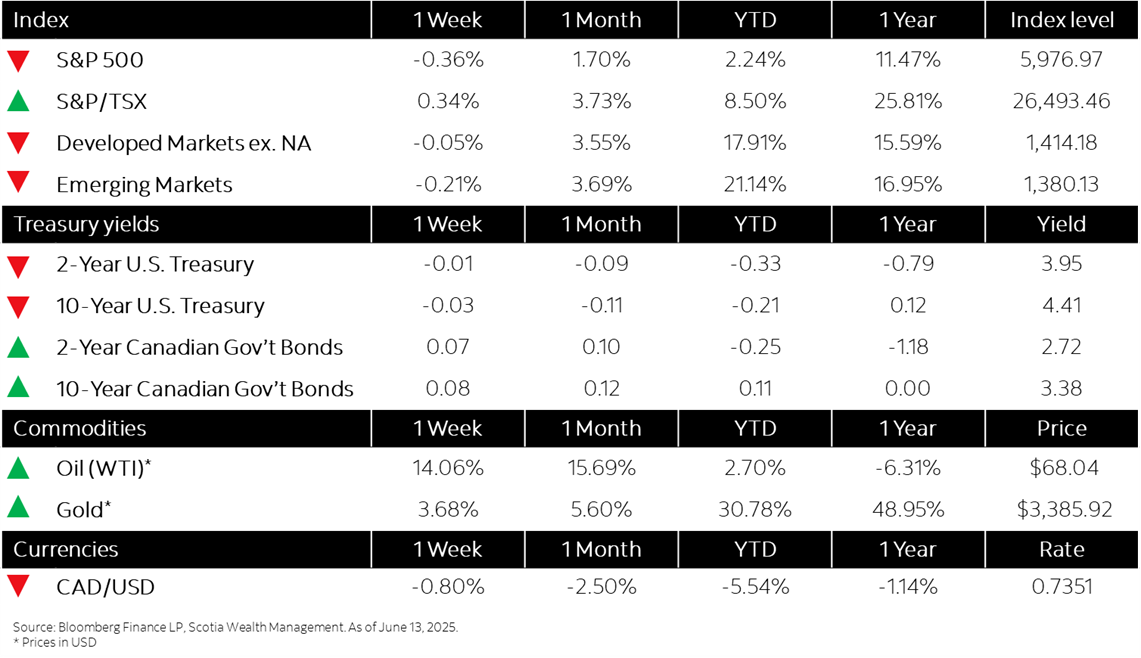
  • U.S. markets returned -0.36%1 with equities rallying early in the week on soft CPI and PPI prints which reinforced Fed rate cut expectations, but late-week geopolitical tensions and renewed tariff threats wiped out weekly gains.
  • Canadian markets returned 0.34%2 for the week as April’s manufacturing and wholesale data showed broad-based declines driven by waning U.S. demand and rising inventories, raising concerns about the durability of export-led growth.
  • European markets returned -0.05%3, initially supported by AI optimism and dovish BoE expectations following soft labour and GDP data, but later declining due to geopolitical tensions and disappointing industrial production data.
  • Emerging markets closed -0.21%4 lower, struggling under persistent deflationary pressures, weak domestic demand, and soft trade data.

Bond markets rally as investors seek safe haven assets amid Middle East tensions

U.S. fixed income markets rallied through the week as softer-than-expected CPI and PPI prints reinforced expectations for two Fed rate cuts in 2025, with yields falling across the curve despite geopolitical tensions and tariff uncertainty late in the week. In Canada, sovereign rates followed U.S. Treasuries lower, supported by weak domestic manufacturing and wholesale data, which signaled growing trade-related headwinds and a potential drag on growth. European bond markets also firmed, led by UK Gilts and German bunds, as soft labour and GDP data in the UK and weaker eurozone industrial production bolstered expectations for continued monetary easing. In emerging markets, rate expectations remained sensitive to inflation surprises, with Mexico’s hotter-than-expected print complicating Banxico’s easing path, while China’s persistent deflationary pressures left room for further stimulus.

Highlights:

  • The 2- and 10-year U.S. Treasury yields fell 1 basis points (bps) and 3 bps, respectively. In Canada, the 2- and 10-year yields were up 7 bps and 8 bps, respectively. Bond yields and prices move inversely to one another.
  • The case for two rate cuts from the Fed by the end of the year is increasing as this week’s inflation reports indicate fewer material price pressures nor notable tariffs impact thus far, although rising energy prices may have the potential to perturb expectations.
  • The primary markets were quiet towards the tail-end of the week as investors stayed on the sidelines given the geopolitical events. New issuance may be front-loaded next week before the FOMC rate decision on Wednesday.

Weekly dashboard

Canada’s trade deficit hits record high $7.1 billion as tariffs hit exports

Canadian exports fell drastically in April and the trade deficit soared to a record high, as U.S. tariffs hit demand for Canadian goods and companies pulled back after rushing products across the border. Statistics Canada (StatCan) reported the country’s trade deficit, the difference between imports and exports, ballooned to $7.1 billion from $2.3 billion the prior month, the highest recorded to date. The value of exports to the U.S. fell a stunning 15.7%, compared to the previous month. The decline was broad-based, led by a sharp pullback in autos, consumer goods and crude oil exports. Imports from the U.S. dropped 10.8%.

Highlights:

  • Canada’s overall merchandise exports to all countries, including the U.S., dropped 10.8% while imports fell 3.5% compared to the previous month. In volume terms, total exports declined 9.1%.
  • Crude oil exports fell by 11.7%, driven by a drop in prices amid economic uncertainty and a planned increase in production by OPEC+. The temporary shutdown of a pipeline in the northern U.S. also contributed.
  • Meanwhile, there was a 2.9% increase in exports to countries other than the U.S., led by exports of various products to China, Algeria and Brazil. This suggests some trade diversification is happening, but the increase was much smaller than the 24.8% jump in non-U.S. trade seen in March.

U.S. inflation rose to 2.4% in May, in line with expectations

Year-over-year inflation in the U.S. edged up slightly in May, after hitting a four-year low in April, defying fears that the impact of U.S. President Trump’s tariffs would start to show a rise in prices. The U.S. Labor Department reported that consumer prices were up 2.4% in May from a year earlier, hotter than April’s gain of 2.3%. That year-over-year number was in line with the 2.4% rise expected by economists.

Highlights:

  • Prices excluding food and energy categories, the so-called core measure economists watch in an effort to better capture inflation’s underlying trend, rose 2.8%, below forecasts for a 2.9% increase.
  • Month over month, the consumer-price index rose a seasonally adjusted 0.1% in May. That was below the 0.2% economists expected. The month-over-month core reading was also below expectations.
  • Concerns that the global economy will get hit by Trump’s trade war have eased since the U.S. and China brokered a 90-day detente last month, staving off the largest potential shocks to the system. Concerns remain as the pause expires in August.

China’s exports to U.S. suffer biggest decline since 2020
A U.S.-China trade truce wasn’t enough to stem a sharp drop in shipments from China to America last month, a sign of the havoc that U.S. President Trump’s tariffs have wrought on trade between the world’s two largest economies. Chinese shipments to the U.S. sank 35% from a year earlier in May, according to government data. It was the biggest percentage decline in U.S.-bound shipments since February 2020, when exports were hit by COVID-induced shutdowns, and followed a 21% drop in U.S.-bound exports in April.

Highlights:

  • As was the case in April, the decline in exports to the U.S. was offset by a jump in outbound shipments to other regions of the world, including Southeast Asia and the European Union.
  • Overall, China’s exports rose 4.8% in dollar-denominated terms in May from a year earlier, though that figure was weaker than the 5.6% expected by economists and down from April’s 8.1% increase.
  • As the outlook for Chinese exports remains cloudy, Beijing has pledged to bolster the economy by stimulating domestic demand (cutting interest rates, injecting liquidity into the financial system and maintaining a consumer goods trade-in program to boost household spending).