
Subscribe to the 100% free rdnewsNOW daily newsletter!
sponsored

Market Watch: June 6, 2025

Jun 9, 2025 | 10:58 PM

This week’s highlights

  • Equity markets experience a week of relief as volatility subsides
  • Bond markets muted following flurry of macro data
  • Bank of Canada holds key interest rate, cites ‘unusual uncertainty’
  • U.S. trade deficit cut in half on record drop in imports
  • Eurozone inflation falls below target
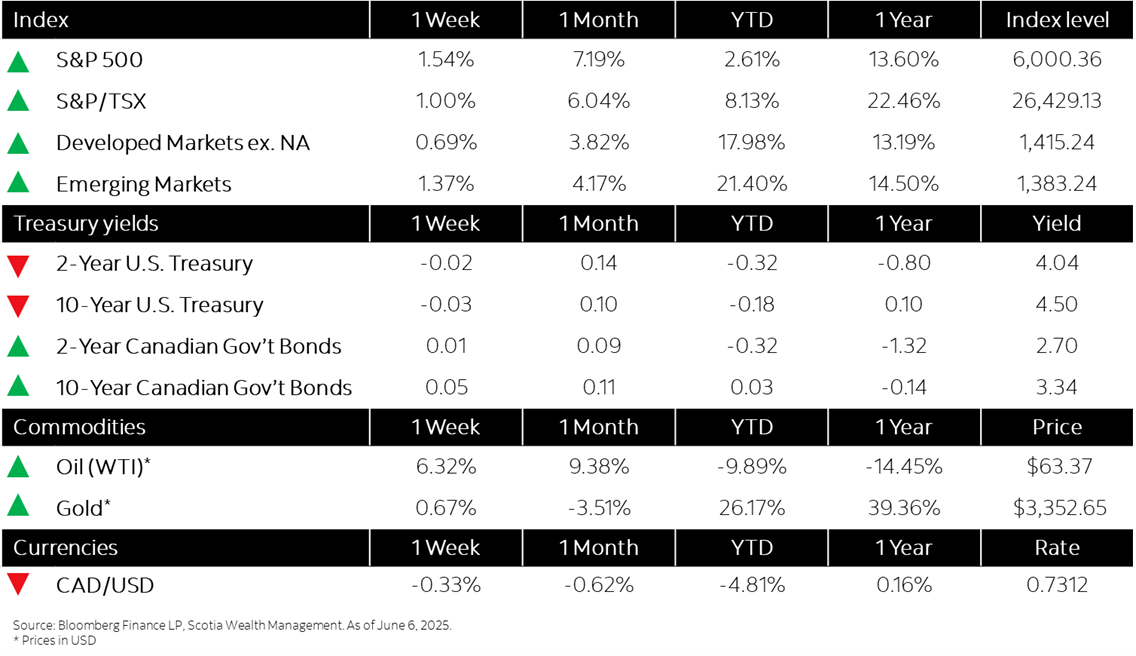
Week in review

Equity markets experience a week of relief as volatility subsides

Equity markets were initially pressured by renewed U.S.-China trade tensions, including tariff hikes and mutual accusations of non-compliance, but regained footing midweek as softer U.S. labour data (notably a weak ADP report) raised expectations for Federal Reserve (Fed) rate cuts. However, Friday’s stronger-than-expected nonfarm payrolls and wage growth tempered those expectations, lifting yields and trimming rate cut bets. In Canada, equities were supported by resilient full-time job gains and steady wage growth, though a rising unemployment rate and a record trade deficit highlighted economic fragility, reinforcing the Bank of Canada’s (BoC) cautious stance. European markets rallied early on expectations of European Central Bank (ECB) easing, but turned lower after President Lagarde’s hawkish tone post-cut signaled the end of the cycle. In China and broader emerging markets, weak PMIs and fading stimulus support weighed on sentiment, though a late-week rebound in services data and signs of renewed U.S.-China dialogue offered modest relief.

Highlights:

  • U.S. markets returned 1.54%1 as early-week trade tensions with China and weak ADP jobs data lifted rate cut hopes, but stronger-than-expected nonfarm payrolls on Friday tempered dovish expectations and pushed yields higher.
  • Canadian markets returned 1.00%2 after the BoC left its policy rate unchanged. Resilient full-time job growth, a record trade deficit, rising unemployment and weak exports highlighted economic uncertainty despite solid wage gains.
  • European markets returned 0.69%3, rising early on expectations of ECB easing, but reversed course after President Lagarde’s hawkish tone post-cut signaled a likely end to the cycle, while weak industrial data from France and Germany added pressure.
  • Emerging markets closed 1.37%4 with chinese equities facing headwinds from weak manufacturing and services PMIs and fading stimulus momentum, though late-week optimism emerged following reports of a U.S.-China leadership call and stronger services sector data.

Bond markets muted following flurry of macro data

U.S. fixed income markets were driven by shifting rate expectations, with early-week dovish sentiment sparked by weak ADP employment data and soft jobless claims, only to reverse after Friday’s stronger-than-expected nonfarm payrolls and wage growth, which pushed yields higher and trimmed Fed cut pricing. In Canada, bond markets were anchored by the BoC’s decision to hold rates steady amid mixed economic signals, including a record trade deficit and resilient labour data, with the front end of the curve reflecting policy caution. European yields initially fell on the ECB’s widely expected rate cut, but rose sharply after President Lagarde’s hawkish tone suggested the end of the easing cycle. In emerging markets, rate moves were more muted, with sentiment shaped by soft Chinese PMIs and ongoing trade policy uncertainty.

Highlights:

  • The 2- and 10-year U.S. Treasury yields fell 2 basis points (bps) and 3 bps, respectively. In Canada, the 2- and 10-year yields were up 1 bps and 5 bps, respectively. Bond yields and prices move inversely to one another.
  • Markets have shifted out further rate-cut expectations for the rest of the year following this week’s macro releases, most notably for the Bank of Canada and the Fed.
  • Credit spreads tightened as corporate bonds and other risky assets were bid following May’s U.S. employment data. High yield debt outperformed investment grade amid surprisingly resilient U.S. economic activity.

Weekly dashboard

Bank of Canada holds key interest rate, cites ‘unusual uncertainty’

The Bank of Canada (BoC) held its key interest rate steady for the second consecutive time. Still, it acknowledged it may need to cut rates if prohibitive U.S. tariffs and uncertainty weaken the economy. The decision to keep the policy rate at 2.75% was in line with financial market odds, which favoured a hold after recent stronger-than-expected economic data. Governor Tiff Macklem said that faced with “unusual uncertainty,” the governing council is being less forward-looking than usual when it comes to its future rate decisions.

Highlights:

  • “With uncertainty about U.S. tariffs still high, the Canadian economy softer but not sharply weaker, and some unexpected firmness in recent inflation data, governing council decided to hold the policy rate as we gain more information on U.S. trade policy and its impacts,” the BoC said in a news release.
  • The BoC also held its key interest rate in April, pointing to the same trade uncertainty contributing to its decision this week. The central bank is suggesting that economic data since then hasn’t fuelled urgency for rate cuts.
  • “On balance, members thought there could be a need for a reduction in the policy rate if the economy weakens in the face of continued U.S. tariffs and uncertainty, and cost pressures on inflation are contained,” Macklem said. However, he warned that Canadians should not interpret that as forward guidance about the future path of rates.

U.S. trade deficit cut in half on record drop in imports

The U.S. trade deficit dramatically decreased in April, as tariffs severely reduced imports. The trade deficit narrowed to a seasonally adjusted US$61.6 billion in April, the U.S. Commerce Department reported, its lowest level since September 2023. That was down sharply from the record US$138.3 billion it hit in March, when businesses were racing to bring in imports before U.S. President Trump’s “Liberation Day” tariffs, which were imposed on April 2.

Highlights:

  • In dollars, the drop was the largest monthly change in the goods and services deficit in data back to 1992. By percentage, the 55% drop was second only to a 59% decrease recorded in February 1992.
  • Imports of goods and services fell 16% to US$351 billion, the largest decline on record. Imports of consumer goods fell 32% to US$69.9 billion, a decline largely driven by a US$26 billion drop in pharmaceutical products.
  • Economists said businesses were still working through their inventories of products they hurried to buy earlier in the year. These numbers will likely be short-lived, as businesses are still highly uncertain about where tariffs will eventually settle.

Eurozone inflation falls below target

Inflation in the eurozone fell below the European Central Bank’s target in May, a big step toward becoming the first major central bank to secure victory over the spiralling inflation that followed the pandemic and the start of the war in Ukraine. According to the European Union’s statistics agency, Eurostat, consumer prices were 1.9% higher on the year in May, down from the 2.2% of April. Economists had estimated annual inflation at 2.0% for the month.

Highlights:

  • May’s decline was driven by a drop in services inflation to 3.2% from 4.0% in April, its lowest level since March 2022. That was in part due to the timing of Easter and sharply declining wages, easing pressure on businesses in the labour-intensive sector.
  • Higher tariffs on imports from the U.S. have helped lower inflation by slowing the economy due to reduced demand for European goods. This led to cheaper exports from countries like China being redirected to Europe.
  • Since the tariffs were first threatened, the euro’s gains against the U.S. dollar and a fall in energy prices due to weaker global economic growth expectations have also contributed to decreased inflation in recent months.

1 S&P 500 Index CAD
2 S&P/TSX Composite Index CAD
3 Bloomberg Developed Markets ex N. America Large & Mid Cap Price Return Index CAD
4 Bloomberg EM Large & Mid Cap Price Return Index CAD